 Written by
 She has been called by ten thousand names. She has been worshipped in caves and cathedrals, in forest clearings and city apartments, in every language and epoch and corner of the world. The Goddess is not a relic of the past. She is the oldest living presence in the human spiritual experience. And she is as immediate and vital as the moon rising tonight.
Reclaiming the Goddess
For much of recorded Western history, the divine has been presented as exclusively masculine. The God of the Abrahamic traditions, omnipotent, singular, imagined as father and king, has dominated Western spiritual culture for two millennia, and with him, a worldview in which creation, authority, and spiritual power are masculine in nature.
The resurgence of Goddess worship in modern spiritual practice is, in part, a correction of this imbalance. It is the recovery of a sacred feminine principle that is not soft or passive or secondary, but fierce and ancient and as fundamental to the nature of existence as any masculine counterpart.
This is not merely feminist politics (though it has profound feminist implications). It is the recovery of a more complete picture of the divine. One that honors both the principle of dynamic action and receptive depth, both the force that shapes and the vessel that holds, both the sun in its brilliance and the moon in her mystery.
The Goddess as Triple: Maiden, Mother, Crone
In most contemporary pagan and witchcraft traditions, the Goddess is most commonly understood through the Triple Goddess framework. Three aspects that together embody the full cycle of feminine life and power.
The Maiden
The Maiden is the first aspect of the Goddess – young, vital, free, independent. She is the self in its fullness before the responsibilities of maturity arrive. She is spring and dawn, the waxing moon, the first green shoot of growth.
The Maiden is not naive or weak. She is clear-eyed and alive, possessed of an instinctive power that older aspects may have learned to temper. She teaches us about joy, adventure, and the courage to begin.
Goddesses who embody the Maiden aspect include Persephone (before her descent), Artemis, Brigid, and the young Eos.
The Mother
The Mother is the full-flowering of the Goddess – generative, nurturing, abundantly powerful. She is summer and noon, the full moon, the height of creative power. But the Mother is not merely a nurturer of children. She is a creator in the broadest sense. Of art, of community, of civilization, of the self.
The Mother teaches us about sustenance, fertility, the courage to bring something into being and take responsibility for it. She is the force of love as active care.
Goddesses who embody the Mother aspect include Demeter, Isis, Danu, Frigg, and the abundant earth herself.
The Crone
The Crone is the third and most powerful aspect of the Goddess. The wise elder, the keeper of death’s mystery, the one who has outlived fear. She is autumn and midnight, the waning and dark moon, the cold wisdom of winter.
The Crone is often the most misunderstood aspect in cultures that fear aging and death. She is not merely diminished power. She is power distilled to its essence, freed from everything unnecessary. She has seen through illusion. She knows what matters and what doesn’t. She is the guide at the threshold of the great transformation.
Goddesses who embody the Crone aspect include Hecate, the Morrigan, Baba Yaga, Cerridwen, and Kali.
Celtic Goddesses
The Celtic tradition offers some of the most vivid and complex goddess figures in all of mythology – fierce, shape-shifting, deeply tied to the land.
Brigid: Perhaps the most beloved goddess in the Celtic tradition, Brigid is a triple goddess in her own right. Patron of poetry, smithcraft, and healing. Her sacred flame was tended by priestesses at Kildare in Ireland, and her festival, Imbolc, marks the first breath of spring. Brigid is a goddess of beginnings, of creative fire, of the forge where transformation happens. She was so beloved that the Christian tradition absorbed her as Saint Brigid rather than erase her. more…
The Morrigan: A complex and formidable figure, goddess of sovereignty, prophecy, battle, and fate. The Morrigan appears as a crow, a beautiful woman, and a hag; she is simultaneously death-bringer and sovereignty-bestower, the one who chooses who will live and who will fall. She tests those who work with her, demanding honesty and courage. more…
Danu: The great mother of the Tuatha Dé Danann, the divine race of Irish mythology. Little is recorded directly about Danu herself, but she represents the primordial mother – the land, the waters, the deep source from which all life springs.
Rhiannon: Welsh goddess of sovereignty, horses, and the Otherworld. Rhiannon rides an impossibly swift white horse and chooses her own husband against all opposition. She endures false accusation with profound dignity. She is a goddess of perseverance, of inner authority, and of the ability to transform suffering into wisdom.
Cerridwen: The keeper of the Cauldron of Inspiration – the Awen – Cerridwen is a goddess of transformation, magic, and the deeper mysteries. Her story of inadvertently giving her cauldron’s gift to the boy Gwion Bach (who becomes the great bard Taliesin) is a story of the unintended alchemy of genuine seeking.
Greek and Roman Goddesses
The Greek and Roman pantheons have been influential in Western magical practice for centuries, and their goddesses offer rich and complex presences to work with.
Hecate: Goddess of magic, crossroads, the night, and the liminal spaces between worlds. Hecate is the companion of witches and the guide of souls. She holds torches at the crossroads, illuminating the path into the unknown. She is one of the most widely worked-with goddesses in contemporary magic. Perhaps because she meets practitioners exactly where they are: at the crossroads, in the threshold moment, when the decision must be made. more…
Artemis: The wild goddess of the hunt, the moon, and female independence. Artemis runs free through the forests with her companions, owing nothing to the masculine world. She is a protector of young women and wild things, a goddess of instinct and of the wilderness within the self.
Aphrodite: Goddess of love, beauty, and the generative force that draws all things toward connection. Aphrodite is far more complex than her common reputation suggests. She is not merely a goddess of romance, but of the fundamental erotic energy that drives all creation.
Persephone: Queen of the Underworld and daughter of Demeter, Persephone is one of the most psychologically rich of the Greek goddesses. Her descent into the underworld and return is the mythic template for every journey through darkness toward wisdom. Her role as Queen of Hades shows that she not only survived her descent but found sovereignty within it.
Isis: Though Egyptian in origin, Isis became one of the most widely worshipped goddesses across the Roman world. She is the great magician. The one who reassembled the dismembered body of Osiris, who nursed Horus, who out-witted the sun god Ra to gain magical knowledge. She is the goddess of the complete magical practitioner.
Norse Goddesses
Freya: Norse goddess of love, sexuality, battle, magic (seiðr), and death. Freya was a practitioner of seiðr, the shamanistic form of Norse magic, and she taught it to Odin. She is golden-haired, falcon-cloaked, weeping golden tears. She claims half of all those who die in battle for her hall, Sessrúmnir. She is both lover and warrior, beauty and fierceness, never one without the other. more…
Frigg: Odin’s wife, goddess of marriage, motherhood, wisdom, and fate. Frigg knows the destiny of all beings but speaks of it to no one. Her wisdom is not the wisdom of the oracle who speaks. It is the wisdom of the one who has seen everything and holds it in patient silence.
Hel: Ruler of the realm of the dead for those who die of age and illness, Hel is half living and half dead in her very body. She is the keeper of the ordinary dead. Not the heroic fallen, but the vast majority of human souls. She is often mischaracterized as evil. She is simply the one who holds what cannot be otherwise held. more…
Skadi: Norse giantess and goddess of winter, mountains, and the hunt. Skadi is fierce independence embodied. She skied into Asgard alone to demand restitution for her father’s death, and she won it. She is the goddess of those who thrive in difficult terrain.
Egyptian Goddesses
Isis (Aset): As above, the great magician, the devoted mother, the keeper of the dead. Isis is the magical practitioner’s goddess above all others.
Bastet: Cat goddess, protector of the home and of women, associated with joy, music, dance, and sensual pleasure. Bastet is protective in the way of cats – gentle and warm until threatened, then fierce and sudden.
Sekhmet: The lioness goddess of war, healing, and plague. Sekhmet is the fierce aspect of the solar divine feminine, she who destroys in order to protect, who is patron of both warrior and physician.
Hathor: Goddess of love, beauty, music, dance, and foreign lands. Hathor is the celestial cow whose body arches over the earth as the night sky, who nurtures creation with milk and song.
Ma’at: Goddess of truth, justice, cosmic order, and balance. Ma’at represents the principle by which the universe is rightly ordered – the divine law that holds chaos at bay. She is justice not as punishment, but as harmony.
Working with Goddess Energy
Building a relationship with a goddess is not like looking up a phone number. It is a living, evolving relationship that deepens over time through attention, devotion, and genuine engagement.
Research: Before approaching any goddess, learn her mythology deeply. Understand her stories, her symbols, her associations. The stories are not merely entertainment, they are the goddess’s nature revealed through narrative.
Listen for her calling: Many practitioners find that a particular goddess makes herself known without being explicitly sought. Recurring appearances of her symbols, synchronicities connected to her mythology, a quality of presence in dreams. These are worth paying attention to.
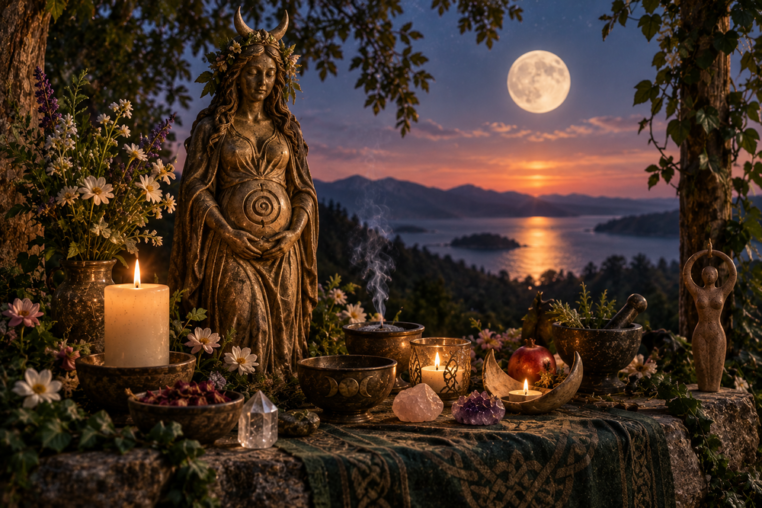
Set up dedicated altar space: If you are deepening a relationship with a specific goddess, a dedicated altar space (or dedicated section of your altar) creates a physical home for that relationship. more…
Offerings: Bring what she loves. Research traditional offerings to your goddess. Visit her altar regularly, not only when you want something, but simply to be present and to honor.
Do the inner work: Working with a powerful goddess will change you. She will show you what is unfinished in you, what needs to be faced, what needs to be released. This is not punishment. It is the gift that comes from genuine relationship with divine intelligence.
She was never truly absent. She was waiting in the moon’s changing face, in the soil’s dark patience, in the fierce love that would sacrifice anything for what it treasures. Call her by whatever name fits your heart. She is already here.