 Written by
 There is a man at the heart of one of China’s most enduring spiritual lineages whom no one can quite locate in history.
He may have lived in the twelfth century, or the thirteenth, or the fifteenth. He may have been a former Shaolin monk who walked away from one tradition to found another. He may have been a composite figure, the accumulated legend of several teachers collapsed into a single name across several generations of storytelling. He may, according to some accounts, have achieved immortality and simply never died.
His name is Zhang Sanfeng (張三豐), and he is the legendary founder of the Wudang tradition. One of the most significant streams of Taoist internal practice ever to emerge from the sacred mountains of China.
Whether or not he was a single, historically verifiable man matters less than you might think. What matters is what gathered around his name. A living lineage of internal cultivation, spiritual alchemy, and martial practice that has been transmitted continuously for centuries and continues to this day. The mountain is real. The tradition is real. The questions about the man at its origin are, in their own way, part of what makes the tradition worth studying.
The Mountain Before the Man
To understand Zhang Sanfeng, you have to begin with Wudang.
The Wudang Mountains (武当山, Wǔdāng Shān) rise in Hubei Province in central China, and have served as a center for Taoist cultivation, martial practice, and temple life for over two thousand years. They are recognized as a UNESCO World Heritage Site and are counted among the Four Sacred Mountains of Taoism. The physical landscape, mist-draped peaks, ancient stone temples, hidden valleys where hermits have retreated for meditation since before the common era, is not merely a backdrop for the tradition. It is part of the tradition. In Taoist understanding, the mountain itself is a practitioner.
By the Tang Dynasty, shrines dedicated to the Five Dragons and to Taiyi were firmly established on the mountain, and Taoist hermits had long been drawn to its peaks for meditation and internal practice. The emerging Taoist hagiography of Zhenwu – the True Warrior deity and patron of Wudang – identified the mountain as the place upon which a divine crown prince practiced austerities for forty-two years, achieved perfection, and ascended to become a god. The sacred geography was already in place, already charged, long before Zhang Sanfeng’s name was attached to it.
What the Wudang tradition would eventually be characterized by was a distinctive synthesis. The worship of Zhenwu; the practice of internal martial arts. The advocacy of the Three Doctrines as One. The integration of Taoism, Buddhism, and Confucianism. And a deep emphasis on inner alchemy, or neidan. This was not a simple, single-source tradition. It was a confluence. And Zhang Sanfeng, whatever his precise historical reality, stands at the point where those streams were said to have met in one person.
The Legend of the Founder
No reliable primary sources from the Song or Yuan dynasties confirm Zhang Sanfeng’s existence with certainty. What we have instead is an accumulation of accounts, each adding detail, each pushing the timeline slightly, each embedding him more deeply in the mythological structure of Chinese spiritual history.
A 1291 compilation of biographies of Wudang immortals, the Complete Biographies of Immortals from Auspicious Wudang Mountain, makes no mention of him. He appears more clearly in Ming Dynasty sources, where Huang Zongxi’s 1669 Epitaph for Wang Zhengnan credits Zhang Sanfeng with the development of an internal martial arts style practiced near Mount Wudang. A style understood as the Taoist counterpart to the external methods of Shaolin.
Zhang Sanfeng is credited by practitioners as having originated the concepts of neijia – the soft, internal martial arts – specifically Taijiquan, through a synthesis of Chan Buddhist Shaolin martial practice with his mastery of Taoist tao yin and neigong principles. The most famous story of how this synthesis came to him describes Zhang watching a fight between a bird and a snake on the mountain. The bird striking with force and speed, the snake yielding, redirecting, finding softness as its method of survival. And recognizing in that encounter the physical expression of a spiritual principle he had been cultivating for years.
Ming Dynasty historical records note that Zhang Sanfeng lived on Wudang Mountain, and the Emperor Yingzong conferred on him the title “Perfect Manifestation of Pervasive Subtlety” in 1459. A posthumous imperial recognition that speaks to how seriously his legacy was taken, whatever the uncertainties around his biography.
Even if historically unverified, modern scholarship frames Zhang Sanfeng as a mythic founder figure, comparable to Bodhidharma in Shaolin lore. Important for cultural identity, and celebrated at Wudang as both a Taoist sage and martial arts patriarch. His supposed birthday, the ninth day of the third lunar month, is still observed by Taijiquan families and Wudang practitioners each year.
This is what a lineage does with a founder whose edges are blurry. It does not abandon him. It deepens him. It lets the legend carry what the historical record cannot.
The Practice at the Heart of Wudang
Whatever the uncertainty around Zhang Sanfeng himself, the practices associated with his name and the Wudang tradition are among the most sophisticated systems of internal cultivation in the Taoist world.
At the centre of everything is neidan (内丹) – inner alchemy. Neidan is the process of transforming one’s internal energy to achieve spiritual enlightenment and a state of harmony with the Tao, the source of all life. It is emphatically not a metaphor. In the Taoist understanding, the body is a microcosm. It contains the same forces that govern the cosmos, and those forces can be cultivated, refined, and ultimately unified. The practitioner is the laboratory. The work happens inside.
This path includes purification and refinement through contemplation, meditation, breath control, and other forms of self-discipline, including Daoyin (導引), Qigong (氣功), Neidan (内丹), and the internal martial arts – Neijiaquan (内家拳). These were not understood as separate disciplines. They were understood as different expressions of the same underlying practice: the cultivation of qi (氣), the intelligent movement of that energy through intention yi, (意), and the gradual refinement of the self toward something less bounded, less cluttered, more aligned with what the Taoists called the natural way.
The martial arts styles considered to belong to the Wudang tradition, collectively called Wudangquan, are defined precisely by this strong element of Taoist neidan practice. The movement is the alchemy. The combat training is a spiritual technology. This is what distinguished the Wudang stream from the external power of Shaolin. Not a rejection of physical discipline, but a different understanding of what physical discipline was for.
This process is described in texts such as The Secret of the Golden Flower (太乙金華宗旨) and various neidan manuals that continue to be studied today. The lineage generated a substantial body of written teaching, including writings attributed directly to Zhang Sanfeng. Texts on the great Tao, on inner cultivation, on the relationship between stillness and movement . Though scholarly debate continues about which of these documents are genuinely early and which are later compositions attached to his name to lend them authority.
The Lineage That Outlasted the Founder
What is not in doubt is the continuity of transmission that extends from the Wudang tradition to the present day.
The Wudang Danpai lineage claims direct descent from Zhang Sanfeng, and has been passed down for thirteen generations, beginning in the Ming Dynasty with Zhang Songxi. Today, approximately seventy percent of Taoist monks on Mount Wudang derive from the Longmen Pai lineage of the Quanzhen Taoist order. The most widespread Taoist lineage across China.
The tradition survived some serious ruptures. The Cultural Revolution scattered Taoist practitioners across China and closed the temples. After Deng Xiaoping’s 1979 program of Opening and Reform relaxed restrictions on religious practice, Taoists who had been dispersed began returning to Wudang. The reconstitution of the tradition that followed – the collection, preservation, and re-teaching of practices that had nearly been lost – is itself part of the lineage story. The transmission carrying forward through political catastrophe, the mountain waiting for its practitioners to come back.
Wudang today remains a living center of practice. Not merely a museum, but a place where the tradition of Taoist cultivation continues as it has for centuries. People travel from across the world to train there, to sit in those temples, to practice internal forms on stone terraces in the early morning mist. The mountain has not stopped being what it was.
The Thread Back to the Wu
In an earlier post in this series, we touched on the wu (巫). The ancient Chinese spirit workers, diviners, and intermediaries between the human and the unseen, whose practices predate Taoism by millennia and whose influence is woven through it. Wudang sits downstream of that current. (Read the post on the Wu here…)
The synthesis that Zhang Sanfeng is said to have embodied, the combination of physical practice, breath, intention, and inner transformation as a unified path toward union with the Tao, carries the older wu understanding of the body as a site of spiritual encounter. The practitioner who cultivates qi through neidan, who moves through forms that encode the principles of yin and yang, who uses the body itself as the instrument of alignment with the unseen, this is not entirely separate from the wu who stood at the threshold between worlds and moved through them.
What Wudang did was systematise. It took what had existed as living, often ecstatic, often individualised spirit practice and gave it a transmittable architecture: lineage structures, written texts, codified forms, mountains designated as sacred centers. The wild became the school. And in that transition, some things were inevitably lost, and some things were preserved that might otherwise have vanished.
Zhang Sanfeng, whether he was one man or many, whether he lived for a century or for several, stands as the named point of that systematisation in the Wudang tradition. He is the place where the legend says: here is where the river found its channel.
For the Practitioner
Zhang Sanfeng’s story, or rather, the story his tradition tells about him, raises something worth sitting with for anyone working with lineage, transmission, and the question of where authority comes from.
The Wudang tradition is not weakened by the uncertainty around its founder. If anything, the way that tradition has held that uncertainty – acknowledging it, continuing to honor Zhang Sanfeng as a mythic and spiritual centre even without being able to nail down his dates – is a kind of sophistication. It knows the difference between historical fact and ancestral truth. It knows that a lineage can be real and continuous even when the figure at its origin is, at least in part, a legend.
Many of the traditions we work within have founders whose edges blur in similar ways. The question is not only whether they existed as the record claims, but what was transmitted in their name, and whether that transmission has integrity. Whether the practice holds. Whether the mountain is still the mountain.
At Wudang, the practice holds. The mountain is still the mountain.
And on the ninth day of the third lunar month, people still celebrate the birthday of a man no one can quite find in the archive. Because some presences are too important to wait for documentary evidence.
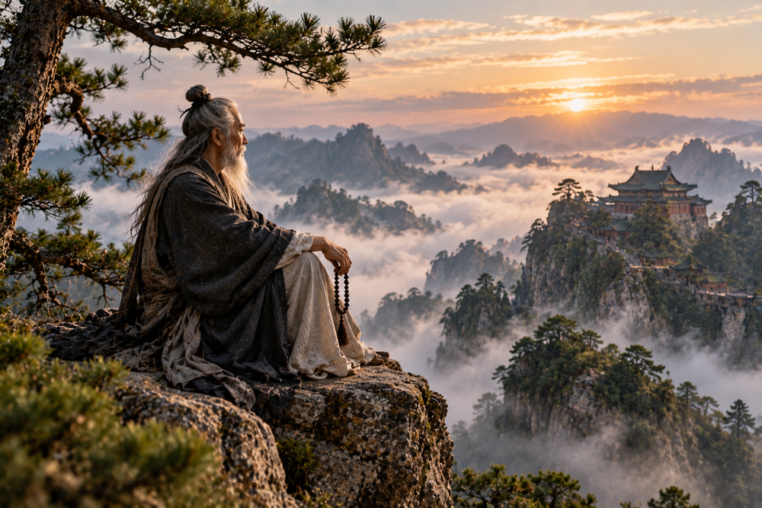
Zhang Sanfeng, c. 12th–15th century (dates disputed). Taoist sage, legendary founder of the Wudang school of internal practice and Taijiquan. Whether one man or many, the lineage his name carries continues.
References
Huang Zongxi. Epitaph for Wang Zhengnan (王征南墓誌銘). 1669. Primary Ming-era source crediting Zhang Sanfeng with the founding of Taoist internal martial arts.
Liu Daoming, ed. Wudang fudi congzhenji (武當福地總真集) – Complete Biographies of Immortals from Auspicious Wudang Mountain. 1291. Notable for the absence of Zhang Sanfeng, establishing that his association with Wudang solidified in the Ming Dynasty rather than earlier.
Yang, Lizhi, Todd Stoll, and Chen Mei. “Mt. Wudang and Daoism.” Journal of Daoist Studies, vol. 2, University of Hawai’i Press, 2009, pp. 193–196. Peer-reviewed overview of Wudang’s Taoist history and the formation of the Wudang tradition.
Wudang Mountains. UNESCO World Heritage Site listing, 1994. whs.unesco.org.
The Secret of the Golden Flower (太乙金華宗旨). Trans. Richard Wilhelm, commentary by C.G. Jung. Kegan Paul, Trench, Trubner & Co., 1931. Key neidan text associated with the broader Taoist internal alchemy tradition of which Wudang is part.
Wudang Academy. “Wǔdāng Shān – The Sacred Mountain.” wiki.wudang.academy. Living lineage documentation including the history of the Sanfengpai and post-Cultural Revolution transmission.
Kung Fu Kulture. “Zhang Sanfeng: The Legend of Taichi and Wudang.” kungfukulture.com. Useful synthesis of modern scholarly framing of Zhang Sanfeng as mythic founder figure comparable to Bodhidharma.