 Written by
Your grimoire does not exist in isolation.
It is part of a tradition of magical record-keeping that stretches back thousands of years. A long, complicated, often clandestine chain of books passing between hands, being copied in secret, being suppressed by authorities, surviving fires and persecution and the slow attrition of time. The grimoire you are building today is the latest point in a lineage that includes some of the most extraordinary documents ever written.
Understanding that lineage changes how you approach your own book. You are not starting from nothing. You are picking up a thread that has been passing between practitioners for millennia.
What follows is a guide to the most significant grimoires in the Western tradition – the books that shaped the magical practice most contemporary practitioners are drawing from, directly or indirectly, whether they know it or not.
The Ancient Foundations
The oldest magical texts we have are not Western in origin.
The Egyptian Books of Magic – collections of spells, invocations, and ritual instructions inscribed on papyrus between roughly 200 BCE and 400 CE – are the direct ancestors of the Western grimoire tradition. The most significant collection, now called the Greek Magical Papyri (PGM), is a body of texts found in Egypt that blend Greek, Egyptian, Jewish, and early Christian magical traditions into a working synthesis. They contain spells for love, protection, cursing, and divination. Instructions for creating magical objects. And long invocations to gods and spirits drawn from multiple traditions simultaneously.
These texts were not theoretical. They were working documents. They show corrections and annotations. Some of them are clearly copies of earlier copies. Practitioners were using these books, adding to them, and passing them on.
The Sefer Raziel HaMalakh – the Book of Raziel the Angel – is a Jewish mystical text whose origins are placed by tradition in the garden of Eden (the angel Raziel giving Adam the book of all cosmic knowledge) but whose actual manuscript history dates to medieval Europe. It is a compendium of angelology, cosmology, astrology, and practical magic, and it exercised enormous influence on later European grimoire tradition. Its cosmology – the organisation of the universe into angelic hierarchies governing different forces and correspondences – became the structural backbone of most subsequent Western magic.
The Medieval Solomonic Tradition
The most influential body of grimoires in the Western tradition carries the name of Solomon. The biblical king understood to have mastered the arts of commanding spirits through the seal and ring given to him by God. The attribution is mythological rather than historical, but the texts themselves are real, substantial, and extremely detailed.
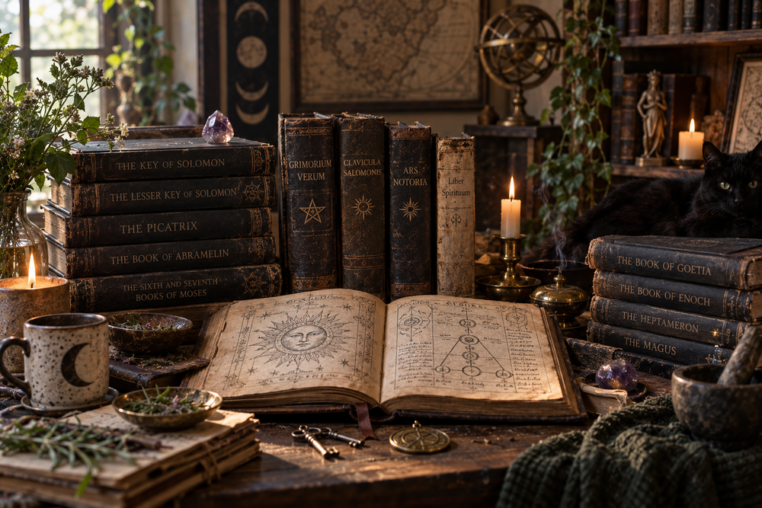
The Key of Solomon (Clavicula Salomonis) exists in dozens of manuscript versions in Latin, Italian, French, and Hebrew, dating from the fourteenth century onward but drawing on material that is certainly older. It is primarily a manual for ceremonial magic. For preparing magical tools and ritual space, for invoking angelic forces, and for performing workings under the authority of divine names. Its influence on modern magical practice is immense, the pentacle, the ritual circle, the magical knife, the wand, the consecration of tools, the structure of the formal ritual. All of these passed into contemporary practice largely through the Solomonic tradition and this text in particular.
The Lesser Key of Solomon, more commonly known as the Goetia, is a seventeenth-century compilation whose most famous section is a catalogue of seventy-two spirits – their names, seals, ranks, and the abilities they can be compelled to provide. The Goetia has become one of the most-referenced texts in Western occultism. Its spirits – Paimon, Buer, Marbas, Asmodeus, and the rest – appear constantly in contemporary demonology, chaos magic, and left-hand path practice. The seals associated with each spirit are among the most recognisable magical images in circulation.
The Picatrix is not strictly Solomonic but belongs to the same broad tradition of learned medieval magic. Originally written in Arabic as the Ghāyat al-Ḥakīm (Goal of the Wise) around the eleventh century, it was translated into Spanish and then Latin in the thirteenth century and circulated widely in European learned circles. It is primarily an astrological magic text, magic performed through the capture and direction of planetary influences, and its sophisticated integration of astrology, cosmology, and practical ritual had significant influence on Renaissance magic.
Renaissance High Magic
The fifteenth and sixteenth centuries produced a flowering of magical scholarship in Europe that drew on the newly available texts of classical antiquity, on Jewish Kabbalah, on Arabic philosophy, and on the established Solomonic tradition. The grimoires of this period are more intellectually elaborate than their medieval predecessors and more concerned with constructing coherent theoretical frameworks for magical practice.
The Three Books of Occult Philosophy by Heinrich Cornelius Agrippa, published in 1531, is the most comprehensive magical textbook of the Renaissance period and remains one of the most important works in the Western tradition. It is not a practical spell book but a complete cosmological and magical philosophy. Three volumes covering the magic of the natural world, the mathematics and celestial influences underlying magic, and the divine or spiritual dimension of magical practice. If you want to understand why magical correspondences work according to the tradition, why certain planets govern certain plants, stones, and qualities; why numbers carry significance; why the ritual structures of Western magic take the forms they do, Agrippa is where those answers are systematically laid out.
Every modern correspondence table ultimately traces back to Agrippa (or to the traditions he was compiling). When you write planetary correspondences in your grimoire, you are working with a system this book did more than any other single source to formalize.
The Fourth Book of Occult Philosophy, published after Agrippa’s death and probably not actually his work, is a more practical and grimoire-like text dealing with spirits and their conjuration. Its influence on subsequent practical magic was significant.
The Heptameron, attributed to Pietro d’Abano, is a ceremonial magic manual focused on the conjuration of spirits through the days and hours of the week and their governing angels. It is primarily a working document rather than a theoretical one, and it circulated widely in manuscript before and after print.
The Seventeenth and Eighteenth Centuries
The grimoire tradition continued through the seventeenth and eighteenth centuries in two directions simultaneously: toward the increasingly elaborate ceremonial traditions of high magic, and toward the printed popular magic books that circulated widely among ordinary people.
The Book of Abramelin, more properly The Book of the Sacred Magic of Abramelin the Mage, claims to be a fifteenth-century text transmitted through an Egyptian mage named Abramelin to a German Jewish wanderer named Abraham. Its central working, an eighteen-month (in some versions six-month) operation aimed at achieving contact with the practitioner’s Holy Guardian Angel and then compelling demonic forces through that angelic authority, became one of the most influential magical operations in modern occultism. Aleister Crowley’s attempt to perform it at Boleskine House in Scotland in the early twentieth century, which he abandoned midway, is probably the most famous engagement with the text.
The Sixth and Seventh Books of Moses (Das Sechste und Siebente Buch Mosis) is an eighteenth-century German text that claimed to be lost books of the Bible and circulated widely as a practical magic manual among both European peasants and, through German immigration, in the American South, where it became an important text in the Hoodoo tradition. It bridges learned magic and folk practice more directly than most grimoires of the period.
The Grand Grimoire (Le Grand Grimoire) and Grimoire du Pape Honorius are French grimoires from the same period, more explicitly diabolical in their content than the Solomonic texts, dealing with the direct pacting with demonic forces rather than their conjuration under divine authority. They represent one end of a spectrum that has always existed within Western magic – the tradition that works with dark forces on their own terms rather than subordinating them to a higher authority.
The Modern Tradition
The nineteenth and twentieth centuries saw the systematic collection, editing, and re-publication of the older grimoire tradition alongside the creation of new foundational texts.
The Sacred Magic of the Qabalah and the publications of the Hermetic Order of the Golden Dawn – founded in London in 1888 – represent the most significant systematisation of Western magic in modern times. The Golden Dawn drew on the Solomonic tradition, Agrippa, Kabbalah, astrology, tarot, and Egyptian symbolism to produce a comprehensive magical curriculum. The correspondences they established – the colours, numbers, divine names, and symbols associated with each of the ten sephiroth on the Kabbalistic Tree of Life – became the standard reference system for twentieth-century Western occultism.
The Book of the Law (Liber AL vel Legis), received by Aleister Crowley in Cairo in 1904, is arguably the most influential magical text of the twentieth century in terms of its effect on subsequent practice. Whatever position you take on its nature and authority, it restructured the map of Western magic in ways that are still reverberating.
The Book of Shadows as a concept and a form emerges from Gerald Gardner’s founding of Wicca in the 1950s. Gardner’s own Book of Shadows – parts of which were written by Doreen Valiente, one of the most important figures in modern Wicca – established the template for the personal magical journal that most contemporary practitioners mean when they use the term.
What This History Means for Your Grimoire
You do not need to read all of these texts, though reading in the tradition is always worthwhile. What this history offers is perspective.
The grimoire you are building is part of a living tradition. The correspondences you record, the ritual structures you note, the symbols you work with – these did not appear from nowhere. They passed through centuries of practitioners who tested them, refined them, added to them, and passed them forward.
Your personal practice and your personal observations are the next layer of that accumulation. Write them down with the same care those earlier practitioners brought to their manuscripts. The tradition continues because practitioners kept writing.
A Selection of Historical Grimoires Worth Exploring
If you want to read in the tradition directly, these are good starting points:
The Greek Magical Papyri – Hans Dieter Betz’s academic translation is the standard English edition. Dense but extraordinary.
Three Books of Occult Philosophy – Agrippa. The Llewellyn edition edited by Donald Tyson is the most accessible.
The Goetia – Available in multiple editions. S.L. MacGregor Mathers’ translation, revised by Crowley, is the most common.
The Book of Abramelin – Georg Dehn’s translation from the older German manuscript (longer version) is preferred by practitioners over the earlier Mathers translation.
The Picatrix – John Michael Greer and Christopher Warnock’s translation is excellent.
The Book of Shadows – Doreen Valiente’s The Rebirth of Witchcraft gives the most honest and detailed account of its origins.