
 Written by
 Most practitioners are good at preparing for a working.
They research correspondences, choose materials, time the ritual to the moon phase or planetary hour, set up their space with care. The preparation receives attention and intention. And then the working happens. And then, often, life continues. The candle burns out. The circle is opened. And nothing gets written down.
This is one of the most common and consequential gaps in magical practice.
The working that is not recorded is the working you cannot learn from. The spell that produced unexpected results, the ritual that felt completely different from how you anticipated, the correspondences that worked precisely as intended or not at all – if none of this is in writing, it exists only in a memory that will be imprecise within a week and largely gone within a year. You will repeat mistakes you cannot remember making. You will reinvent what you have already learned. You will have no way of seeing the patterns that only become visible across time.
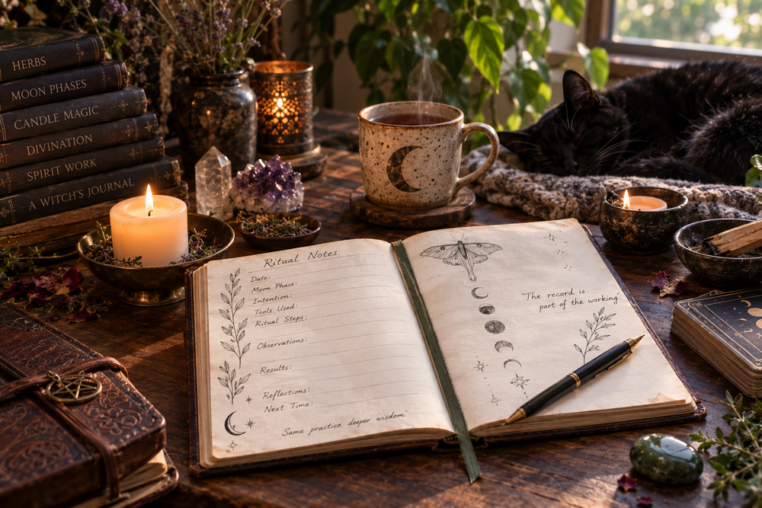
The historical grimoire tradition understood this. The magical papyri contain annotations and corrections. The working manuscripts of Renaissance mages include notes on outcomes. The Solomonic tradition explicitly instructs the practitioner to keep records. This is not incidental. The record is part of the working.
Why Practitioners Don’t Record (And Why Those Reasons Don’t Hold)
It breaks the atmosphere. There is something to this. Reaching for a journal immediately after a meaningful ritual can feel like switching off a light. The solution is not to abandon recording but to adapt when you record. Give yourself ten minutes to sit in the aftermath of the working before you write. Let the immediate atmosphere settle. Then write.
Nothing seems to have happened. This is exactly when recording matters most. The working that felt flat or uncertain is the one most worth examining. What did you do? What did you feel, or not feel? When did your attention wander? What are you genuinely uncertain about? These are the most instructive entries you will ever write.
The results aren’t in yet. Record the working now. Record the results when they arrive. Write the date you performed the working and the date results appeared (or didn’t). Over time, this gives you real data about timing. How long different types of workings typically take to manifest in your practice.
It feels like homework. Reframe it. The post-working entry is not a report submitted to an invisible authority. It is a conversation with your future self, who will be building on what you do today. Write to that person. Write what they would want to know.
What to Record: A Working Template
There is no single correct format for recording a magical working. Different practitioners develop different systems over time, and your system should reflect how you actually think and what you actually find useful to know later. That said, certain elements appear consistently in the most useful working records.
The basics
~ Date, day of the week, time
~ Moon phase and sign
~ Planetary hour (if relevant to your practice)
~ Weather and general conditions
~ Your physical and emotional state going in
These are the contextual data. They seem like administrative detail until the day you notice that your workings consistently produce stronger results in a waning moon, or that everything you perform during Mercury retrograde needs following up. You cannot notice patterns you have not recorded.
The working itself
~ What was the intention? State it clearly, in a single sentence if possible.
~ What did you use? Materials, tools, any written components.
~ What did you do? A brief description of the ritual actions in sequence.
~ What words were spoken, written, or visualised?
Be specific enough that you could approximately recreate this working from the record alone. You do not need to reproduce every word of a chant, but you need enough that you remember what you were doing and why.
The experience
This is where most working records are thin, and where the most important information actually lives.
~ How did the working feel? Not how it was supposed to feel – how it actually felt.
~ Were there moments of particular intensity or presence? When?
~ Were there moments when your attention drifted or the connection felt weak?
~ Did anything unexpected happen – internally or externally?
~ What was your state immediately after? Grounded, depleted, energised, flat, emotional?
Write this honestly. The working that felt powerful is not always the working that produces results. The working that felt uncertain is not always ineffective. But you can only begin to understand these discrepancies if you have recorded what the experience was actually like.
The outcome
This entry comes later – days or weeks after the working, when results have had time to appear.
~ What, if anything, changed?
~ How did it change? Gradually, suddenly, unexpectedly?
~ Did the outcome match the intention precisely, or did it arrive in a different form?
~ Were there any apparent side effects or unintended consequences?
~ What would you do differently?
The outcome entry is where the grimoire becomes a genuine research document. Over time, it shows you what works in your practice, what doesn’t, what the common patterns are, and where your particular strengths and gaps lie.
Recording Dreams and Signs
Many workings do not resolve entirely in waking life. Dreams, synchronicities, and signs in the days following a ritual are often as significant as any external outcome, and they need to be recorded with the same care.
Dream entries immediately following a working should be written down as soon as you wake, before the rational mind edits them into sense. Write what you actually experienced, not what you think it meant. Interpretation can come later. The raw material – the images, the emotional tone, the fragments of action or conversation – is what needs to be preserved. Meaning accrues over time as you re-read entries and see patterns.
Synchronicities – the meaningful coincidences, the repeated symbols, the right-book-falling-open, the overheard phrase that answers a question you were holding – belong in the working record alongside the ritual itself. They are part of the working’s response. Note them with the date and the specific detail. The tendency is to remember them vaguely. Write them exactly.
Signs that arrive in the days following a working – animal appearances, candle behaviour during a working, specific numbers recurring, the quality of light on a particular morning – all of these are data. The practitioner who notes them consistently begins to develop a personal symbolic vocabulary, a set of signs whose meaning they have established through repeated experience rather than borrowed from a book.
The Correspondence Record
Alongside your working records, your grimoire needs a growing body of personal correspondence data – your own record of what works with what, drawn from your actual experience rather than from tables in other people’s books.
The standard correspondence tables – planetary correspondences, elemental associations, color meanings, crystal properties – are starting points. They represent accumulated tradition, and that accumulated tradition carries real weight. But they are not always the whole story, and they are not always accurate for every practitioner.
The herb that your grandmother grew and that you associate with protection and safety may not appear in any correspondence table in that role. The color that means grief to you personally may carry a completely different meaning in general magical tradition. Your specific relationship with particular animals, places, or materials creates a personal correspondence layer that sits on top of the general one and that, for your own practice, is often more reliable.
Record your personal correspondences separately from the traditional tables, or annotate the traditional tables with your personal experience. Mark clearly what comes from tradition and what comes from your own working. Both are valid. Both belong in your grimoire.
Keeping the Record Honest
A few principles for maintaining the integrity of your working records over time.
Write as soon as you can. Memory degrades rapidly after any emotionally significant experience. The working record written an hour after the ritual is three times more useful than the one written three days later from vague recollection.
Do not edit for a flattering record. The grimoire is not a performance. The working that went badly, the spell that produced no result, the ritual in which you felt nothing at all – these are as important to record as the extraordinary ones, and more instructive. The practitioner whose records show only successes is a practitioner who is not learning from failure.
Date everything. This seems obvious and is often neglected. The undated entry is nearly useless for pattern-tracking. The date is the coordinate that locates an experience in time and allows you to compare it to other experiences, to astrological conditions, to seasonal patterns, to the arc of your practice over years.
Re-read regularly. The working record is not a write-only document. Reading back through it – every three months, or every season, or on the turning of the year – is how the patterns become visible. What you could not see in any single entry becomes legible across twelve months of entries. Schedule a regular review. It is one of the most consistently useful practices available to any serious practitioner.
A Simple Template to Start With
If you have been avoiding recording your workings because the blank page feels overwhelming, use this as your starting structure until you develop your own.
Working Record
Date: – Time: – Moon: – Day/Planet:
Intention (one sentence):
Materials used:
What I did:
How it felt:
Anything unexpected:
My state afterward:
~~~
Follow-up (to complete within 28 days):
What appeared:
What I notice in reflection:
This is the minimum. Use it consistently for three months and you will have a body of working records that already begins to show you things about your practice you could not see before.
The craft written down is the craft that develops. The record is not separate from the practice. It is part of it.