 Written by
 There is a difference between buying something and making something.
This sounds obvious. But in a world in which nearly everything we use has been manufactured somewhere far away by hands we will never know, in conditions we rarely think about, the difference has become theoretical for most people. The experience of making, of having an object that exists because your hands created it from raw materials, is something that most contemporary people encounter only rarely, if at all.
Practitioners who make things know the difference viscerally.
When you make something by hand with magical intention, you are doing several things simultaneously. You are spending time – real, embodied, present time – with the materials. You are directing attention toward the object through every stage of its creation. You are encoding your intention into the thing itself, not through any separate act of charging or consecration, but through the sustained quality of presence that the making requires. And you are, at the end of all that, holding something that did not exist before you made it.
That is a genuinely extraordinary thing. Creation always is.
Why Handmade Objects Hold Power
The magical tradition has always understood that objects accumulate energy through use and attention. This is the basis of relic veneration, of the power of ancestral objects, of the particular quality that a well-loved tool develops over years of committed practice. An object that has been in relationship with a practitioner over time is different from the same object fresh from a manufacturer’s warehouse. Something has passed into it.
The handmade object begins this process at the point of creation. Every stage of making – the choosing of materials, the measuring and cutting and joining, the decisions made along the way, the moment when the thing begins to take its final form, is attended by the maker’s consciousness. The object is made, in a real sense, out of attention as much as out of materials.
This is why the handmade talisman, the sewn pouch, the carved figure, the hand-poured candle, the woven cord, however technically imperfect, tends to carry more power for the practitioner who made it than the most beautifully crafted purchased equivalent. It is not about technical skill. It is about the relationship built in the making.
Talismans and Amulets
A talisman is an object made or prepared to attract something – luck, love, prosperity, protection, health. An amulet is made to repel or ward against something. In practice, many magical objects do both, and the distinction is less important than the quality of intention brought to the making.
The oldest talismans in the archaeological record are tens of thousands of years old. Shells with holes drilled through them, carved figures, painted stones. The impulse to make objects that carry meaning and power is as old as the impulse to make anything at all. It may be older.
What makes a talisman effective is not its materials, though materials have their own correspondences and properties that are worth understanding. It is not the complexity of any ritual performed over it. It is the quality of intention held through its making and the clarity of what it is made for.
Simple talisman-making: Take a small stone, one you have found rather than purchased, which already carries a different relationship to you. Hold it for a few minutes and consider what you want to carry with you. Not in vague terms, but specifically. What quality are you calling in? What are you asking this object to hold and reflect back to you?
When you are clear, speak the intention aloud. Once, directly, into the stone. Then carry it. That’s all. The simplicity is not a deficiency. The stone you found and spoke to and have been carrying for three months is a working talisman. The elaborate purchased pendant you have never held with full attention is not.
Cord Magic and Weaving
Cord magic is one of the oldest and most widely practised forms of magical making. The basic principle is simple: intention is tied into a cord or knot and held there until it is released.
Knot magic appears in ancient Mesopotamia, in ancient Egypt, in the folk traditions of virtually every European country, in maritime magic (sailors’ knots tied for wind), in the binding and releasing practices of Scottish and Irish folk tradition, and in the witches’ ladders and witch’s cord of modern practice. It is genuinely universal. The logic is the same everywhere: the knot is a fixed point, a held intention, a visible and tangible embodiment of a decision or a working.
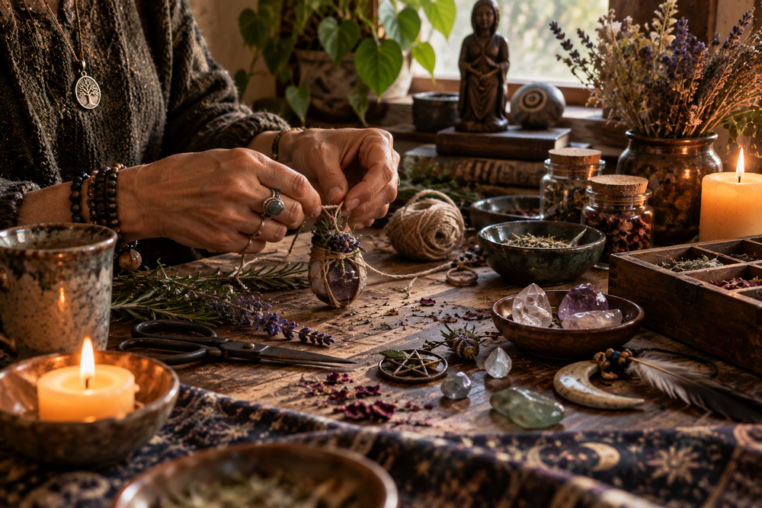
A simple cord working: Take a length of cord, natural fibre works best, and the color can carry correspondence if you work with color symbolism. Sit with it and bring your intention to mind as clearly as you can. Then tie a knot, speaking or thinking the intention as you draw the knot tight. Tie nine knots in the cord, each with the same or a related intention, spaced evenly along its length. The traditional formula moves through positions: by knot of one, the spell’s begun / by knot of two, it cometh true / by knot of three, so mote it be – and so on. The counting and the formula are mnemonic aids as much as magical ones, helping you to stay focused through the full working.
Keep the knotted cord somewhere it will be regularly seen. When the intention has manifested or is no longer relevant, cut the cord with scissors and either burn it or bury it, releasing what was tied there.
Weaving and braiding extend this logic. A braided cord made of three strands of different colors, each color carrying a different intention or correspondence, is a sustained and elaborate working built into the object as it is made. Every pass of the strands over each other is intentional. The finished braid carries all of that.
Poppets and Figures
The poppet – a small figure made to represent a person – has a long and slightly misunderstood history in popular imagination. The image of the voodoo doll being stuck with pins for harm is the cultural shorthand, and it obscures a much more complex and largely benevolent tradition.
Poppets have been found in ancient Egyptian tombs. They appear in the record of medieval European folk practice. They are documented in the trial records of accused witches across Britain, generally used for healing rather than harming. A poppet made to represent someone ill, filled with healing herbs, dressed in a scrap of their cloth, worked over with intention for their recovery – this is the mainstream of the tradition.
The principle is sympathy: like acts on like. A figure that represents a person can be worked on in ways that affect the person it represents. The word for this in magical terminology is sympathetic magic, and it is one of the oldest and most universal operating principles in the tradition.
Making a poppet by hand, from cloth or clay or wax, is an act of sustained creative attention. As you sew or shape it, you are building the sympathetic link. As you fill it with herbs, stones, or other materials chosen for their correspondences, you are loading it with intention. As you name it – I name you [person], this figure is they and they are this figure – you complete the connection.
The figure then becomes a working partner. Place it on your altar during healing work. Speak to it. Tend it. The tending of the figure is the tending of the relationship or the situation it represents.
Candle-Making as Magical Practice
The candle is one of the most fundamental magical tools – flame as focused intention, light in darkness, the slow transformation of solid into light and heat and smoke. When you make candles yourself, you extend the working back into the creation of the tool itself.
The simplest approach: Melt natural wax – beeswax is traditional and carries powerful solar correspondence; soy wax is accessible and takes colour and scent well. As the wax melts, add essential oils or botanicals chosen for their magical correspondence to your intention. Pour into moulds or containers while holding your intention clearly in mind. The candle sets. What it holds is what you brought to its making.
A candle made with rosemary and mugwort for a working of clarity and dream awareness is different from the same physical candle bought from a shop. Not because the shop candle is inferior as an object, but because the handmade candle has the making as part of its history. When you light it, you are not only beginning the ritual. You are completing a working that began when you melted the wax.
Inscribe your candles before lighting them – a single word, a sigil, a name. Draw the inscription toward you for drawing work, away from you for releasing work. This is a small gesture but a deliberate one, and deliberate gestures accumulate.
The Ritual of Making
Every act of making by hand has the structure of a ritual, whether you frame it that way or not.
There is a beginning: the gathering of materials, the preparation of the space, the setting of intention.
There is a middle: the sustained engagement with the work, the decisions made along the way, the attention required to shape material toward the desired form.
And there is an end: the completion, the object that now exists in the world, the moment of recognition that something has changed because you were here and you made something.
This is the structure of all effective magical working. The handmade object makes it visible.
You do not need to be a skilled craftsperson to begin. The beginner’s awkward attempt to sew a small pouch carries the same quality of intention as the master embroiderer’s elaborate work. And sometimes more, because the beginner is attending more closely to every stitch. Skill makes the physical result more refined. It does not make the magical dimension more powerful.
Start with what you have. A length of cord. A piece of cloth and a needle. Some wax. A handful of herbs. A stone from the ground.
Make something. Make it with your full attention and your clearly held intention. Handle it regularly. Tend it.
Notice what you have made.
The world is full of things made without attention, produced without intention, present without relationship. The thing you made with your own hands, for a purpose you understood, using materials you chose – that is something else entirely. It knows you made it. And in the most essential sense of the word, it is yours.