 Written by
Before the altar. Before the tools. Before the words and the symbols and the ritual structures that the tradition has accumulated over millennia – there was breath.
Breath is the first magical act. The moment of birth is the moment of first breath.
Every tradition that has developed a serious engagement with the body and consciousness has developed, alongside that engagement, a sophisticated understanding of breath as a tool for transformation. Yoga’s pranayama. The Tibetan Buddhist practices of tummo and vase breathing. The shamanic traditions of circular breathing to sustain trance. The Sufi practices of breath synchronised with the dhikr. The Hebrew mystical tradition in which the name of God, YHWH, is understood to be the sound of inhale and exhale.
This is not coincidence. Breath is the only physiological function that is simultaneously involuntary and voluntary. It happens without your attention, but you can also take conscious control of it at any moment. This makes it the bridge between the automatic and the deliberate, between the body’s own intelligence and the practitioner’s intention.
Which makes it, potentially, one of the most powerful tools in your practice. And one of the most overlooked, precisely because it is so ordinary.
What Breath Actually Does
To understand why breath is magically and energetically significant, it helps to understand what it does physiologically. Because the physiological and the energetic are not as separate as the conventional mind assumes.
Your breath directly regulates your nervous system. A slow, deep exhale activates the parasympathetic nervous system. The rest-and-digest, open-and-receive mode. A sharp, rapid inhale activates the sympathetic. The alert, energized, ready-to-act mode. By changing your breathing pattern, you are literally changing the neurological state you are operating from.
Different neurological states have different qualities of consciousness associated with them. The calm, open state produced by extended slow breathing is the state in which intuition is most accessible, in which the boundary between ordinary and non-ordinary perception is most permeable, in which the kind of receptive attention that magical work requires is most available. The alert state produced by rapid breathing is the state in which will and focused intention are strongest.
Every magical tradition that has worked with breath has been working with this. With the capacity to consciously shift states through the deliberate use of breath patterns.
Basic Breath Practices for Magical Work
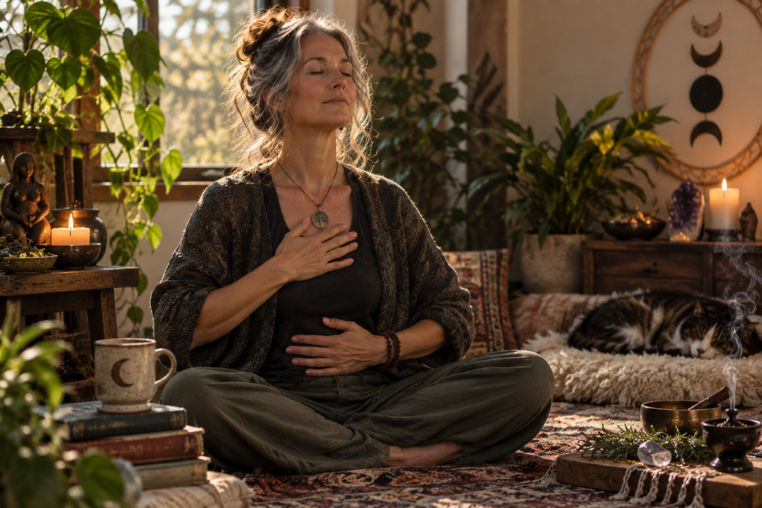
The settling breath. Before any ritual or working, take three to five minutes to settle your breath. Breathe slowly, making the exhale slightly longer than the inhale. In for four counts, out for six. This simple shift activates the parasympathetic nervous system and signals to your body that it is moving out of ordinary activity and into a different quality of attention. It is the simplest possible preparation for magical work, and it is extraordinarily effective.
Box breathing. Inhale for four counts. Hold for four. Exhale for four. Hold for four. This square pattern, equal time on each phase, produces a deep steadiness and a quality of internal silence that is useful before divination, meditation, or any working that requires clear receptivity. It is also an effective reset when you are anxious, overwhelmed, or struggling to enter the state the working requires.
Extended exhale breathing. Make your exhale at least twice as long as your inhale. In for four, out for eight; or in for three, out for six. Sustained extended exhale breathing produces a deeply relaxed, open state that approaches light trance. This is the breath pattern to work with before lucid journeying, guided visualization, or any practice in which you want to move into expanded perception.
The energising breath. Three short, sharp inhales through the nose, followed by one long, forceful exhale through the mouth. Repeat this cycle several times. This activates and energises, raising the quality of alert presence. Use it before workings that require strong will and clear intention. Before casting a circle, before a significant petition, before any working where you want to bring the full force of your focused energy.
Breath of fire. Rapid, rhythmic breathing through the nose – both inhale and exhale are active, roughly equal in length, at a rate of about one breath per second. Sustained for two to three minutes, this produces a marked shift in consciousness – a buzzing, heightened awareness that many practitioners find useful for raising energy before ritual. Start slowly and build. If you feel dizzy, stop and return to ordinary breathing.
Note: If you have any cardiovascular condition, high blood pressure, or respiratory illness, consult a healthcare practitioner before working with intensive breath practices.
Breath and Energy
In the energetic traditions, breath is not only air. It is the vehicle through which life force – called prana in the yogic tradition, chi or qi in the Chinese, pneuma in the ancient Greek, ruach in the Hebrew – moves through the body.
This is not a metaphor, or not only a metaphor. The same observation, that breath carries something more than its chemical constituents, that conscious breathing moves something through and around the body that ordinary breathing does not, appears independently in traditions that had no contact with each other. It is one of the most consistently reported phenomena in the history of human engagement with consciousness.
Working with breath in energy practice:
Breathing into sensation. When you locate a sensation in your body – tension, tightness, discomfort, blocked energy – breathe directly into it. Not metaphorically: consciously direct your inhale toward that area, expand it with breath, and then exhale fully. Repeat. The practice of breathing into blocked or contracted areas releases energy that has become stuck far more effectively than any intellectual engagement with it.
Breathing into the energy body. As you inhale, visualise the breath filling not just your lungs but your entire energy field. Expanding outward with the inhale, contracting slightly and clarifying with the exhale. Ten minutes of this practice, done daily, develops your sensitivity to your own energy field remarkably quickly.
Breath and intention. Hold a clear intention in mind as you breathe. On each inhale, breathe in the quality you are seeking – clarity, courage, healing, groundedness. On each exhale, release what you want to let go of – fear, stagnation, the energetic residue of a difficult day. This is one of the simplest forms of energy working available, and it is effective out of all proportion to its apparent simplicity.
Breath in Ritual
Most ritual structures have an opening phase. A period of settling and preparation before the main working begins. Breath practice belongs here, every time.
Three minutes of conscious slow breathing before you begin any ritual changes the quality of what follows. It is the difference between bringing your full attention to the work and bringing whatever state you happened to be in when you walked through the door.
Develop a specific breath sequence that you use as your ritual opening. It does not need to be elaborate. Three minutes of box breathing, or five minutes of extended exhale breathing, or simply three deliberately slow breaths taken with clear intention. Any of these, done consistently, becomes the signal that shifts you from ordinary to sacred time.
The consistency matters more than the specific technique. Your nervous system learns. Over time, the ritual breath becomes a trigger. A Pavlovian cue that begins the shift in state before your rational mind has caught up with what you are doing. This is what all ritual is, at its most fundamental: the use of consistent forms to produce reliable states.
The breath is where that begins.