
On Sunday, December 21, 2025, at 10:03 AM EST, the Northern Hemisphere will experience the winter solstice. That’s the instant when the Sun reaches its southernmost point in the sky, marking the official beginning of astronomical winter and when daylight hours are at their minimum before they start lengthening again. Also known as the shortest day and longest night of the year. This astronomical event has captivated humanity for millennia, inspiring celebrations, rituals, and traditions that continue to resonate in our modern world. What Is the Winter Solstice? The winter solstice occurs when the northern half of the Earth is tilted its farthest away from the sun, causing the sun to reach its lowest point in the sky. While many think of it as an entire day, the solstice actually lasts just a moment. A precise astronomical alignment that marks the official beginning of winter. The word “solstice” comes from the Latin words meaning “sun” and “still,” reflecting how the sun appears to pause in its southward journey before reversing direction. After December 21st, the days gradually begin to lengthen again, offering the promise of returning light and the eventual arrival of spring. Why Our Ancestors Celebrated For ancient peoples without modern scientific understanding, the shortening days of autumn and early winter were deeply unsettling. The sun, source of all warmth and life, appeared to be abandoning the world. Would it return? Would crops grow again? Would they survive the harsh months ahead? To combat their fear that the Sun would be gone forever, our ancestors held various celebrations and rites to light up the darkness encouraging the Sun to return and bring new life. These solstice celebrations were not merely parties, they were sacred acts of faith, community bonding, and hope in the face of winter’s darkness and scarcity. Ancient Solstice Celebrations Around the World Stonehenge and the Druids (England) Perhaps no place is more iconic for solstice celebrations than Stonehenge. This 5,000-year-old structure in England was built to align with the sun at the solstice. The monument’s massive stones frame the sunset on the winter solstice and the sunrise on the summer solstice with stunning precision. Every year, Stonehenge hosts a winter solstice ceremony, with crowds gathering in the early hours of the morning to see the sunrise over its stones. For 2025, the site will open at 5:15 AM, with sunrise occurring around 8:09 AM. Those unable to attend can watch via English Heritage’s YouTube livestream. Yule (Norse and Germanic Traditions) The ancient Norse and Germanic peoples celebrated Yule, a festival that began on the winter solstice and lasted for twelve days. During Yule, families would burn a specially selected log, the Yule log, which was meant to burn throughout the twelve days of celebration. The ashes were kept and used for protection and fertility in the coming year. Yule festivities included feasting, drinking mead, honoring ancestors, and sacrifices to the gods to ensure the sun’s return and a bountiful year ahead. Many of our modern Christmas traditions, including the Yule log, evergreen decorations, and gift-giving, trace their roots to these ancient celebrations. Saturnalia (Ancient Rome) The Romans celebrated Saturnalia in honor of Saturn, the god of agriculture and time. This week-long festival, which began around December 17th and coincided with the solstice, was characterized by role reversals, feasting, gambling, and gift-giving. Social norms were temporarily suspended. Slaves were treated as equals, and a “Lord of Misrule” was chosen to preside over the festivities. Homes were decorated with wreaths and greenery, candles were lit to drive away darkness, and clay figurines called sigillaria were exchanged as gifts…. …
As we approach the winter solstice, the night sky gifts us with one last celestial spectacle of 2025. On December 19th at 6:43 PM MST, the final full moon of the year will rise, offering us a powerful opportunity for closure, reflection, and intention-setting as we prepare to welcome a new year. The Cold Moon’s Significance December’s full moon is traditionally known as the Cold Moon, named by Native American tribes for the long, frigid nights that accompany this time of year. It’s also called the Long Night Moon, as it occurs near the winter solstice when darkness reaches its peak in the Northern Hemisphere. This moon carries with it a particular energy of completion, rest, and inner contemplation. A Moment of Cosmic Closure There’s something profoundly symbolic about experiencing the year’s final full moon just days before the solstice and less than two weeks before the new year. This lunar event marks a natural pause point, a cosmic full stop that invites us to take stock of where we’ve been and where we’re heading. The full moon has long been associated with illumination, both literal and metaphorical. It reveals what has been hidden in shadow and brings clarity to situations that have felt murky or unclear. As the last full moon of 2025, this particular lunar phase asks us to examine what we’re carrying forward into 2026 and what we’re ready to release. How to Harness This Moon’s Energy Whether you’re spiritually inclined or simply appreciate the beauty of celestial events, here are some ways to mark this significant moment. Create Space for Stillness The longest nights of the year naturally call us inward. Use this evening to disconnect from the noise of the holiday season and simply be present with yourself. Release What No Longer Serves Write down habits, relationships, beliefs, or patterns you’re ready to let go of. The full moon’s energy supports release and completion. Express Gratitude Reflect on the gifts this year has brought you, even the challenging moments that fostered growth. Set Intentions While new moons are traditionally for setting intentions, the final full moon offers a unique opportunity to plant seeds for the year ahead while honoring where you’ve been. ✍️ Journal Prompts for the Final Full Moon of 2025 Take some time on December 19th to sit with these reflective questions. Let your thoughts flow without judgment, allowing the moon’s illuminating energy to guide your insights. ✍️ Reflection & Release ~ What were the three most significant moments of 2025 for me? How did they shape who I am today? ~ What challenges did I face this year, and what strength did I discover within myself through them? ~ What patterns or habits have I outgrown? What am I ready to release as this year comes to a close? ~ Who or what do I need to forgive (including myself) before entering the new year? ~ What dreams or goals did I pursue this year? Which ones energized me, and which ones drained me? ✍️ Gratitude & Growth ~ What unexpected blessings appeared in my life in 2025? ~ How have I grown emotionally, mentally, or spiritually over the past twelve months? ~ What relationships deepened this year, and what made that possible? ~ What did I learn about myself in moments of discomfort or uncertainty? ~ What am I most proud of accomplishing or becoming this year? ✍️ Intention & Vision ~ As I stand in this moment of completion, what word or phrase best captures the energy I want to carry into 2026? ~ What do I want to feel… …
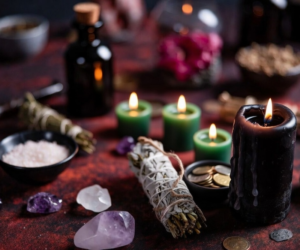
Fire has always been sacred. It transforms, illuminates, consumes, and purifies. When you light a candle with intention, you’re working with one of humanity’s oldest tools for magic and prayer. The flame becomes a focal point for your will, carrying your intention into the universe as it burns. But color matters. Each hue carries its own vibration, its own energy, its own particular way of working. Choosing the right candle color for your intention isn’t about rigid rules. It’s about understanding the language of color and speaking it fluently in your practice. Here’s your guide to candle colors, what they mean, and how to work with them effectively. White ~ Purity, Truth, and the Universal Substitute Energy: Cleansing, purification, truth, protection, peace, spirituality, healing, new beginnings Best Used For:~ Cleansing and purifying spaces or yourself~ Truth-seeking and clarity work~ Protection rituals~ Meditation and spiritual connection~ Healing of any kind~ Peace and tranquility spells~ Baby blessings or new beginnings How to Use: White candles are the universal substitute in candle magic. If you don’t have the “right” color, white works for any intention because it contains all colors within it. Light a white candle when you need a clean slate, when you’re seeking truth in a murky situation, or when you want to establish peace. White candles are excellent for full moon rituals, cleansing your space before other workings, or simply creating sacred atmosphere. Practical Tip: Keep white candles on hand always. They’re your foundation, your go-to, your “I need to do magic right now but don’t have a specific colored candle” solution. Black ~ Protection, Banishing, and Shadow Work Energy: Protection, banishing negativity, breaking hexes, shadow work, absorbing negative energy, endings, mystery, the void Best Used For:~ Banishing unwanted energy, people, or situations~ Breaking curses or hexes~ Protection from psychic attack~ Shadow work and confronting your darkness~ Ending toxic patterns or relationships~ Absorbing negativity from a space~ Dark moon rituals How to Use: Black candles get a bad reputation, but they’re incredibly protective and useful. Light a black candle when you need to banish something from your life. Whether that’s a bad habit, negative energy, or unwelcome attention. Black absorbs, so it pulls negativity away from you. Use black candles during the dark moon, when you’re doing deep shadow work, or when you need serious psychic protection. Practical Tip: Carve what you’re banishing into the candle, then burn it completely. As the wax melts and the words disappear, visualize the thing leaving your life. Bury the remains away from your home or dispose of them at a crossroads. Red ~ Passion, Power, and Vitality Energy: Passion, love (particularly sexual love), courage, strength, willpower, vitality, energy, survival, action Best Used For:~ Sexual attraction and passionate love~ Courage and bravery spells~ Physical strength and vitality~ Survival and root chakra work~ Taking action on delayed projects~ Overcoming fear~ Blood magic (symbolically) How to Use: Red is the color of life force itself, blood, fire, the beating heart. Light red candles when you need to tap into primal power, when you want to attract passionate love (not gentle romance, use pink for that), or when you need the courage to do something that terrifies you. Red candles are excellent for motivation, for lighting a fire under yourself, for calling in desire and manifestation through sheer force of will. Practical Tip: Red candles burn hot, metaphorically and literally. Use them for short, intense workings rather than prolonged meditation. Anoint red candles with cinnamon oil for extra heat and attraction power. Pink ~ Love, Friendship, and Emotional Healing Energy: Romantic love, self-love, friendship, emotional healing, compassion,… …
What is Yule? Yule is one of the oldest winter celebrations in the world, a sacred festival marking the winter solstice and the rebirth of the sun. For witches, pagans, and spiritual practitioners, it represents a powerful turning point in the Wheel of the Year – the longest, darkest night that promises the return of light and warmth. Originating with Germanic peoples, particularly the Norse and Anglo-Saxons, Yule (from Old Norse “jól” and Old English “Geōl”) was historically a midwinter festival centered on themes of light, fire, feasting, and honoring the cycles of death and rebirth. Today’s modern witches and neo-pagans have revived and reimagined these ancient traditions, blending historical practices with contemporary spiritual needs. The Many Dates of Yule ~ Different Traditions, Different Timings One of the most fascinating aspects of Yule is that different belief systems celebrate it at different times, each with valid historical and spiritual reasoning. Winter Solstice Celebration (December 21-22) Most modern pagans and Wiccans celebrate Yule on the winter solstice, which falls on December 21 in the Northern Hemisphere, marking the astronomical moment when the sun reaches its lowest point in the sky. For Wiccans specifically, this represents the rebirth of the sun god, a powerful time of transformation and renewal. Why this date? It’s astronomically precise and connects directly to the observable phenomenon of the sun’s journey. The solstice represents the literal turning point when days begin to lengthen again. Historic Norse/Heathen Yule (January Full Moon) Historical research suggests that ancient Norse pagans celebrated Yule on the first full moon after the winter solstice, which can fall anywhere from early to mid-January. This lunisolar timing meant the celebration moved each year, following the natural cycles of both sun and moon. Why this date? Ancient peoples used lunar calendars, and the full moon provided practical illumination for nighttime festivities during the darkest time of year. For 2026, this would place historic Yule around January 3, lasting three nights during the full moon. Extended Yuletide (December 21 ~ January 1) Many modern practitioners celebrate Yule as a 12-day festival beginning at the winter solstice and extending through New Year’s Day. This approach combines the astronomical precision of the solstice with the historical tradition of extended midwinter celebrations. Why this timing? Historical records indicate that Yule was celebrated as a multi-day festival, with some accounts describing three-day feasts and others mentioning 12-day revelries. The extended celebration reflects the agricultural calendar. When work slowed during winter, communities gathered for prolonged festivities. Southern Hemisphere (June 20-21) For witches and pagans in the Southern Hemisphere, Yule falls during their winter solstice in June, maintaining the celebration’s connection to the actual seasonal turning point rather than calendar dates. Which date should you choose? There’s no single “correct” answer. Choose the timing that resonates with your practice, your tradition, and your spiritual path. Many solitary practitioners blend approaches, marking the solstice itself while extending celebrations over multiple days. Celebrating the 12 Days of Yule ~ A Witchy Journey The 12 days of Yule offer a beautiful structure for deepening your spiritual practice, honoring the season, and welcoming the returning light. Here’s how to celebrate each day with intention and magic. Remember: These are suggestions and inspirations. Your practice is your own. Adapt, modify, and personalize these celebrations to align with your path, your tradition, and your intuition. The most powerful magic is that which resonates authentically with your spirit. Journaling Prompts for all 12 Days of Yule are here. Day 1: Mother’s Night (December 20/21 ~ Solstice Eve) Theme: Honoring the Divine Feminine and Ancestral Mothers Mother’s Night is dedicated to… …
Use these journal prompts to deepen your Yule experience and create a record of your spiritual journey through the darkest days and into the returning light. Tips for Journaling Through Yule Create sacred space: Light a candle, burn incense, or play soft music before you begin writing. Be honest: Your journal is for you alone. Write without censoring or judging yourself. Don’t overthink: If a prompt doesn’t resonate, skip it or modify it. Trust your intuition. Return and reflect: Consider revisiting these entries throughout the year to see how you’ve grown. Make it magical: You can write with intention, charge your journal with crystals, or seal pages with wax and sigils. Combine with ritual: Journal before or after your daily Yule activities to deepen the experience. May your words be spells, your reflections be revelations, and your Yule journey be transformative. Blessed writing. Download the full 12 Days here ✍️ Day 1: Mother’s Night (December 20/21) Honoring the Divine Feminine and Ancestral Mothers 1. Who are the maternal figures (biological, chosen, or spiritual) who have shaped who you are today? What gifts did each one give you? 2. Reflect on the divine feminine energy in your life. How do you embody qualities like nurturing, intuition, creativity, or protection? 3. Write a letter to an ancestor or maternal figure (living or deceased) expressing gratitude for their influence on your path. 4. What wisdom have the women in your lineage passed down to you? What wisdom do you want to pass forward? 5. If you could ask your ancestors one question about navigating life’s challenges, what would it be? Sit quietly and write whatever answer comes to you. ✍️ Day 2: Winter Solstice (December 21/22) Death, Rebirth, and the Return of the Sun 1. What needs to die in your life so that something new can be born? What are you ready to release as the old sun sets? 2. Describe a time when you experienced a personal “dark night of the soul.” How did you find your way back to the light? 3. The sun is reborn today after the longest night. What part of yourself is ready to be reborn? What does this renewed version of you look like? 4. What darkness (literally or metaphorically) are you grateful for? What has it taught you? 5. Write about the balance between light and dark in your life. How do you honor both? ✍️ Day 3: Family and Feasting Day (December 22) Community, Gratitude, and Togetherness 1. List ten things you’re grateful for in your relationships (family, friends, chosen family, community, coven). 2. What does “family” mean to you beyond blood relations? Who are your people? 3. Reflect on a cherished memory of gathering with loved ones. What made it special? How can you create more moments like this? 4. Is there a relationship that needs mending or attention? What small step could you take toward healing or connection? 5. How do you nourish others? How do you allow others to nourish you? ✍️ Day 4: The Wild Hunt (December 23) Honoring Spirits, Ancestors, and the Otherworld 1. What messages have you received from dreams, signs, or intuition lately? What might your ancestors or guides be trying to tell you? 2. Describe your relationship with the spirit world. Are you comfortable with it, afraid of it, curious about it? 3. What shadows are you ready to confront? What have you been avoiding that prowls at the edges of your consciousness? 4. Write about a time when you felt the presence of something beyond the physical world. How did it affect you?… …
The word “witch” carries weight. Say it aloud and watch how the air changes. For centuries, it’s been used as an accusation, a threat, a death sentence. But before that, and increasingly now, it meant something else entirely. A person who walks between worlds, who knows the language of herbs and stars, who refuses to be limited by what others say is possible. The symbols associated with witchcraft tell stories too. Some are ancient, rooted in pre-Christian traditions. Others emerged during the witch trials, assigned to witches by those who feared them. And some have been reclaimed in recent decades by those who wear the title proudly. Let’s explore what these symbols mean, where they come from, and what they represent to those who practice the craft today. The Witch Herself ~ What Does It Mean? Before diving into symbols, we need to understand what “witch” actually signifies. Etymology: The word likely derives from Old English “wicce” (feminine) and “wicca” (masculine), possibly related to “wiccian” meaning “to practice sorcery” or “witan” meaning “to know.” A witch is, fundamentally, one who knows. Particularly knowledge that exists outside acceptable channels. Historical Meaning: Throughout history, witches were healers, midwives, herbalists, and wise women who served their communities. They knew which plants stopped bleeding, eased childbirth, prevented pregnancy, or caused visions. This knowledge made them essential, and dangerous to those in power. Modern Meaning: Today, witch encompasses many practices, Wicca, traditional witchcraft, folk magic, chaos magic, eclectic practices, and more. What unites them is working with energy, intention, and the natural world to create change. To call yourself a witch is to claim agency, to say you won’t wait for permission or divine intervention. You’ll work the magic yourself. The Pentacle/Pentagram ~ Protection and the Elements The Symbol: A five-pointed star, often enclosed in a circle. When the point faces up, it’s generally considered protective. Point down has been associated (often incorrectly) with dark magic, though some traditions use it deliberately to represent different aspects of the craft. Meaning: Each point represents one of the five elements.~ Earth (lower left): grounding, stability, the physical body~ Air (lower right): intellect, communication, breath~ Fire (upper right): passion, transformation, will~ Water (upper left): emotion, intuition, the subconscious~ Spirit (top point): the divine, consciousness, what connects all things The circle around it represents unity, protection, and the infinite nature of energy. History: The pentagram is ancient, appearing in Mesopotamian and Greek contexts long before Christianity. Pythagoras used it as a symbol of mathematical perfection. Early Christians associated it with the five wounds of Christ. It wasn’t until much later that it became exclusively linked with witchcraft and paganism. Often through the very trials that sought to destroy these practices. Modern Use: Witches wear pentacles for protection, to signify their path, and to remind themselves of the elemental balance they work to maintain. The Cauldron ~ Transformation and the Womb of Creation The Symbol: A large pot, usually cast iron, often depicted bubbling with mysterious contents. Meaning: The cauldron represents transformation, the place where raw ingredients become something new. It’s the womb, the grave, the place of death and rebirth. What goes into the cauldron emerges changed. History: Cauldrons appear in Celtic mythology as vessels of plenty and rebirth. The Dagda’s cauldron never ran empty. Cerridwen’s cauldron brewed inspiration and knowledge. In practical terms, cauldrons were essential tools for cooking, brewing medicine, and yes, creating herbal preparations that looked suspiciously like “potions” to the uninformed. Modern Use: Witches use cauldrons (or any fireproof bowl) for burning herbs, mixing ingredients, scrying, or as a symbolic representation of the Goddess. The… …
This is a modern ritual drawing on traditional reversal magic principles, combining tree symbolism (grounding, boundaries, protection), flame energy (transformation, purification, power), and gate work (thresholds, portals, barriers). While rooted in established magical theory, this specific working is a contemporary creation. What Is the Tree Flame Reverse Gate? The Tree Flame Reverse Gate is an advanced protective working that creates an unbreakable energetic barrier around you. One that doesn’t just block harmful energy, but actively returns it to its sender with transformative force. Think of it as installing a mystical security system that both shields you and ensures anyone attempting to harm you receives their own negativity back threefold. This working combines three powerful magical elements: The Tree represents your rootedness, stability, and natural boundaries. Like a mighty oak that cannot be toppled, you become immovable and protected. The tree’s roots ground you deeply while its branches create a protective canopy. Trees also represent the World Tree concept – the connection between realms, making them natural gatekeepers. The Flame represents transformation, purification, and the power to consume negativity. Fire doesn’t just deflect, it transforms. Any harmful energy sent your way is transmuted by the flame into purifying light that burns away the attack while sending its essence back to the sender. The Gate represents the threshold, the boundary between your sacred space and the outside world. A gate controls what enters and what leaves. The Reverse Gate specifically ensures that while blessings can enter, harm cannot. And anything harmful that attempts entry is immediately turned around and sent back through the portal to its source. Together, these three elements create a self-sustaining protection that requires no maintenance once established. The gate stands vigilant, the tree roots it in unshakeable reality, and the flame ensures continuous transformation of negativity. Why the Tree Flame Reverse Gate Works ~ The Magical Theory Understanding why this protection works makes it exponentially more powerful. When you comprehend the mechanics of reversal magic, you can cast with confidence and authority. The Principle of Energetic Reflection Return-to-sender spells operate by sending back harmful energy, curses, or destructive patterns to their source. This isn’t about creating new negativity or seeking revenge. It’s about taking ownership of your space and releasing what isn’t yours to carry. Think of it this way: when someone sends harmful energy toward you, they’re essentially throwing something at you. Without protection, you catch it and it harms you. With simple shielding, you might duck or block it, but it still exists in the world, potentially harming someone else. With reversal magic, you install a mirror. When they throw negativity, it bounces directly back to them with the same force they used. By casting a return-to-sender spell, you aren’t producing any negative energy yourself; you are merely redirecting it. The person who sent the harm is the only one who suffers. And only to the degree that they attempted to harm you. The Mirror Principle Reversal spells use mirrors as spiritual tools that reflect evil intentions back to the one who sent them. The Tree Flame Reverse Gate incorporates this principle through the gate itself, which functions as a mystical mirror-portal. When harmful energy hits the gate, it sees itself reflected and returns to its source automatically. The Natural Law of Return This working operates on a fundamental principle recognized across spiritual traditions: energy seeks to return to its source. Water flows downhill to the ocean. Smoke rises back to the sky. Energy that’s been sent out will eventually circle back. The Tree Flame Reverse Gate simply ensures that harmful energy makes this return journey… …
There’s something undeniably magnetic about crows. Watch one long enough and you’ll notice the way they tilt their heads with what can only be described as curiosity, the deliberate way they assess their surroundings, the knowing glint in those dark, intelligent eyes. For witches, mystics, and spiritual seekers, crows have long been recognized as more than just birds – they are teachers, messengers, and mirrors reflecting profound spiritual truths. Modern science is finally catching up to what practitioners of the old ways have always known, that crows are remarkably intelligent, deeply social, and possess an awareness that challenges our understanding of consciousness itself. They remember faces, hold grudges across generations, mourn their dead, and solve problems with creativity that rivals primates. But beyond the scientific facts lies something equally compelling – the spiritual wisdom these black-feathered beings offer to those willing to listen. The Intelligence of Crows ~ Minds That Mirror Magic Let’s talk about just how brilliant these birds actually are, because understanding their intelligence deepens our appreciation for them as spiritual allies. Consciousness and Self-Awareness Research has revealed that crows possess what scientists call “subjective experience” or sensory consciousness. They know what they know and can reflect on the contents of their own minds. This level of self-awareness was long thought to be exclusively human, or at best limited to primates. Crows possess around 1.5 billion neurons packed tightly in their brains, comparable to some monkey species, and this density allows for sophisticated communication between brain cells. Think about what this means spiritually. When a crow looks at you, there is genuine awareness behind those eyes. They are not operating on pure instinct, they are thinking, evaluating, remembering. Problem-Solving and Tool Use Crows can create and use tools, solve complex puzzles, and even understand abstract concepts like water displacement at a level comparable to a human seven-year-old child. New Caledonian crows fashion hooks from sticks and wire to retrieve food beyond their reach. They’ve been observed using cars to crack nuts, storing food for later, and adapting to new challenges with remarkable flexibility. In witchcraft, we honor the power of adaptability and creative solutions. The crow embodies this perfectly. Teaching us that intelligence is not about brute force but about clever approaches and innovative thinking. Memory and Recognition Perhaps most striking is the crow’s memory. They can recognize individual human faces and remember them for years. Even passing that information to other crows who have never met the person. Research shows that crows who witnessed researchers trapping their companions while wearing specific masks continued to scold and dive-bomb people wearing those masks more than a decade later, with over half the crow population on a university campus learning to recognize the “dangerous” humans despite never having been trapped themselves. This is ancestral knowledge in action. Crows literally pass down warnings through generations, teaching their young who to trust and who to avoid. As witches who honor ancestral wisdom, we can learn from this powerful transmission of knowledge through community and kinship. Lesson One ~ The Power of Community and Collective Intelligence Crows don’t survive alone, they thrive in community. While pairs of crows mate for life and establish territories during breeding season, outside that time they gather in massive communal roosts called “murders” that can number in the thousands. These gatherings aren’t just for show; they serve vital purposes. Strength in Numbers When crows come together, they share information about food sources, predators, and safe spaces. A crow that discovers danger shares that knowledge with the entire community through distinctive alarm calls. They work cooperatively, sometimes teaming up… …
Winter is a season of quiet magic, introspection, and powerful transformation. While the earth rests beneath snow and frost, we’re invited to turn inward and work with the unique energies this time of year offers. You don’t need elaborate ceremonies or expensive tools. Some of the most potent magic happens in small, intentional moments woven into your daily life. Here are simple winter rituals to help you connect with the season’s magic, invite protection and abundance, and prepare yourself for the year ahead. Open Your Windows on December 12 at 12:12 The Ritual: On December 12th, set an alarm for exactly 12:12 (noon or midnight, your choice). At that precise moment, open all the windows in your home for at least one minute, even if it’s freezing outside. The Magic The repeating number 12 (12/12 at 12:12) creates a powerful portal for manifestation and new beginnings. This synchronized moment amplifies intention and creates an opening for fresh energy to enter your space. Opening your windows releases stagnant energy from the year and literally invites good fortune to flow in for the coming year. How To Do It ~ Set your intention beforehand: “I welcome abundance, luck, and blessings for the new year”~ At 12:12 sharp, open your windows~ Stand in the center of your home and breathe deeply~ Visualize golden light streaming in with the fresh air~ You can ring a bell or clap to seal the intention~ Close the windows after 1-3 minutes Bonus: Write your wishes for the new year on small pieces of paper and place them on windowsills during this time. Brew Clove Tea for Protection The Ritual During the darkest months, brew yourself a simple tea using whole cloves for spiritual protection and energetic boundaries. The Magic Cloves have been used for centuries in protection magic. They ward off negative energy, psychic attacks, and unwanted influences. Drinking clove tea creates protection from the inside out, strengthening your aura and personal boundaries during winter’s vulnerable, introspective season. How To Do It ~ Boil water and add 3-5 whole cloves~ As it steeps, visualize a protective golden shield forming around you~ You can add cinnamon, orange peel, or honey for flavor and additional properties~ Drink slowly and intentionally, feeling warmth and safety fill your body~ Save the used cloves to dry and carry in a protection sachet When To Use It ~ Before entering challenging situations~ During dark moon phases~ When you feel energetically vulnerable~ As a daily winter wellness ritual Magical Correspondence: Clove is associated with Jupiter and fire energy, bringing not just protection but also prosperity, courage, and mental clarity. Collect Snow Water for Peaceful Transformation The Ritual During the first snowfall of the season (or any significant snowfall), collect fresh, clean snow in a glass jar or bowl. The Magic Snow water carries the energy of peaceful transformation, gentle change, and purification. Unlike the dramatic transformation of fire or the emotional depth of rain, snow represents quiet, gradual shifts. The kind of change that happens slowly and settles softly. It’s perfect for intentions around gentle personal evolution, releasing what no longer serves you without drama, and embracing new beginnings with grace. How To Do It ~ Go outside during or immediately after snowfall~ Use a clean glass container to collect fresh snow~ As you collect it, set your intention: “I embrace peaceful change and gentle transformation”~ Bring it inside and let it melt naturally at room temperature~ Bottle the water and label it “Snow Water” with the date Ways To Use Snow Water ~ Add to ritual baths for gentle release work~ Use in floor… …
Every full moon, I set out water beneath the night sky. By morning, it’s transformed, as the tradition goes, into moon water, charged with lunar energy and intention. I keep this water in a small brass holder on my gratitude altar, refreshing it each evening as part of my practice. And every morning, without fail, Freyja jumps onto the altar and drinks it. My cat has inserted herself into my ritual so completely that I’ve stopped questioning whether the water is really for me at all. She approaches the brass holder with the kind of reverence I’m still learning – no hesitation, no doubt, just pure presence. While I stumble through my gratitude practice some mornings, distracted and half-awake, she shows up with absolute certainty. Who Practices for Whom? I never asked Freyja if she wanted to be part of this. I never explained the full moon, or intention-setting, or why this particular water sits in this particular place. Yet she’s made it her ritual too, perhaps more faithfully than I have. This raises a question that’s been sitting with me, quiet but persistent. When we practice something spiritually, creatively, emotionally – how much of it ripples out to those who share our space? And do we have any right to create those ripples without asking first? The Unspoken Influence of Practice We think of spiritual practice as deeply personal, contained within the boundaries of our own consciousness. But practice doesn’t exist in a vacuum. It shapes the air in our homes, the rhythms of our days, the small objects we place with care in certain spots. It creates patterns that others, human or animal, learn to navigate. Freyja didn’t choose to live with someone who keeps an altar. She didn’t consent to the particular energy I’m trying to cultivate when I light incense or sit in meditation. Yet she’s shaped by it anyway, just as I’m shaped by her presence. The way she demands attention when I’m too much in my head, or settles beside me when the practice actually lands. The Ethics of Shared Space There’s something uncomfortable in this realization. We’re often careful about consent in explicit ways. We ask before sharing someone else’s story, before touching, before entering. But what about the subtler impositions? The mood we bring into a room. The practices that reorganize shared space according to our own seeking. I can’t ask Freyja if she minds. I can’t know if the energy I’m trying to cultivate feels like home to her or like living in someone else’s dream. All I can do is watch her return to that brass holder, morning after morning, and wonder if she’s found something in this practice that I’m still looking for. When Practice Becomes Ours Maybe the question isn’t whether my practice becomes hers, but whether any practice ever really belongs to just one person. The moment we bring something into being – a ritual, a creative routine, a way of moving through the day, it becomes part of the shared ecosystem. Others adapt to it, resist it, or surprisingly, join it. Freyja has taught me that practice isn’t about perfect intention or pristine isolation. It’s messy and collaborative, even when we didn’t plan for collaboration. It’s the brass holder that holds moon water some days and cat spit most days. It’s the altar that’s both sacred and functional, depending on who’s approaching it. The Gift of Unexpected Participation Perhaps there’s grace in not asking permission for every ripple we create. Perhaps some of the most profound practices emerge not from careful consent but from organic adaptation…. …