 Written by
 Starting your herbal apothecary journey can feel overwhelming. Walk into any herb shop or browse online suppliers and you’ll find hundreds of plants, oils, tools, and supplies. All promising to be essential. The truth is, you need far less than you think to begin making effective remedies, tinctures, salves, and magical preparations.
This guide breaks down exactly what you need as a beginner, why you need it, and how to use it. Think of this as your apothecary starter pack – the foundation you’ll build on as your knowledge and practice grow.
Essential Tools ~ Your Apothecary Toolkit
Mason Jars and Glass Containers
What you need: A variety of sizes from 2 oz to quart-sized jars
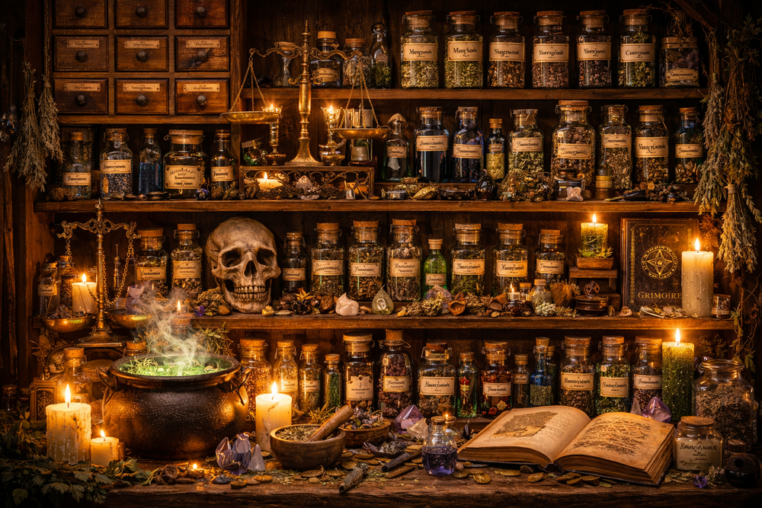
Mason jars are the backbone of any apothecary. You’ll use them for storing dried herbs, making tinctures, infusing oils, creating herbal vinegars, mixing salves, and storing finished products. Glass is non-reactive, doesn’t leach chemicals, and allows you to see your preparations at a glance.
Start with at least six 4-oz jars for storing dried herbs, four 8-oz jars for tinctures and infusions, and two or three pint or quart jars for larger batches. Having lids that seal properly is crucial. A standard two-piece canning lids work perfectly for most applications.
For long-term herb storage, consider investing in a few amber or cobalt blue glass jars to protect light-sensitive herbs from UV degradation. However, regular clear jars stored in a dark cupboard work just fine and are much more budget-friendly when you’re starting out.
Mortar and Pestle
What you need: One medium-sized mortar and pestle (4-6 inch diameter)
This ancient tool grinds, crushes, and powders dried herbs, releasing their essential oils and increasing surface area for better extraction. You’ll use it constantly, breaking down resinous herbs like frankincense, grinding seeds and roots, creating custom spice and herb blends, and pulverizing ingredients for incense.
Materials matter. Granite, marble, and stone mortars are heavy, stable, and excellent for tough materials like roots and resins. Ceramic works well for most herbs and is easier on your budget. Wooden mortars are beautiful but can absorb oils and colors from herbs, making them harder to clean and potentially causing cross-contamination between batches.
Avoid tiny decorative mortars, they’re frustrating to actually use. A bowl diameter of 4-6 inches gives you room to work without herbs flying everywhere.
Mixing Bowls
What you need: Two or three bowls in various sizes (glass, ceramic, or stainless steel)
You’ll need dedicated bowls for mixing salves, combining dry herb blends, preparing poultices, and general preparation work. Glass and ceramic are ideal because they’re non-reactive and easy to clean. Stainless steel works well too. Avoid plastic when working with essential oils or hot preparations, as some plastics can leach chemicals or absorb strong scents.
Having at least one small bowl (for quick herb blends), one medium bowl (for salve mixing), and one large bowl (for big batches) covers most needs.
Strainers and Cheesecloth
What you need: Fine-mesh strainer, cheesecloth or muslin cloth, and a funnel
Straining is a constant task in apothecary work. You’ll strain tinctures, infused oils, herbal teas, and decoctions. A fine-mesh stainless steel strainer handles most jobs and can be washed and reused indefinitely.
Cheesecloth or unbleached muslin cloth allows you to squeeze out every last drop from your preparations. Essential when working with expensive herbs or carefully crafted tinctures. You can wash and reuse these cloths multiple times before composting them.
A funnel (glass or stainless steel) helps you pour strained liquids into bottles without spilling. Once you’ve lost half a batch of laboriously made tincture to a clumsy pour, you’ll never skip the funnel again.
Measuring Tools
What you need: Measuring spoons, measuring cups, and a kitchen scale
Precision matters, especially when you’re learning. Measuring spoons and cups handle most everyday preparations. As you advance into more technical work, particularly if you begin making remedies for others or want consistent results, invest in a digital kitchen scale that measures in grams. Many herbal recipes are more accurate by weight than volume.
Double Boiler or Makeshift Setup
What you need: Either a proper double boiler or a heat-safe bowl that fits over a pot
A double boiler provides gentle, indirect heat essential for making salves, infusing oils, and melting beeswax without scorching. If you don’t have a double boiler, create one by placing a heat-safe glass or metal bowl over a pot of simmering water, ensuring the bottom of the bowl doesn’t touch the water.
Direct heat can burn herbs and oils, destroying their beneficial properties and creating acrid, unusable preparations. The double boiler method prevents this.
Labels and Markers
What you need: Waterproof labels or masking tape and a permanent marker
This seems obvious but gets overlooked constantly. Label everything immediately. The herb name, date of preparation, and any relevant notes (solvent used, herb ratio, intended use). Six months from now, you will not remember which unmarked jar contains valerian tincture versus black cohosh tincture, and guessing with potent herbs is dangerous.
Masking tape and a Sharpie work perfectly fine and are easily removable when you reuse jars. If you want something more polished, invest in waterproof labels.
Optional but Useful Tools
~ Dropper bottles: For tinctures and essential oil blends (2 oz and 4 oz sizes)
~ Small spray bottles: For hydrosols, room sprays, and linen mists
~ Tins and salve containers: For lip balms, salves, and solid preparations (0.5 oz to 4 oz)
~ Pipettes or droppers: For measuring essential oils precisely
~ Parchment paper: For lining surfaces when working with sticky herbs or resins
~ Tea infuser or muslin bags: For making medicinal teas
Solvents ~ The Foundation of Extraction
Solvents extract the beneficial compounds from herbs, making them bioavailable and preserving them for later use. Different solvents extract different compounds, which is why choosing the right one matters.
Alcohol (Vodka, Brandy, Grain Alcohol)
What you need: 80-proof vodka for most tinctures, 190-proof grain alcohol (Everclear) for resinous herbs and stronger extractions
Alcohol is the most versatile solvent for tincture-making. It extracts both water-soluble and alcohol-soluble compounds, preserves preparations for years, and is absorbed quickly into the bloodstream.
For most dried herb tinctures, 80-proof vodka (40% alcohol) works beautifully. It’s affordable, readily available, and effective. Choose unflavored vodka, you want the herb’s properties, not berry essence.
For fresh herbs, resins like frankincense and myrrh, or herbs requiring stronger extraction, use 190-proof grain alcohol. You can dilute it with distilled water to achieve whatever alcohol percentage your recipe requires.
Brandy makes tinctures more palatable and adds its own warming properties. Excellent for children’s remedies (when properly diluted) or for herbs taken regularly.
Glycerin (Vegetable Glycerin)
What you need: Food-grade vegetable glycerin
Glycerin creates sweet, alcohol-free extractions called glycerites. It’s perfect for children, people avoiding alcohol, or when you want a sweet base for herbal syrups. However, glycerin doesn’t extract as broadly as alcohol. It misses some alkaloids and resins that alcohol captures.
Use glycerin for gentle herbs like chamomile, lemon balm, and elderberry. The resulting preparations taste pleasant and have a long shelf life when properly stored.
Vinegar (Apple Cider Vinegar)
What you need: Raw, unfiltered apple cider vinegar with “the mother”
Vinegar extracts minerals and nutrients particularly well, making it excellent for preparations with nutritive herbs like nettles, oatstraw, and red raspberry leaf. The acetic acid pulls out minerals that alcohol might miss.
Apple cider vinegar also has its own health benefits and creates preparations that are pleasant in salad dressings, cooking, or taken as a daily tonic diluted in water.
Use vinegar tinctures within a year. They don’t preserve quite as long as alcohol tinctures but are still shelf-stable for many months.
Water (Distilled or Filtered)
What you need: Distilled water for preparations, filtered water for teas and decoctions
Water is the original solvent. Teas, decoctions, and infusions use water to extract the water-soluble compounds from herbs. While not long-lasting like tinctures, water preparations are immediately usable and gentle on the system.
Use distilled water when making preparations you’ll store (like hydrosols or some infusions) to prevent bacterial growth. Filtered water is fine for teas and decoctions you’ll consume immediately.
Carrier Oils
What you need: Start with olive oil and sweet almond oil, expand to jojoba and fractionated coconut oil as needed
Carrier oils extract fat-soluble compounds from herbs and serve as the base for salves, balms, and body oils. Each carrier oil has different properties:
Olive oil: Affordable, stable, readily available. Extra virgin is wonderful but regular light olive oil works fine for most preparations and has less scent. Great all-purpose choice.
Sweet almond oil: Light, easily absorbed, mild scent. Excellent for facial oils and massage blends. Contains vitamins E and D.
Jojoba oil: Technically a liquid wax, not an oil. Very stable, long shelf life, closely mimics skin’s natural sebum. More expensive but worth it for facial products.
Coconut oil: Fractionated (liquid) coconut oil stays liquid at room temperature and has a long shelf life. Regular coconut oil solidifies below 76°F, which is fine for some preparations but inconvenient for others.
Grapeseed oil: Light, easily absorbed, but shorter shelf life than olive or jojoba. Good for lightweight body oils.
Start with olive and sweet almond, they cover most needs affordably.
Essential Additives and Base Ingredients
Beeswax
What you need: 1-2 cups of beeswax pellets or grated beeswax
Beeswax turns liquid infused oils into solid or semi-solid salves and balms. It provides structure, protective properties, and helps remedies stick to skin rather than immediately absorbing. The ratio of oil to beeswax determines your final texture. More beeswax creates firmer products, less creates softer balms.
Beeswax pellets are easier to measure and melt than blocks. They’re also easier to work with for beginners who don’t want to grate beeswax chunks.
If you prefer vegan options, candelilla wax or carnauba wax can substitute, though ratios differ slightly.
Salt (Various Types)
What you need: Sea salt, Epsom salt, pink Himalayan salt
Salt is endlessly useful in an apothecary. Sea salt cleanses, preserves, and draws out toxins. Use it in scrubs, bath salts, and preservation. Pink Himalayan salt contains trace minerals and makes beautiful bath preparations. Epsom salt (magnesium sulfate) relieves sore muscles and aids magnesium absorption, essential for bath soaks.
For magical work, different salts carry different energies. Black salt (sea salt mixed with charcoal or ash) is used for protection and banishing. Keep several types on hand.
Sugar (White, Brown, Raw Honey)
What you need: Granulated sugar for scrubs, raw honey for medicinal preparations
Sugar creates gentle exfoliating scrubs when mixed with oils. More importantly, honey is medicinal, antimicrobial, soothing, healing. Raw, unpasteurized honey contains enzymes, antioxidants, and beneficial compounds that pasteurization destroys.
Use honey in herbal oxymels (honey and vinegar preparations), throat syrups, and wound care. Never give honey to children under one year old due to botulism risk.
Sugar also preserves. You can create herbal syrups using sugar as the preservative, allowing you to store liquid preparations without alcohol.
Crystals and Stones
What you need: Clear quartz, rose quartz, amethyst, black tourmaline, citrine
Crystals aren’t necessary for herbal preparations to work medicinally, but many practitioners use them to charge oils, tinctures, and waters with specific energies. Clear quartz amplifies intention, rose quartz adds loving energy, amethyst enhances spiritual properties, black tourmaline offers protection, and citrine attracts abundance.
If you work with crystal energy, you can place a cleansed stone in or near your preparations as they infuse, or arrange them around your workspace. Make sure any crystal that contacts your preparations is non-toxic and properly cleansed.
Your Beginner Herb Collection
You don’t need fifty herbs to start. These ten foundational herbs are versatile, safe, readily available, and cover a wide range of uses—both medicinal and magical.
Lavender (Lavandula angustifolia)
Uses: Relaxation, sleep, anxiety relief, skin healing, headache relief, peace, purification, love
Lavender is gentle, effective, and beloved by nearly everyone. Use it in teas for anxiety and sleeplessness, in salves for burns and skin irritation, in bath salts for stress relief, and in sachets or pillows for peaceful sleep. Magically, lavender brings peace, purifies spaces, and attracts love.
Chamomile (Matricaria chamomilla)
Uses: Digestive upset, anxiety, sleep, inflammation, menstrual cramps, peace, prosperity, purification
Chamomile tea is one of the most recognized herbal remedies. It soothes upset stomachs, calms nerves, and helps you sleep. Topically, chamomile reduces inflammation and soothes irritated skin. It’s safe enough for children (though always check for allergies to plants in the daisy family).
Peppermint (Mentha piperita)
Uses: Digestive issues, nausea, headaches, mental clarity, energy, purification, prosperity, healing
Peppermint settles nausea, relieves gas and bloating, and clears mental fog. The cooling sensation soothes headaches when applied topically. Energetically, peppermint cleanses, refreshes, and attracts prosperity. A true workhorse herb.
Rose (Rosa spp.)
Uses: Heart healing, self-love, grief, astringent for skin, inflammation, love, divination, psychic powers
Rose petals are gentle astringents useful for skin care and wound healing. Emotionally and spiritually, rose opens the heart, heals heartbreak, and invites self-love. Rose is also cooling and slightly astringent, making it useful for inflammation.
Calendula (Calendula officinalis)
Uses: Wound healing, skin inflammation, lymphatic support, eczema, diaper rash, protection, prophetic dreams
Calendula is one of the best herbs for skin care. It’s vulnerary (wound-healing), anti-inflammatory, and antimicrobial. Use infused calendula oil in salves for cuts, scrapes, rashes, dry skin, and any kind of skin irritation. It’s gentle enough for babies.
Rosemary (Rosmarinus officinalis)
Uses: Memory, mental clarity, circulation, hair health, protection, purification, love, mental powers
Rosemary stimulates circulation and memory, making it useful in both medicinal and magical contexts. Infuse it in oil for hair growth treatments or sore muscle rubs. Burn it as incense for mental clarity. Rosemary is strongly protective and purifying.
Mugwort (Artemisia vulgaris)
Uses: Dreams, intuition, psychic abilities, divination, women’s health (NOT during pregnancy), protection
Mugwort enhances dreams and intuition, the dreamer’s herb. Use it in dream pillows, teas before divination, or burned as incense before spiritual work. Never use during pregnancy as it stimulates uterine contractions.
Nettle (Urtica dioica)
Uses: Nutritive tonic, allergies, iron and mineral content, hair and nail health, protection, hex-breaking
Nettle is extraordinarily nutritious, packed with vitamins and minerals. It’s a valuable ally for anyone needing iron, dealing with seasonal allergies, or wanting stronger hair and nails. Make nourishing infusions by steeping large amounts overnight.
Elderflower and Elderberry (Sambucus nigra)
Uses: Immune support, colds and flu, fever reduction, respiratory issues, protection, prosperity, healing
Elderflower and elderberry are among the most researched immune-supporting herbs. Elderberry syrup is a staple during cold and flu season. Elderflower makes a delicious, gentle tea that supports the respiratory system and reduces fevers.
Ginger (Zingiber officinale)
Uses: Nausea, digestive support, circulation, warming, inflammation, love, money, success, power
Fresh or dried ginger settles nausea (especially motion sickness and morning sickness), stimulates digestion, and brings warming circulation to cold hands and feet. It’s anti-inflammatory and adds spicy warmth to any preparation.
Additional Herbs to Add as You Grow
Once you’re comfortable with your foundational ten, consider adding:
– Lemon balm: Anxiety, stress, viral infections, joy
– Echinacea: Immune support, colds (use at first sign)
– Valerian root: Insomnia, anxiety, muscle tension
– Holy basil (Tulsi): Stress adaptation, spiritual opening
– Yarrow: Fever, bleeding, boundaries, courage
– Dandelion: Liver support, digestion, wishes, divination
– Cinnamon: Blood sugar, circulation, money, success, speed
– Thyme: Respiratory infections, antimicrobial, courage, purification
Essential Oils ~ Use Sparingly and Wisely
Essential oils are highly concentrated plant extracts. It takes pounds of plant material to produce one small bottle. They’re potent, useful, and potentially dangerous if misused.
Beginner Essential Oils
Start with just three to five essential oils:
Lavender: Calming, skin healing, headache relief, sleep support
Peppermint: Mental clarity, nausea, headache relief (avoid with children under 3)
Tea tree: Antimicrobial, antifungal, skin issues (never ingest)
Frankincense: Spiritual work, meditation, skin care, grounding
Eucalyptus: Respiratory support, congestion, mental clarity
Safety Rules for Essential Oils
– Always dilute: Never apply undiluted to skin (except lavender and tea tree in tiny amounts for spot treatment). Dilute to 1-3% for most applications, that’s 6-18 drops per ounce of carrier oil.
– Never ingest: Despite what some companies claim, essential oils are not safe to ingest without expert guidance. They can damage mucous membranes, cause digestive upset, and interact with medications.
– Pregnancy and children: Many essential oils are unsafe during pregnancy or for young children. Research thoroughly or consult a qualified aromatherapist.
– Phototoxicity: Citrus oils (especially bergamot, lemon, lime) make skin more sensitive to sun. Avoid sun exposure for 12-24 hours after topical application.
– Quality matters: Buy from reputable companies. Essential oils should list the Latin name, country of origin, and extraction method. If a price seems too good to be true, it probably is—real essential oils are expensive.
Making Your First Preparations
Simple Herbal Infusion (Tea)
1. Place 1-2 teaspoons dried herbs (or 1 tablespoon fresh) in a mug
2. Pour 8 oz boiling water over herbs
3. Cover and steep 10-15 minutes
4. Strain and drink
Basic Tincture (Folk Method)
1. Fill a jar 1/3 to 1/2 full with dried herbs (or 3/4 full with fresh)
2. Cover completely with alcohol (vodka or grain alcohol)
3. Cap tightly and label with herb name and date
4. Shake daily for 4-6 weeks
5. Strain through cheesecloth, squeezing out all liquid
6. Bottle in dropper bottles and label
Infused Oil (Quick Method)
1. Fill a jar 1/3 full with dried herbs
2. Cover completely with carrier oil (olive or sweet almond)
3. Place jar in a double boiler with water
4. Heat gently on lowest setting for 4-6 hours (water should barely simmer)
5. Strain through cheesecloth while still warm
6. Bottle and label
Simple Salve
1. For every cup of infused oil, add 1-2 tablespoons beeswax (less for soft salve, more for firm)
2. Melt together in double boiler
3. Test consistency by putting a spoonful on a cold plate. It will firm up quickly
4. Add more beeswax if too soft, more oil if too hard
5. Remove from heat and optionally add a few drops essential oil
6. Pour into tins or jars before it hardens
7. Label once cool
Organization and Storage
Store dried herbs in labeled glass jars in a cool, dark cupboard. Keep tinctures in dark glass bottles away from heat and light – they last for years. Infused oils should be refrigerated and used within 1-2 months, or kept at room temperature for up to 6 months if you add vitamin E oil as a preservative.
Keep all toxic or potentially harmful herbs (even common ones like mugwort) clearly labeled and stored separately from culinary herbs to prevent accidental misuse.
Create a simple inventory system, a notebook where you track what you have, when you made it, and how much remains. This prevents waste and helps you plan what to make next.
Start Simple and Build Slowly
The most common mistake beginners make is buying too much too fast. They acquire dozens of herbs they don’t know how to use, complicated tools they don’t need yet, and expensive supplies that sit unused.
Resist this urge. Start with the tools and herbs listed here. Learn them deeply. Make preparations. Use them. Pay attention to results. Read, study, and experiment within this focused scope.
As you gain confidence and knowledge, you’ll naturally expand. You’ll discover which herbs call to you, which preparations you make most often, and which tools would genuinely improve your practice. Let your apothecary grow organically from actual use rather than anxious accumulation.
Your apothecary is a living practice, not a collection to complete. Approach it with patience, respect, and curiosity. The plants are ancient teachers. They’ll guide you if you listen.
Members can download a printable PDF under the documents section once logged in.