Marie Laveau ~ Where History Meets Mythology in the Voodoo Queen of New Orleans

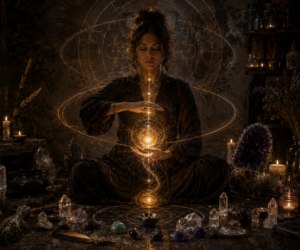
The image depicted here is an AI-generated representation of Marie Laveau. Very few verified photographs of her exist, in fact, none that we can confirm. Several 19th-century paintings of unidentified Creole women wearing tignons have been labeled as portraits of Laveau, but by the 1940s, any portrait of an unidentified woman of color in a head wrap was simply assumed to be her. The real Marie Laveau was never photographed, and likely never sat for a formal portrait. I also wrestled with how to categorize this post and ultimately placed it under “mythology.” Mythology doesn’t mean “untrue”, it refers to a body of stories and narratives that shape our understanding of a subject. What we genuinely know about Marie Laveau is limited to what appears in official records: birth certificates, marriage documents, census records, newspaper accounts. The rest – her magical abilities, her network of power, her spiritual practices – exists as story, speculation, oral history, and legend. Marie has become mythological in the truest sense: a figure whose reality is woven inextricably with mystery. She is called the Voodoo Queen of New Orleans. Her tomb is one of the most visited graves in America. People still mark three X’s on cemetery walls, begging for her intercession from beyond the grave. Songs have been written about her. She appears in novels, TV shows, horror films, and tourist ghost tours. She is worshiped and feared, romanticized and demonized, studied and sensationalized. But who was Marie Laveau, really? The answer is far more complicated, and far more interesting, than the legend suggests. The Documented Facts ~ What We Actually Know Let’s begin with what can be verified through official records – the paper trail that survives two centuries of storytelling. Born: September 10, 1801, in the French Quarter of New Orleans, Louisiana. At the time of her birth, Louisiana was still under Spanish colonial administration, though France had recently reclaimed it by treaty. Parents: Her mother was Marguerite D’Arcantel (sometimes spelled Darcantel), a free woman of color of African, European, and Native American ancestry. Her father’s identity is less certain – likely either Charles Laveau (a white Creole) or Charles Laveaux (a free man of color). The confusion stems from inconsistent spelling in surviving records and the fact that Marguerite was unmarried at the time of Marie’s birth. Family Background: Marie was the first of her maternal line to be born free. Her great-grandmother Marguerite was enslaved, likely transported from Senegal to Louisiana aboard the last French slave-trading vessel, the St. Ursin, in 1743. Her grandmother Catherine endured three owners before finally purchasing her freedom in 1795, taking the name Catherine Henry. Catherine’s daughter, Marguerite Henry (Marie’s mother), was manumitted in 1790 by Henry Roche-Belaire. First Marriage: On August 4, 1819, at age 18, Marie married Jacques Paris, a free man of color from Saint-Domingue (Haiti), who had emigrated to New Orleans following the Haitian Revolution. Their marriage certificate, preserved in St. Louis Cathedral, includes the names of both her parents. The marriage was officiated by Père Antoine (Antonio de Sedella), the beloved Spanish Capuchin friar who would remain connected to Marie throughout her life. Children with Jacques Paris: Two daughters, Félicité (born 1817, before the marriage) and Angèle (born 1822). Both are presumed to have died in childhood, as they disappear from historical records. Jacques Paris Disappears: Between 1822 and 1824, Jacques Paris vanishes from city records. He is believed to have died in Baton Rouge in 1823, though there’s no death certificate. On Félicité’s 1824 baptismal certificate, Marie is referred to as “the Widow Paris” – a designation she would… …

Membership Required

You must be a member to access this content.

View Membership Levels

Already a member? Log in here

The Best Categories to Lay Out Your Book of Shadows

Your Book of Shadows is a deeply personal grimoire, but having a clear structure helps you find what you need when you need it. Here are some essential categories to consider: Core Sections Dedications & Beliefs Start with your personal dedication, spiritual philosophy, and the ethical guidelines you follow in your practice. This grounds your entire book in intention. Sabbats & Esbats* Document the Wheel of the Year sabbats and moon phases, including rituals, correspondences, recipes, and personal observations for each celebration. Spellwork Your collection of spells organized by purpose (protection, love, prosperity, healing, banishing). Include ingredients, timing, results, and notes on what worked. Divination Tarot spreads, rune meanings, pendulum techniques, scrying methods, and records of your readings and their accuracy. Correspondences Quick reference charts for herbs, crystals, colors, planetary hours, elemental associations, and deity attributes. Rituals & Ceremonies Circle casting methods, invocations, quarter calls, and ceremonial formats for different occasions. Deities & Spirits Information about gods, goddesses, ancestors, and spirit guides you work with, including offerings and experiences. Herbalism & Kitchen Witchery Magical recipes, herbal remedies, tea blends, and the properties of plants you use. Personal Reflections Dream journals, meditation experiences, magical successes and failures, and lessons learned. Remember Your Book of Shadows evolves with you. Start with what resonates, and let it grow organically. There’s no wrong way to organize your practice – only what serves you best. Blessed be! ✨ Book of Shadows Blessing By moon and star, by earth and flame, I consecrate this book by name. A sacred space for wisdom’s art, Where magic flows from mind and heart. Guard these pages, keep them true, Protect the old and welcome new. May ink and intention here combine, And every word hold power divine. As I will it, so shall it be, This book is blessed, so mote it be. **Esbats are celebrations or rituals held in honor of the full moon (and sometimes the new moon) in Wiccan and pagan practices. While Sabbats mark the eight seasonal festivals of the Wheel of the Year (like Samhain, Beltane, and the solstices), Esbats are the monthly lunar celebrations. Since there are typically 13 full moons in a year, practitioners observe about 13 Esbats annually. What happens during an Esbat ~ Moon magic and spellwork (the full moon is considered a powerful time for manifestation)~ Divination and scrying~ Charging crystals, tools, and moon water~ Honoring lunar deities (like Diana, Selene, or Hecate)~ Personal reflection and spiritual work~ Coven gatherings for ritual Full Moon vs. New Moon Esbats ~ Full Moon – Peak magical power, manifestation, gratitude, celebration ~ New Moon – New beginnings, setting intentions, shadow work, rest The word “Esbat” likely comes from Old French s’esbattre, meaning “to frolic or enjoy oneself,” reflecting the celebratory nature of these lunar gatherings. Many solitary practitioners and covens consider Esbats just as important as Sabbats, using them as regular touchpoints for their magical practice throughout the year…. Membership Required You must be a member to access this content.View Membership LevelsAlready a member? Log in here...

Membership Required

You must be a member to access this content.

View Membership Levels

Already a member? Log in here

Where Spirit Meets Reality ~ Understanding Spirituality and Metaphysics

The Dance Between the Seen and Unseen We live in a world that exists on multiple levels simultaneously. There’s the physical reality we navigate each day, the coffee cup in your hand, the ground beneath your feet, the people you encounter. And then there’s something else, something harder to define but just as real: the energy of a room when you walk in, the inexplicable knowing that precedes a phone call, the sense that consciousness extends beyond the boundaries of our skin. This is where spirituality and metaphysics meet, in that liminal space where the material and immaterial dance together, where ancient wisdom and personal experience converge to reveal deeper truths about existence. What Is Metaphysics? Metaphysics, at its heart, is the study of what lies beyond the physical. The word itself comes from the Greek “meta” (beyond) and “physika” (physical things). It asks the fundamental questions that have haunted and inspired humanity since we first looked up at the stars: What is the nature of reality? Does consciousness create reality or merely observe it? What is time, truly? Do we have souls, and if so, what are they made of? Is there a purpose to existence, or do we create purpose through living? These aren’t idle philosophical musings. These questions shape how we understand ourselves, how we move through the world, and what we believe is possible. The Bridge Between Philosophy and Practice While Western academic philosophy often treats metaphysics as purely theoretical, spiritual metaphysics understands these questions as lived experience. It’s one thing to debate whether consciousness survives death in a classroom; it’s quite another to feel the presence of a deceased loved one or remember what feels like a past life. Spiritual practitioners engage with metaphysical questions not just intellectually but experientially. Through meditation, ritual, energy work, and altered states of consciousness, we explore these realities directly. What Is Spirituality? Spirituality is the practice of connecting with something larger than our individual selves. That “something” takes different forms for different people, God, Goddess, the Universe, Source, Spirit, the Divine, Nature, or simply the interconnected web of all existence. Unlike religion, which provides specific doctrines and structures, spirituality is deeply personal. It’s the individual’s direct relationship with the sacred, however they understand it. The Many Faces of Spiritual Practice Spirituality manifests in countless ways: Nature-based spirituality finds the divine in the cycles of seasons, the wisdom of plants and animals, the power of earth, air, fire, and water. Practitioners might work with herbs, stones, and natural cycles to deepen their connection to the living world. Energy work and healing operates on the premise that consciousness and energy are fundamental to reality. Practices like Reiki, chakra balancing, or qi gong work with subtle energies that Western science is only beginning to acknowledge and measure. Mystical traditions across cultures, from Sufism to Kabbalah to Buddhist meditation, seek direct experience of the divine through contemplation, ecstatic practice, or disciplined inner work. Eclectic and syncretic paths draw from multiple traditions, creating personalized spiritual practices that honor diverse wisdom while remaining authentic to individual experience and cultural respect. Secular spirituality finds transcendence in connection, awe, creativity, and meaning without necessarily invoking supernatural elements. The sense of being part of something vast when viewing the night sky or feeling moved by music can be profoundly spiritual experiences. Core Metaphysical Concepts in Spiritual Practice Certain metaphysical ideas appear across spiritual traditions, though they may be described in different language. Understanding these concepts can deepen your spiritual practice and help you navigate metaphysical experiences. Consciousness as Fundamental Many spiritual traditions hold that consciousness isn’t produced by… …

Membership Required

You must be a member to access this content.

View Membership Levels

Already a member? Log in here

Friday the 13th ~ Reclaiming the Magic of a Misunderstood Day

For centuries, Friday the 13th has been shrouded in superstition and fear. But what if I told you that this date holds powerful transformative energy that witches and spiritual seekers can harness for deep inner work and manifestation? The Origins of Friday the 13th The fear of Friday the 13th, known as paraskevidekatriaphobia, is a relatively modern phenomenon. Historically, both Fridays and the number 13 held sacred significance: Friday was named after the Norse goddess Freya (or Frigg), the goddess of love, beauty, fertility, and magic. In many pagan traditions, Friday was considered an auspicious day for spellwork, particularly love magic. The number 13 has long been associated with the divine feminine. There are 13 lunar cycles in a year, connecting this number to moon magic and the goddess. Many ancient cultures revered 13 as a number of completion and transformation. The negative associations likely arose during the patriarchal shift in medieval Europe, when the Church sought to demonize pagan practices and feminine power. What was once sacred became “sinister.” Reclaiming Friday the 13th Energy Rather than fearing this day, we can embrace it as a portal for: ~ Shadow work and self-reflection ~ This is an ideal time to explore the hidden aspects of yourself~ Breaking through limiting beliefs ~ Challenge the fears and superstitions that hold you back~ Transformation and release ~ Use this potent energy to shed what no longer serves you~ Divine feminine connection ~ Honor the goddess within and tap into intuitive wisdom~ Protection magic ~ Turn the tables on fear-based energy by strengthening your spiritual boundaries 🪄 Rituals for Friday the 13th Mirror Scrying: Gaze into a black mirror or darkened water to receive messages from your subconscious or spirit guides. Banishing Ritual Write down fears, bad habits, or toxic patterns on biodegradable paper and burn them safely, releasing their hold on you. Goddess Meditation Connect with Freya, Hecate, or another deity associated with transformation and feminine power. Protection Sachet Create a small bag filled with protective herbs like rosemary, bay leaf, and black salt. Carry it with you or place it in your home. Tarot Reading Pull cards specifically asking about what needs to be released and what transformative energy is available to you now. ✍️ Journal Prompts Grab your grimoire or journal and explore these shadow-work prompts: On Fear and Superstition ~ What superstitions or irrational fears do I still carry? Where did they come from?~ How has fear held me back from pursuing my desires or expressing my authentic self?~ What would change in my life if I released these fears completely? On Transformation ~ What part of my old self is ready to die so something new can be born?~ What patterns or beliefs have I outgrown but am still clinging to out of habit?~ If I could transform one aspect of my life with magic, what would it be and why? On Shadow Work ~ What parts of myself do I hide from others? What am I afraid they’ll see?~ What emotions do I tend to suppress or avoid? What might they be trying to tell me?~ How do I sabotage my own success or happiness? What protective purpose did this behavior once serve? On Feminine Power ~ How do I embody the divine feminine in my life? Where could I embrace it more fully?~ What aspects of my power or intuition have I been taught to doubt or diminish?~ How can I honor my cyclical nature (like the moon) rather than forcing linear productivity? On Luck and Manifestation ~ Do I truly believe I’m worthy of receiving good… …

Membership Required

You must be a member to access this content.

View Membership Levels

Already a member? Log in here

Water Carries Your Intentions ~ The Magic of Fluid Memory

Pour a glass of water. Hold it in your hands. What you’re holding is not simply H₂O molecules arranged in liquid form. You’re holding memory, adaptability, receptivity, and potential. Water is the universe’s most perfect carrier. It flows into every space, takes every shape, touches everything, and remembers what it encounters. When you understand that water carries intention, you unlock one of magic’s most fundamental and powerful tools. Water is not passive. It doesn’t merely exist. It responds, adapts, receives, and transmits. Scientists are beginning to discover what magical practitioners have always known water has memory. It holds information. It changes its structure based on what it encounters. Words spoken to it, emotions directed at it, energies it absorbs. Water is consciousness made liquid, intention given form that can flow anywhere, reach anything, penetrate everything. This is why water appears in virtually every magical tradition. Holy water. Wishing wells. Water offerings. Ritual baths. Potion-making. Scrying bowls. Across every culture and time, humans have recognized water as the element that can carry prayers to gods, intentions to manifestation, healing to the sick, and blessings to the people. Water doesn’t just symbolize emotions and intuition, it literally carries intention from your mind into material reality. The Science of Water’s Memory Modern science is catching up with ancient wisdom. Dr. Masaru Emoto’s controversial but influential research photographed water crystals after exposure to different words, music, and emotions. Water exposed to loving words formed beautiful, symmetrical crystals. Water exposed to hateful words formed chaotic, broken patterns. Whether or not you accept his exact methodology, the principle aligns with what magical practitioners have experienced for millennia water responds to intention. Other researchers have found that water’s molecular structure changes based on electromagnetic fields, sound vibrations, and even consciousness directed toward it. Water molecules form clusters and networks that can hold information patterns. These structures are temporary but reformable. Water can “remember” and “forget” and “remember again.” Homeopathy, whatever its efficacy debates, is built entirely on the premise that water retains information from substances it has contacted, even when those substances are no longer physically present. The mechanism matters less than the principle water holds imprints. On a quantum level, water exhibits properties that defy classical physics. Its anomalous behavior, expanding when frozen, having an unusually high specific heat, its role in quantum tunneling in biological systems, suggests water is far stranger and more complex than we typically acknowledge. Water bridges the quantum and classical worlds, making it the perfect medium for carrying intention from thought into manifestation. Water’s Nature as Universal Carrier Understanding why water carries intention so effectively requires understanding water’s essential properties Water is Universal Solvent Water dissolves more substances than any other liquid. Chemically, this means water molecules pull apart other molecules and hold them in solution. Magically, this translates to water’s ability to accept, hold, and carry anything you put into it – herbs, oils, salt, crystals, spoken words, visualized energy, emotional states, clear intentions. Water is Adaptable Water takes the shape of whatever contains it. Pour it into a cup, it becomes cup-shaped. Pour it into a bottle, it becomes bottle-shaped. This adaptability means water can conform to any intention you pour into it. It doesn’t resist; it receives and shapes itself to what you give it. Water Flows Unlike solid earth or airy smoke, water moves while maintaining coherence. It flows from one place to another, carrying what it holds. This makes it ideal for delivering intentions. To yourself through drinking, to your home through sprinkling, to the universe through pouring into moving water, to others through gifting or… …

Membership Required

You must be a member to access this content.

View Membership Levels

Already a member? Log in here

Beyond Binary Magic ~ Advanced Practices in Queer Witchcraft

Deepening Your Identity-Affirming Practice While the foundations of queer magic honor authenticity and transformation, there’s a rich landscape of advanced techniques and philosophical approaches that many practitioners explore as their practice deepens. This guide delves into specific magical methodologies that center LGBTQ+ experiences and challenges traditional magical frameworks. Deconstructing Gender in Energy Work Traditional magical systems often assign gender to energy itself – active/passive, sun/moon, god/goddess. Many queer practitioners are reimagining these correspondences entirely. Reframing Polarity Rather than viewing magical polarities through a gender lens, consider: Expansion and Contraction: Energy that reaches outward versus energy that draws inward, with both movements equally powerful and necessary. Creation and Dissolution: The forces that build and those that break down, both essential to transformation and neither inherently gendered. Stillness and Movement: Recognizing that rest and action are complementary forces that exist independent of gender associations. This reframing allows practitioners to work with complementary energies without reinforcing binary thinking or feeling excluded from certain types of magic based on their gender identity. Personal Energy Signatures Instead of conforming to prescribed energetic templates, many practitioners develop a deep understanding of their unique energetic signature. This involves: Spending time in meditation observing how your personal energy moves and feels without judgment or comparison. Some practitioners describe their energy as swirling, others as flowing, pulsing, or radiating. There’s no correct pattern. Experimenting with different magical techniques and noting which ones resonate most strongly with your natural energy flow. You may find that your approach to raising power or grounding energy differs significantly from traditional methods, and that’s valuable information. Creating personalized correspondences that reflect your authentic experience rather than inherited associations. If green feels masculine to you or fire feels gentle, honor that truth in your practice. Pronoun Magic and Name Work Names and pronouns carry tremendous magical power, particularly for trans and nonbinary practitioners. This goes far beyond simple affirmation into deep transformative magic. The Power of Chosen Names A chosen name is already a magical act, it’s an intentional claiming of identity and self-definition. Many practitioners work with their names magically: Name consecration rituals formally introduce your chosen name to the spiritual realm. This might involve writing your name in ritual space, speaking it aloud with intention, or creating a sigil from its letters. Deadname release ceremonies help sever energetic ties to a name that no longer serves you. These should be approached with care, acknowledging any grief that arises while firmly releasing what no longer fits. Some practitioners write their former name on dissolvable paper and release it in moving water, or burn it in ritual fire. Multiple magical names for different aspects of self or different contexts. You might have a name for your public practice, another for private work, and another for your most intimate spiritual experiences. This multiplicity honors the complexity of identity. Pronoun Sigils and Protection Creating sigils from your pronouns can serve as both affirmation and protection: Design a personal sigil incorporating your pronouns that you can draw on your body, wear as jewelry, or place on your altar. Charge this sigil with the intention of being seen, respected, and safe. Craft protection spells specifically around correct pronoun use in challenging environments. These might include glamours that encourage others to perceive and address you correctly, or shielding that deflects misgendering. Use pronoun affirmations as mantras during meditation or energy work, allowing the vibration of correct language to settle into your energetic body. Dysphoria and Euphoria as Magical Tools Gender dysphoria and euphoria represent powerful emotional and energetic states that can be worked with magically. Transmuting Dysphoria Rather than simply… …

Membership Required

You must be a member to access this content.

View Membership Levels

Already a member? Log in here

Reading the Signs ~ A Guide to Omens in Everyday Life

The universe is always speaking. Sometimes it whispers through dreams, sometimes it shouts through synchronicities, and often it communicates through the small, seemingly mundane moments we might otherwise overlook. An omen is simply a sign. A message encoded in the ordinary world, waiting for those with eyes to see and minds open enough to interpret. Our ancestors lived immersed in omen-reading. They watched how bread rose in the oven, observed which direction birds flew, noted when mirrors cracked or candles flickered. These weren’t superstitions but rather a sophisticated system of paying attention. Of recognizing that the material world reflects spiritual patterns, and that meaning hides in plain sight. What Makes Something an Omen? Not every occurrence is an omen. A bird flying past your window is just a bird. But a bird flying directly at your window three times while you’re contemplating a major decision? That’s worth noting. An omen carries weight, unusualness, or timing that makes it stand out from the background noise of daily life. True omens often have these qualities: Timing: They occur at significant moments. During important decisions, life transitions, or when you’re actively seeking guidance. Repetition: The same symbol, animal, or occurrence appears multiple times in a short period. Unusual circumstances: Something happens that’s out of the ordinary – the bizarre timing, the strange behavior, the unexpected appearance. Emotional impact: You feel something when it happens, a chill, a knowing, an intuitive ping that says “pay attention.” Personal resonance: The omen means something specific to you based on your life, culture, or intuitive understanding. The key to reading omens is developing a relationship with signs over time. Your interpretation matters more than any book’s definitive meaning. The universe speaks your language. The symbols that appear to you carry messages calibrated to your understanding. Omens in Food and Cooking The kitchen has long been considered a magical space, and the behavior of food, how it cooks, how it breaks, how it appears, carries messages. Bread Splitting Down the Middle When bread splits unexpectedly down the center while baking or cooling, traditional interpretation suggests division, separation, or a parting of ways. This might indicate a coming split in a relationship, a choice between two paths, or the need to separate something that’s been joined. The clean center split specifically suggests this division is natural or necessary rather than forced or harmful. However, context matters. If you’re baking bread while contemplating divorce, this omen reinforces what you already sense. If you’re happily partnered with no conflict, it might indicate a necessary division of responsibilities or a fork in the road requiring you both to choose a direction. Eggs with Double Yolks Finding double yolks is traditionally a sign of good fortune, unexpected abundance, or duality. Some interpret it as an omen of twins or partnership. Others see it as getting more than you expected, a windfall, a bonus, double blessings. Eggs that Won’t Crack Cleanly When an eggshell shatters into tiny pieces instead of cracking cleanly, or when shell bits keep falling into your bowl, this suggests complications ahead. Things won’t be as simple as expected. You might need more effort to achieve your goal, or there will be small annoyances that accumulate. Salt Spilling Spilled salt is one of the oldest omens, traditionally considered bad luck. The antidote, throwing a pinch over your left shoulder, supposedly blinds the devil or bad spirits waiting there. More broadly, spilled salt suggests carelessness leading to consequences, waste of precious resources, or tears to come (salt being associated with tears). Bubbles in Coffee or Tea Bubbles forming on the surface of… …

Membership Required

You must be a member to access this content.

View Membership Levels

Already a member? Log in here

Uncle Monday ~ The Shapeshifting Legend of Hoodoo

In the humid swamps of Florida, where Spanish moss drapes like curtains and alligators glide silently through dark waters, there lives a legend that refuses to die. His name is Uncle Monday, and his story weaves together African spiritual traditions, resistance to enslavement, Native American alliances, and the mysterious practice of shapeshifting. He is one of Hoodoo’s most compelling and enigmatic figures. A medicine man, a trickster, a protector, and quite possibly, an immortal alligator still swimming through Florida’s murky lakes. The Story Preserved by Zora Neale Hurston We know Uncle Monday’s tale primarily through the work of Zora Neale Hurston, the celebrated author, anthropologist, and initiated Voodoo priestess who collected folklore throughout the American South during the 1930s. Hurston gathered Uncle Monday’s story in her home state of Florida and included it in her writings, preserving this remarkable piece of African American folk tradition for future generations. In describing Uncle Monday, Hurston noted there was something about him that transcended ordinary Hoodoo practice – a deeper, more primal magic that connected him to forces beyond the typical conjure work of the time. From African Shaman to Escaped Captive According to the legends Hurston collected, Uncle Monday was born in Africa, where he was an accomplished shaman and medicine man. Some versions of the tale suggest he may have been a priest, sorcerer, or even a king. His specialty was crocodile medicine. A powerful form of magic deeply rooted in West African spiritual traditions. Captured during the slave trade, Uncle Monday was brought to the Carolinas (accounts vary between South Carolina and Georgia) to be sold into bondage. But Uncle Monday was not a man who would submit to enslavement. Using his considerable spiritual power, he escaped his captors and fled south, eventually arriving in Florida’s wild Seminole territory. Alliance with the Seminole People In Florida, Uncle Monday found refuge among the Seminole Indians, a tribe that actively resisted white colonization and welcomed escaped African slaves into their communities. This alliance between African Americans and Native Americans was not uncommon in Florida, where many Black Seminoles lived and fought alongside their Indigenous allies. The Seminoles recognized Uncle Monday’s gifts, and there was a natural compatibility between his African crocodile medicine and their own sacred relationship with alligators. Uncle Monday helped the Seminole people with herbal magic and medicines, and according to some accounts, he even helped lead resistance efforts against those who sought to conquer them. The Great Transformation As conflicts intensified during the Seminole Wars, Uncle Monday faced a crucial decision. The spirits told him that resistance against the white forces would ultimately prove futile, but Uncle Monday refused to accept either slavery or death at the hands of his enemies. Instead, he made a vow that would become the centerpiece of his legend. He would transform himself into an alligator and wait in the waters until better times arrived, when he could emerge in peace. The Seminoles prepared for a great ceremonial ritual. As drums thundered through the swamp, Uncle Monday began to dance. Witnesses watched in awe as his transformation unfolded before their eyes. His legs grew shorter and his face elongated into a reptilian snout. His skin became thick and scaly, darkening to the deep green-black of an alligator’s hide. His voice deepened into a powerful bellow that made the waters tremble. Uncle Monday became the largest alligator anyone had ever seen. He walked between two rows of alligators that had gathered to witness the transformation, then slid into the water with a thunderous roar. All the other alligators followed him into the depths, bellowing in… …

Membership Required

You must be a member to access this content.

View Membership Levels

Already a member? Log in here

Symbols to Wear for Protection ~ Ancient Wisdom for Modern Times

Throughout human history, people have turned to symbols and amulets for protection, comfort, and spiritual guidance. These powerful emblems, worn as jewelry or carried as talismans, serve as personal guardians that connect us to ancient wisdom and cultural traditions. Whether you’re drawn to their historical significance, spiritual meaning, or simply their aesthetic appeal, protective symbols offer a sense of security and connection to something greater than ourselves. Understanding Amulets vs. Talismans Before exploring specific symbols, it’s important to understand the distinction between amulets and talismans. Amulets refer to any object which has the power to avert evil influences or ill luck, while a talisman provides good fortune. A concept that brings us great peace, a bubble of protection. In contrast, a talisman is believed to give the wearer more power. Many symbols can function as both, depending on the wearer’s intention and cultural context. The Evil Eye: Ancient Protection Against Envy Origin and Meaning The “evil eye” is a belief found in many cultures that someone can cause you harm, like bad luck, illness, or other misfortune, just by looking at you with jealousy or ill will. This concept is said to have originated in ancient Mesopotamia some 5000 years ago, where it was used as a way to ward off evil spirits. How It Works The evil eye symbol, typically depicted as a blue eye, acts as a protective shield. The belief is that when someone with malicious intent looks at the wearer, the evil eye symbol will deflect that negative energy back to its source, protecting the wearer from harm. Modern Use Evil eye jewelry has gained tremendous popularity in recent years, with celebrities and everyday people alike wearing these protective talismans. The symbol is commonly found on necklaces, bracelets, rings, and earrings, often crafted in blue and white enamel or featuring blue gemstones like turquoise or lapis lazuli. The Hamsa Hand: Universal Symbol of Protection Cultural Significance Fatima’s hand – a palm-shaped amulet popular throughout North Africa and in the Middle East and commonly used in jewelry and wall hangings. Also known as the Hand of Fatima in Islamic tradition or the Hand of Miriam in Jewish culture, this symbol transcends religious boundaries. Protective Properties This hamsa symbol deflects harmful intentions and symbolizes protection, blessings, power, and spiritual strength. The hand acts as a stop sign to all negative energies. Often the evil eye symbol is located in the palm of the hamsa for double protection. Wearing the Hamsa The hamsa can be worn facing up or down, each orientation carrying different meanings. Facing up, it’s said to provide protection against negative energies, while facing down, it’s believed to bring blessings and good fortune. The Ankh: Egyptian Key of Life Ancient Egyptian Origins The Ankh is an ancient Egyptian symbol that represents life and immortality. It resembles a cross with a loop at the top and is often depicted in the hands of gods and goddesses. The Ankh represented eternal life. It signified wisdom and insight on the highest level and it was also a fertility symbol. Spiritual Meaning From the spiritual point of view the ankh represented the key to all hidden knowledge. The loop symbolized the eternal soul. The Ankh is believed to bring protection, fertility, and good fortune to its wearer. Contemporary Appeal Today, the ankh remains a popular symbol in jewelry, representing not only protection but also a connection to ancient wisdom and the eternal nature of the soul. It’s particularly meaningful for those drawn to Egyptian spirituality or seeking symbols of life and regeneration. The Cross: Universal Symbol of Faith and Protection… …

Membership Required

You must be a member to access this content.

View Membership Levels

Already a member? Log in here

Beech ~ The Tree of Wisdom and Ancient Knowledge

Stand beneath a beech tree and you’ll understand immediately why our ancestors revered it. The smooth, silvery bark seems to glow with its own light, even on cloudy days. The canopy spreads wide and generous, creating cathedral-like spaces beneath its branches. In autumn, copper leaves drift down like pages from ancient books. The beech has been called the tree of wisdom, the keeper of knowledge, the library of the forest. And for good reason. The Nature and Spirit of Beech The beech tree (Fagus) carries an energy distinct from other trees. Where oak is strength and willow is emotion, beech is intellect, memory, and the preservation of knowledge. This isn’t abstract. It’s rooted in the tree’s very nature and its relationship with humanity across millennia. Beech bark is uniquely smooth and pale, making it ideal for carving. For thousands of years, humans have carved messages, symbols, and records into beech bark and wood. The word “book” itself may derive from the Old English “bōc,” which also meant beech tree. Some scholars believe this connection arose because early Germanic peoples carved runes onto beech tablets. The tree literally became synonymous with the written word, with recorded knowledge, with learning preserved across time. Beech forests create a special environment. Their dense canopy allows little undergrowth, resulting in clean, open spaces beneath, natural halls perfect for study, contemplation, and teaching. The beech mast (nuts) that fall in autumn provided sustenance for both people and animals, linking the tree to abundance and provision as well as wisdom. Energetically, beech is cool, calm, and clarifying. It doesn’t have the fiery passion of rowan or the deep emotion of willow. Instead, beech offers mental clarity, enhanced memory, access to stored knowledge, and the patience required for true learning. It teaches that wisdom accumulates slowly, like rings in wood, and that knowledge preserved serves future generations. Beech in Mythology and Tradition Throughout European tradition, beech has been associated with learning, writing, and the preservation of knowledge. In Celtic tree lore, beech represents old knowledge, not the hidden mysteries of yew or the intuitive wisdom of willow, but accumulated learning, the kind found in libraries and passed through teaching. It’s the tree of scholars, scribes, and historians. The ogham symbol for beech is Phagos, though beech’s association with ogham is somewhat contested by scholars. Regardless of its technical placement in the ogham alphabet, folk tradition has long linked beech with written knowledge and the recording of information. Germanic peoples held beech sacred, using its wood for rune staves and magical inscriptions. The smooth bark and fine-grained wood made it ideal for carving symbols meant to last. When you wanted knowledge preserved, you carved it into beech. In later European tradition, beech groves were seen as natural schools. Places where children could be taught letters and numbers, where scholars could contemplate, where knowledge could be shared in the tree’s peaceful presence. Properties and Correspondences Element: Air (though some traditions assign it to Earth)Planet: Saturn or Mercury, depending on traditionGender: FeminineDeities: Odin (for runes and knowledge), Ogma (Celtic god of eloquence and writing), any deity associated with wisdom and learningMagical Properties: Wisdom, learning, memory enhancement, knowledge retention, literary pursuits, past-life recall, ancestor wisdom, patience, manifestation of wishes written on beech woodSeason: Late summer into autumnChakra: Third eye, for enhanced mental clarity and access to inner wisdom Harvesting Beech Respectfully When working with beech, approach with the respect you’d show a teacher or librarian. This tree guards knowledge, and accessing its gifts requires courtesy. Identification American beech (Fagus grandifolia) and European beech (Fagus sylvatica) are the primary species used in magical… …

Membership Required

You must be a member to access this content.

View Membership Levels

Already a member? Log in here