 Written by
 You have already done candle magic.
Every birthday cake you ever stood before, eyes closed, holding a wish in your chest before you blew out the candles – that was candle magic. The flame, the intention, the breath that carries the wish outward into the world. The structure is identical. The only difference between that and what we are going to discuss in this post is the degree of consciousness you bring to it.
Candle magic is the most accessible form of working magic that exists. It requires no special lineage, no expensive tools, no years of training before you are permitted to begin. It asks for a flame, an intention, and your full attention. Most people already own everything they need.
This will help you understand what transforms a lit candle from a simple mood-setter into a conscious act of intention. So that you know what you are doing and why, and what you do carries real weight.
What Candle Magic Actually Is
Candle magic is a form of sympathetic and elemental magic. It works on two levels simultaneously.
On the elemental level, it calls on fire: the oldest of the transformative forces, the element that takes one thing and turns it into another. Fire does not merely move matter from place to place, the way water or wind does. It transforms it, changes its fundamental state. The ash that remains when a candle has burned is not what the candle was. Fire is the element of change, of becoming, of the irreversible transformation from one state into another.
On the sympathetic level, candle magic works through the principle that like affects like. That by representing something symbolically (through color, through written intention, through carved words or symbols) and then directing energy toward it through the act of burning, you affect the actual thing. The candle becomes a stand-in for your intention, and what happens to the candle mirrors and amplifies what you are working toward in your life.
These two levels together make candle magic particularly potent. The fire transforms the physical representation of your intention into energy and smoke, releasing it into the world. Into whatever forces you work with, into the wider field of possibility, into the channels through which manifestation moves.
And practically speaking: the focused attention required to sit with a burning candle and hold an intention in mind is itself a form of concentration practice that aligns your whole system – mind, body, emotion – with what you are calling in. This alignment is, in many traditions, the actual mechanism of magic.
The Basics: What You Need
One of the most liberating things about candle magic is that it genuinely does not require much.
The Candle
Any candle can be used for candle magic. Taper candles are traditional in many folk magic systems because they burn completely in a single working and leave nothing behind . The candle is consumed by the working. Pillar candles can be burned in sections over multiple sessions, which suits longer-term intentions. Tea lights and votive candles are practical and accessible. Chime candles, small, slender candles about four inches long, are popular in contemporary practice because they burn relatively quickly and completely and come in a wide range of colors.
The size of the candle is less important than the intention you bring to it. A single tea light held with full attention is more potent than an elaborate candle array approached distractedly.
A note on beeswax: In the magical tradition, beeswax candles are considered particularly potent because beeswax is itself a substance associated with abundance, sweetness, and the organized, purposeful energy of the hive. If you are doing abundance work specifically, beeswax candles are worth seeking out. For general use, any candle will serve.
A note on paraffin vs. natural wax: From a purely practical standpoint, soy and beeswax candles burn more cleanly and produce less soot. From a magical standpoint, a candle made with intention from natural materials carries a slightly different energy than a heavily processed one. Though this is a refinement rather than a requirement, especially when you are beginning.
Color
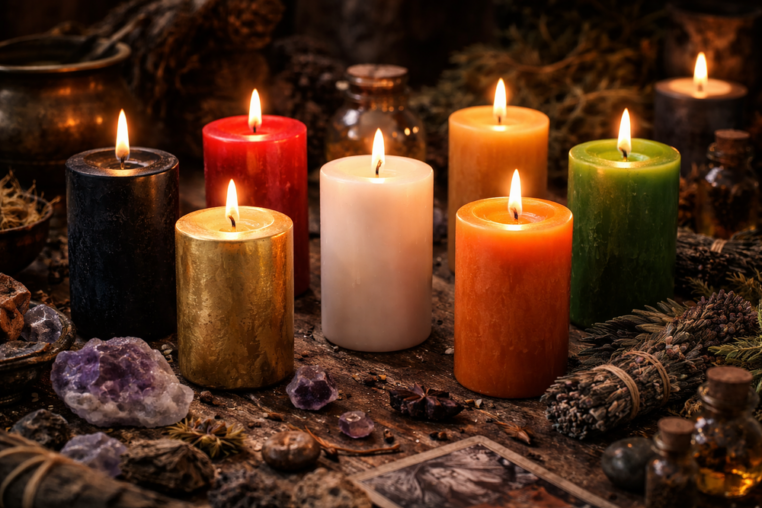
Color is the primary language of candle magic. Each color carries a set of traditional associations, accumulated over centuries of practice across multiple folk magic systems, that align it with particular kinds of working. Learning color correspondences is one of the first and most useful things you can do as a candle magic practitioner.
White is the universal candle. In the absence of any other color, white can stand in for all purposes. It is associated with purity, clarity, truth, protection, new beginnings, and the full spectrum of possibility. When in doubt, use white.
Green is the color of abundance, prosperity, growth, and fertility. It is the primary color for money workings, for calling in financial ease, for work related to career and material wellbeing, and for anything associated with growth and increase.
Gold carries solar energy, warmth, confidence, success, optimism, and the kind of abundance that comes from being fully seen and valued. Where green calls in the money, gold calls in the recognition and success that tends to bring money with it.
Yellow is associated with the mind, communication, clarity, creativity, and learning. Use yellow for workings related to study, writing, decision-making, or any situation where you need to think clearly.
Orange carries the energy of enthusiasm, momentum, attraction, and opportunity. It is a good color for workings where things have stalled and you need movement, or for calling in social connection and the kinds of luck that come through people and serendipity.
Red is the color of passion, vitality, courage, and life force. Use red for workings related to energy, physical strength, passion in relationships, sexual connection, and the kind of bold action that requires courage.
Pink is associated with love, tenderness, self-love, friendship, gentle healing, and emotional wellbeing. Where red is the passion of new desire, pink is the warmth of sustained affection. Pink is also the primary color for self-love workings. An area that is both deeply magical and deeply practical.
Blue is the color of calm, peace, communication, healing, and truth-speaking. Light blue for peace and calming; darker blue for deeper healing, truth, and the kind of communication that comes from wisdom rather than reactivity. Excellent for use before difficult conversations or when working through emotional pain.
Purple carries the energy of spiritual development, psychic awareness, intuition, wisdom, and connection to higher guidance. Use purple for meditation, for divination work, for deepening your spiritual practice, and for workings that involve the unseen and the symbolic.
Black is one of the most misunderstood colors in candle magic. It is not the color of evil or dark magic. It is the color of protection, banishing, reversal, and absorption. A black candle absorbs and neutralizes negative energy, banishes what you do not want, and marks definitive endings. It is also used in shadow work . In the deliberate engagement with the parts of yourself that you have pushed into the dark.
Brown is the color of stability, grounding, home, practical matters, and the earth itself. Use brown for workings related to home and property, for stabilizing a situation that feels unstable, and for connecting with animal allies and the natural world.
Silver carries lunar energy. Intuition, the unconscious, dream work, cyclical change, and feminine energy in its flowing, receptive aspect.
Other Supplies
Something to carve with: A pin, a nail, a toothpick, or a dedicated carving tool. You will use this to inscribe your intention, your name, runes, or symbols into the wax.
An anointing oil: Olive oil is the universal base. It has been used for anointing sacred objects for thousands of years across Mediterranean traditions. Into this you can add a small amount of an essential oil aligned with your intention: cinnamon for abundance and speed, lavender for peace and healing, rosemary for protection and clarity, rose for love, frankincense for spiritual connection. You can also use commercially prepared magical oils if you prefer.
A fireproof holder: Your candle must stand in or on something that will not catch fire. A proper candle holder, a small ceramic dish, a plate of sand or salt, any of these work. Never leave a burning candle unattended, and never place a candle where it could ignite something nearby.
A match or lighter: Traditionally, matches are preferred in many folk magic systems. The act of striking a match is itself a small act of fire-calling. But a lighter works perfectly well.
Something to write with: A pen and paper for your written intention.
The Technique: How to Do It
Step One: Cleanse and Clear
Before any magical working, cleanse the space. This does not need to be elaborate. A moment of deliberate breathing to clear your own mind, a brief pass of rosemary smoke or sound, or simply the act of tidying the surface where you will work. All of these shift the energetic quality of the space from ambient and diffuse to focused and intentional.
Cleanse the candle itself by passing it briefly through smoke, or by holding it in your hands and breathing your cleansing intention across it. You are clearing any energy the candle has accumulated before it came to you, and making it a clean vessel for your working.
Step Two: Clarify Your Intention
This step is more important than any object or technique. Before you carve, before you anoint, before you light, know exactly what you are working toward. Not vaguely, not in the abstract. What specifically are you calling in? What specifically are you releasing? What change, exactly, are you working toward?
Write it down. A single, clear sentence in the present tense: I am receiving [specific thing]. Or: [Situation] is resolving with ease. Or: I am releasing [specific pattern] and welcoming [specific quality] in its place. Present tense, specific, honest.
This written intention will be part of the working. Either placed beneath the candle, burned at the end of the working, or kept in your journal as a record.
Step Three: Dress the Candle
Dressing a candle means anointing it with oil, and the direction of the anointing matters.
To draw toward yourself, to call something in, to attract, to bring closer, anoint the candle from the top down to the middle, then from the bottom up to the middle. You are directing the energy inward, toward the center, toward you.
To send outward, to release, to banish, to push something away, anoint from the center outward toward both ends. You are directing the energy away from you.
Apply the oil in thin, deliberate strokes, coating the candle while holding your intention in mind. As you dress the candle, speak or think what you are doing: I am drawing abundance toward me. I am anointing this candle with the intention of [specific working]. The spoken word, in candle magic as in most folk magic traditions, activates and anchors the intention.
Step Four: Carve Your Intention
With your pin or carving tool, inscribe the candle. What you carve is yours to choose. It should carry meaning for you and align with your working. Options include:
Your name or the name of the person the working is for. A single word that captures the intention: ABUNDANCE, PEACE, CLARITY, RELEASE, LOVE, HEALTH. A symbol that has meaning in your practice. A rune, a planetary symbol, a sigil you have created. The written intention in abbreviated form.
Carve with deliberation. This is not a step to rush. Every mark you make in the wax is an act of inscription. You are writing your intention into the substance of the working.
Step Five: Speak the Incantation
Before you light the candle, hold it in both hands (if it is small enough to do so comfortably) or place your hands on either side of it, and speak your incantation. This is the moment of activation. The point at which the candle transforms from a prepared object into a working.
An incantation does not need to be elaborate or rhymed. Rhyme is traditional because rhythm aids memory and because the repetition of meter creates a particular quality of focused attention. But plain speech spoken with genuine feeling is more powerful than elaborate verse spoken without connection.
Here are foundational incantations for the most common types of working. Speak them slowly, with full attention on the meaning of each word. Let yourself feel what you are saying.
—
For Abundance and Prosperity
I light this flame as welcome and as witness.
Abundance is my birthright and I claim it now.
Money flows to me from expected and unexpected sources.
Opportunities find me. Doors open before me.
I receive all that is mine with gratitude and ease.
The fire carries this intention into the world.
So it is. So it is. So it is.
—
For Love and Relationships
I light this flame for love
Not desperate love,
Not love at any cost, but love that is true.
Love that sees me clearly and chooses me still.
I am ready to receive and to give in equal measure.
I release what I have been holding that is not love
And open this space for what is.
The fire carries this intention into the world.
So it is. So it is. So it is.
—
For Protection
I light this flame as a boundary and a guardian.
What is mine is held safe within this light.
What does not serve me cannot enter here.
What has been sent against me is returned to its source.
I stand in my own power, surrounded by my own light.
Nothing crosses this boundary that I have not chosen.
The fire holds this protection steady.
So it is. So it is. So it is.
—
For Healing
I light this flame for healing – in body, in mind,
In the places I have carried pain longer than I needed to.
The fire transforms. What was stuck begins to move.
What was wounded begins to close.
I receive the healing that is available to me.
I release the identity of being unwell.
I remember what wholeness feels like
And I call it back.
So it is. So it is. So it is.
—
For Clarity and Decision-Making
I light this flame for the clear sight I need.
The fog lifts. The confusion settles.
What I need to see becomes visible.
What I need to know becomes known.
I trust the knowing that comes through this light.
I am not confused. I am in the process of becoming clear.
So it is. So it is. So it is.
—
For Releasing and Letting Go
I light this flame for release.
What I have been carrying that is not mine – I let it go.
What I have been holding out of fear rather than love – I release it.
What no longer serves the life I am building – it is free to leave.
As this candle burns, it burns away what was.
As this wax transforms, I transform.
I am lighter. I am clearer. I am free.
So it is. So it is. So it is.
—
For New Beginnings
I light this flame at the threshold of something new.
The old is complete. I honor what it was.
I release it with gratitude and without grief.
Before me is a door I have not opened.
I open it now.
I step through with all that I have learned
And none of what I have outgrown.
New beginnings are welcome here.
So it is. So it is. So it is.
Step Six: Light the Candle
Strike your match and light the candle. In that moment, that small, irreversible act of bringing fire to the wick, the working begins.
Sit with the candle. Watch the flame. Let your mind rest on your intention. Not anxiously, not straining toward outcome, but with the settled confidence of someone who has planted a seed and trusts the ground.
If your mind wanders, return to the flame. The flame is your focal point, your anchor, your reminder of what you have set in motion.
How long you sit is a matter of practice and working. Some practitioners sit for the full burn of a chime candle. Twenty to thirty minutes. With their full attention on the flame and the intention. Others light the candle, speak the incantation, sit for ten minutes in focused presence, and then allow the candle to burn in a safe holder while they go about their day, returning periodically to it as a reminder of what is active.
For longer-burning candles intended for sustained workings, you may burn the candle over several sessions. Lighting it fresh each time with a brief incantation, extinguishing it when you need to step away. Do not blow a working candle out, this is said to scatter the intention. Snuff it with a candle snuffer or pinch the wick with a damp finger.
Step Seven: Close the Working
When the candle has burned completely, or when you are closing a session of a longer working, take a moment to close deliberately. Say:
This working is active and moving in the world.
I release attachment to how it arrives.
I trust the process.
Thank you.
The release of attachment is not a small thing. It is, in fact, one of the most important elements of any magical working. Gripping the outcome, checking obsessively for signs, second-guessing the working, filling the space with anxious attention, actively impedes what you have set in motion. The magic works in the gap between the intention and the outcome. You have to leave space for that gap.
Candle Reading: What the Flame Tells You
In many folk magic traditions, the behavior of the candle flame during a working is read as information. Feedback from the working itself about the energy around the intention.
A strong, steady flame is generally considered a good sign. The working is moving clearly and with power, the intention is clean and the path is relatively unobstructed.
A flickering or dancing flame (when there is no draft to explain it) suggests that energy is active around the intention. Movement, change, multiple forces at work. This is usually positive, indicating that things are in motion.
A flame that burns very high suggests a great deal of energy around the working. It is moving powerfully and may arrive quickly.
A flame that burns very low suggests that the working is working against resistance, or that the energy available for this intention at this time is limited. This is information, not defeat. It may indicate that more clearing work needs to be done first, or that the timing is not yet right.
A candle that goes out unexpectedly (and cannot be blamed on a draft) is traditionally read as a sign that the working is not ready. That something needs to be addressed or reconsidered before the intention is set. Sit with this. Ask what might need clearing before you relight.
Soot on the glass (for container candles) at the top, clearing as it burns, is traditionally read as clearing taking place. Obstacles being burned away before the cleaner working below. Soot that persists throughout may indicate more significant resistance.
Wax that drips heavily toward you as the candle burns is traditionally read as the energy of the working flowing toward you. A good sign in an attraction working.
Wax that drips away from you may indicate that the working is releasing something, which may or may not be what you intended. Consider whether release is actually what is needed here.
All of this is interpretive rather than absolute. Read the candle the way you would read a conversation. Looking for overall patterns and significant moments rather than dissecting every micro-movement.
✍️ Journal Prompts for Candle Magic Practice
Journaling around your candle magic practice deepens it considerably. These prompts track the full arc of a working, from before you begin to after it has landed.
Before the Working
What specifically am I working toward? Am I being as honest as I could be about what I actually want, or am I softening it to something more palatable? Is there any part of my intention that conflicts with another part, any ambivalence or divided desire that might work against itself?
What do I genuinely believe about this working? Do I believe it is possible? If not, what would need to shift in my understanding for me to believe it? Is the doubt about this specific intention, or about my right to want it, or about magic itself?
During and Immediately After
What did I notice in the flame? What feelings arose while I sat with the candle – excitement, doubt, peace, grief, resistance? What surprised me? Did anything shift in my body or my mood during the working?
What did the candle do? Record whatever you observed, the behavior of the flame, the way the wax burned, the quality of the smoke. You may not be able to interpret it all immediately, but the record will be useful later.
In the Days Following
What am I noticing in my daily life that might be related to the working, however tangentially? Am I being given opportunities and not taking them? Am I receiving things and minimizing or explaining them away? What is arriving, even in small forms?
How am I holding the working, with trust, with anxiety, with impatience? What does the quality of my holding tell me about my underlying relationship with receiving?
When the Working Arrives
What came, and how? Was it in the form I expected or something I didn’t anticipate? What did it feel like to receive it? Did I let myself receive it fully, or did something in me resist or minimize it?
What do I understand now, having arrived here, that I didn’t understand when I lit the candle? What did the space between the intention and the arrival teach me?
When a Working Does Not Arrive
When something you worked toward does not materialize, sit with honest inquiry rather than the assumption that you did something wrong. Write about: What might this not-arriving be protecting me from? What has arrived instead, and is there wisdom in what replaced it? Was the intention genuinely mine, or was it what I thought I should want? Has the timing simply not arrived, or has the path changed? What is this teaching me about trust, about patience, about how I relate to the gap between desire and outcome?
A Few Things Worth Knowing
You Do Not Have to Believe Perfectly
Doubt does not cancel a working. Most experienced practitioners carry some doubt. It is the nature of working between the seen and the unseen world. What matters is that you bring your genuine intention and your genuine attention. Doubt can coexist with that. You do not have to resolve the philosophical question of how magic works in order to do it.
Safety Is Part of the Practice
Candle safety is not a distraction from the magical work – it is part of it. A practice that causes a house fire has not served your highest good, regardless of how powerful the working was. Never leave a burning candle unattended. Keep candles away from flammable materials, drafts, and anything that could be knocked over by a pet or child. Use proper candle holders. Keep burning candles in sight.
Consistency Beats Complexity
A single candle lit weekly with genuine attention will accomplish more over time than an elaborate ritual performed once and never returned to. Candle magic is a practice, which means it develops with repetition. Begin simply. Return consistently. Trust that what you are building accumulates.
Your Words Are Yours
The incantations in this post are starting points, not prescriptions. The most powerful words you will ever speak in a working are the ones that come from your own understanding, in your own voice, about your own life. As you develop your practice, write your own incantations. Let them evolve. Let them become specific to what you are actually working with, rather than what someone else wrote about a general category.
Record Everything
Keep a candle magic journal. Record the date, the moon phase, the candle color, the intention, the incantation, the behavior of the flame, and what you noticed in the days and weeks following. Over time, this record becomes an invaluable map of your practice. Showing you what works for you, what patterns emerge, where your magic is strongest, and where it meets consistent resistance.
The Flame That Is Already Yours
Candle magic endures because it is elemental.
Not in the sense of being simple, though it is accessible, but in the sense of working with something so fundamental to human experience that it bypasses the complicated layers of belief and doubt and technique and reaches something older. We are creatures who gathered around fire for warmth and light and protection since before we were fully human. The flame does something to us that we do not entirely have to explain.
When you light a candle with intention, you are participating in a lineage that stretches back past every grimoire, every written tradition, past the formal systems and the named practices, all the way back to the first human who held a burning branch in the dark and understood, somehow, that the light was not just practical.
That it meant something.
That it could be directed.
That the dark could be changed by it.
You already know this. You knew it the first time you closed your eyes before birthday candles and held a wish in your chest like something precious.
The only thing that has changed is that now you know you know it.
Light the candle. Mean what you say. Trust the fire.