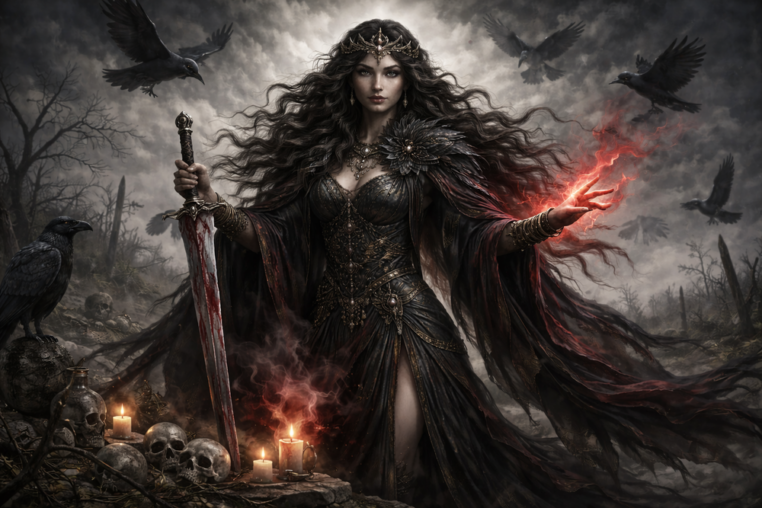
She comes before the battle, not after it. She does not wait for the dead. She announces them. A crow settling on a warrior’s shoulder before the first sword is drawn. A washerwoman at the ford, scrubbing the armor of those who will not survive the day. A beautiful woman on a red horse, watching from a hillside with eyes that have already counted the cost.By the time you see the Morrigan, she has already seen you.She is one of the oldest and most formidable presences in the Celtic tradition. A goddess whose name translates as Phantom Queen or Great Queen, whose triple nature encompasses war, death, prophecy, and the deep sovereignty of the land itself. She is not a goddess you approach for comfort or gentle guidance. She is a goddess you approach when you are ready to stop lying to yourself about what you are, what is coming, and what it is going to cost.The Irish mythological tradition treats her with extraordinary complexity. She is simultaneously terrifying and magnificent. She does not choose sides in war . She chooses outcomes. She does not mourn the dead. She makes them. She does not offer prophecy as a gift. She offers it as a burden, and she gives it whether you want it or not.But she also grants victory. She also grants sovereignty. She also stands at the ford between life and death and holds the door for those she favours. And for the tradition’s greatest heroes, she is not an enemy but a test, the hardest and most honest test they will ever face.She is the Morrigan. And she has been waiting a very long time. Who is the Morrigan?The Morrigan, Mór Ríoghain in Old Irish, meaning Great Queen or Phantom Queen, is one of the Tuatha Dé Danann, the divine race of Irish mythology who inhabited Ireland before the coming of the Milesians and who retreated into the sídhe, the fairy mounds, when the human world took over.But she is older, in feeling and in function, than any written mythology can contain. She belongs to a layer of Celtic religious thought that precedes the texts that recorded it, a layer in which the land itself was understood to be alive, feminine, and demanding. A layer in which the goddess of the earth and the goddess of death were the same figure, because the earth that gives birth also receives the dead.Her Triple NatureThe Morrigan is most often understood as a triple goddess – a composite of three distinct but related figures:Badb ~ the crow goddess, the battle crow, the one who incites warriors to frenzy and cries out over the slain. Her name means crow or raven, and she is the most purely martial aspect of the triad. She is the voice shrieking over the battlefield, the carrion bird settling on the fallen, the bardic image of war at its most visceral and unsparing.Macha ~ the most complex of the three, associated with horses, sovereignty, land, and the particular kind of power that comes from the sacred union between ruler and earth. She is also, paradoxically, a goddess of suffering, in one of the most arresting myths in the entire Irish tradition, Macha is a pregnant woman forced to race against the king’s horses. She wins, gives birth on the finish line, and curses the men of Ulster with the labour pains of childbirth at the moment they are most needed in battle. Her name is embedded in the landscape: Armagh – Ard Macha, the Height of Macha – is named for her.Nemain ~ the panic, the frenzy,...
