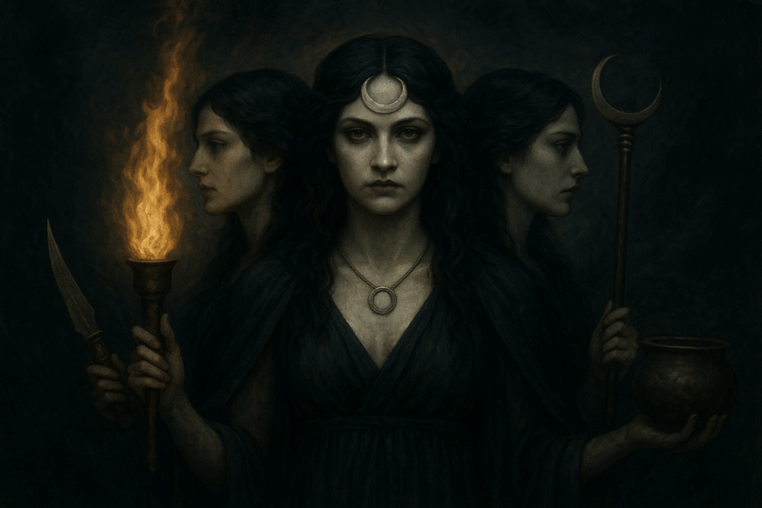

In the liminal spaces where shadows dance and mysteries unfold, stands one of the most powerful and revered figures in witchcraft and ancient religion: Hecate (pronounced HEK-ah-tay or HEK-ah-tee). Known as the Goddess of Magic, the Guardian of Thresholds, and the Torchbearer of the Mysteries, Hecate has guided seekers, witches, and mystics for over two millennia.Origins and Ancient HistoryHecate’s origins trace back to ancient Anatolia (modern-day Turkey), where she was first worshipped as early as the 7th century BCE. From there, her cult spread throughout the Greek world, where she became deeply integrated into Hellenic religion and mythology. Unlike many deities who were later additions to pantheons, Hecate held a position of remarkable authority from her earliest appearances in Greek literature.The poet Hesiod, writing in the 8th century BCE, describes Hecate as having received unique honors from Zeus himself. In his Theogony, she is portrayed as a powerful titaness who retained her authority even after the Olympian gods rose to power. A testament to her ancient and formidable nature.The Triple Goddess: Her Many FacesHecate is often depicted as a triple goddess, appearing in three forms that represent her dominion over different realms:Hecate Epipyrgidia ~ The Heavenly Hecate, associated with the moon, stars, and cosmic mysteriesHecate Kleidouchos ~ The Earthly Hecate, keeper of keys and guardian of thresholds Hecate Phosphoros ~ The Torchbearer, guide through the underworld and dark placesThis triple nature reflects her role as a goddess who can traverse and command all three realms: heaven, earth, and the underworld. She is one of the few deities granted such universal access and authority.Domains of PowerMagic and WitchcraftHecate is perhaps most famous as the goddess of magic itself. Ancient texts describe her as the teacher of pharmakeia (the art of herbs and potions), necromancy, and the magical arts. She was said to wander the earth at night with a pack of red-eyed hounds, teaching magic to those who sought her wisdom.Crossroads and Liminal SpacesThree-way crossroads were considered sacred to Hecate, as these intersections represent choice, transformation, and the meeting of different paths. She governs all threshold spaces – doorways, bridges, cemeteries, and the boundaries between worlds.Night, Moon, and DarknessAs a goddess of the night, Hecate rules over the dark hours when the veil between worlds grows thin. She is associated with the dark moon phase, when her power is said to be strongest and most accessible to practitioners.Death and the UnderworldHecate serves as a psychopomp, guiding souls between the world of the living and the realm of the dead. She holds the keys to the mysteries of death and rebirth, making her a powerful ally for shadow work and transformation.Protection and BoundariesAncient Greeks placed Hekataia (small shrines to Hecate) at the entrances to cities and homes, believing she would protect against malevolent spirits and negative influences.Sacred Stories and MythsThe Abduction of PersephoneOne of Hecate’s most significant mythological appearances is in the story of Persephone’s abduction. When Hades seized Persephone and carried her to the underworld, only Hecate heard her cries. Armed with torches, Hecate helped Demeter search for her missing daughter. This myth establishes Hecate as a guide through dark times and a loyal ally to those in distress.The Titan WarsUnlike other Titans who were overthrown by the Olympian gods, Hecate maintained her power and position. Zeus honored her above all others, granting her dominion over earth, sea, and sky. A unique privilege that speaks to her immense power and importance.Teacher of MedeaIn later myths, Hecate appears as the teacher of the sorceress Medea, instructing her in the arts of magic and herbalism. This connection firmly establishes Hecate’s role as the...
