
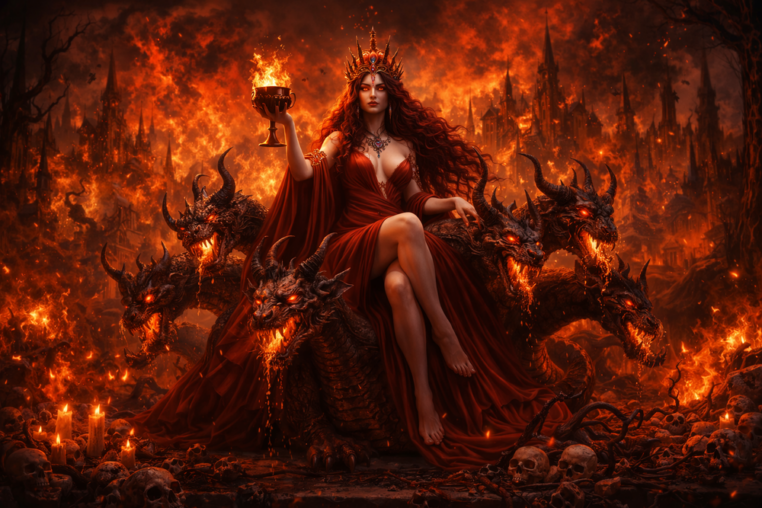

She rides a beast with seven heads across a crimson sea. She holds a golden cup – and the cup is full. She is drunk on the blood of saints and the wine of fornication, robed in purple and scarlet, adorned with gold and precious stones, and on her forehead is written a name: Mystery. Babylon the Great. The Mother of Harlots and Abominations of the Earth.The Book of Revelation meant her as a horror. A warning. The ultimate symbol of spiritual corruption, worldly excess, and the empire that devoured the faithful.It did not work out quite as intended.Because the magicians got hold of her. The visionaries. The rebels and the heretics and the poets who understood that the things the church called most abominable were often the things it feared most . And that’s what power fears, power is telling you something important about it.Aleister Crowley looked at the Whore of Babylon and saw a goddess. Kenneth Grant built an entire cosmology around her. Marjorie Cameron painted her as a red-winged queen striding through fire. Jack Parsons, rocket scientist, occultist, and one of the strangest figures of the twentieth century, called her down into the California desert and believed, at least for a time, that she had arrived.Babalon is not a reclaimed demon. She is something stranger and more interesting than that. A figure born directly from the language of condemnation, who absorbed that condemnation and became something that transcends it entirely. She is the goddess who was built from a slur and became a crown.She is not for everyone. She is barely for anyone. But for those she calls, she calls with unmistakable force. Who is Babalon?Babalon, the spelling used in Thelemic tradition to distinguish her from the Biblical Babylon, is simultaneously one of the oldest and one of the newest figures in the Western magical tradition. She is ancient in her roots and modern in her articulation, and understanding both is essential to understanding her.The Biblical Whore of Babylon is her raw material. In the Book of Revelation, chapters 17 and 18, she appears as the great harlot seated upon many waters, with whom the kings of the earth have committed fornication. She is dressed in luxury, drunk on the blood of martyrs, and her destruction, at the hands of the beast she rides,is presented as a divine victory over corruption. Rome is the obvious political subtext. Spiritual decadence is the theological one. For the early Christian church, Babylon was everything that was wrong with the world.The Gnostic thread runs through her. The idea that the material world and its pleasures are not the enemy of the divine – that matter itself is sacred, that the body is not a cage but a temple – has been suppressed and persecuted throughout the history of Western religion but never extinguished. Babalon belongs to this thread. She is the goddess who does not apologise for being embodied.The Thelemic Babalon is the formal articulation, and it begins with Aleister Crowley and the reception of The Book of the Law in Cairo in April 1904. The text Crowley believed was dictated to him by a praeterhuman intelligence called Aiwass, which founded the religious and magical system he called Thelema. In the Thelemic cosmology, Babalon is not the enemy of divinity but one of its central expressions: the Great Mother, the goddess of understanding, the force of universal love so absolute that it destroys the ego entirely in its embrace.She is paired with Hadit, the infinitely contracted point of pure consciousness, as his feminine counterpart: Nuit, the infinite expanse of the night...
