 Written by
 On Sunday, December 21, 2025, at 10:03 AM EST, the Northern Hemisphere will experience the winter solstice. That’s the instant when the Sun reaches its southernmost point in the sky, marking the official beginning of astronomical winter and when daylight hours are at their minimum before they start lengthening again. Also known as the shortest day and longest night of the year. This astronomical event has captivated humanity for millennia, inspiring celebrations, rituals, and traditions that continue to resonate in our modern world.
What Is the Winter Solstice?
The winter solstice occurs when the northern half of the Earth is tilted its farthest away from the sun, causing the sun to reach its lowest point in the sky. While many think of it as an entire day, the solstice actually lasts just a moment. A precise astronomical alignment that marks the official beginning of winter.
The word “solstice” comes from the Latin words meaning “sun” and “still,” reflecting how the sun appears to pause in its southward journey before reversing direction. After December 21st, the days gradually begin to lengthen again, offering the promise of returning light and the eventual arrival of spring.
Why Our Ancestors Celebrated
For ancient peoples without modern scientific understanding, the shortening days of autumn and early winter were deeply unsettling. The sun, source of all warmth and life, appeared to be abandoning the world. Would it return? Would crops grow again? Would they survive the harsh months ahead?
To combat their fear that the Sun would be gone forever, our ancestors held various celebrations and rites to light up the darkness encouraging the Sun to return and bring new life. These solstice celebrations were not merely parties, they were sacred acts of faith, community bonding, and hope in the face of winter’s darkness and scarcity.
Ancient Solstice Celebrations Around the World
Stonehenge and the Druids (England)
Perhaps no place is more iconic for solstice celebrations than Stonehenge. This 5,000-year-old structure in England was built to align with the sun at the solstice. The monument’s massive stones frame the sunset on the winter solstice and the sunrise on the summer solstice with stunning precision.
Every year, Stonehenge hosts a winter solstice ceremony, with crowds gathering in the early hours of the morning to see the sunrise over its stones. For 2025, the site will open at 5:15 AM, with sunrise occurring around 8:09 AM. Those unable to attend can watch via English Heritage’s YouTube livestream.
Yule (Norse and Germanic Traditions)
The ancient Norse and Germanic peoples celebrated Yule, a festival that began on the winter solstice and lasted for twelve days. During Yule, families would burn a specially selected log, the Yule log, which was meant to burn throughout the twelve days of celebration. The ashes were kept and used for protection and fertility in the coming year.
Yule festivities included feasting, drinking mead, honoring ancestors, and sacrifices to the gods to ensure the sun’s return and a bountiful year ahead. Many of our modern Christmas traditions, including the Yule log, evergreen decorations, and gift-giving, trace their roots to these ancient celebrations.
Saturnalia (Ancient Rome)
The Romans celebrated Saturnalia in honor of Saturn, the god of agriculture and time. This week-long festival, which began around December 17th and coincided with the solstice, was characterized by role reversals, feasting, gambling, and gift-giving. Social norms were temporarily suspended. Slaves were treated as equals, and a “Lord of Misrule” was chosen to preside over the festivities.
Homes were decorated with wreaths and greenery, candles were lit to drive away darkness, and clay figurines called sigillaria were exchanged as gifts. Sound familiar? Many Christmas traditions evolved directly from Saturnalia.
Dongzhi Festival (China and East Asia)
In China and throughout East Asia, the Dongzhi Festival marks the winter solstice and celebrates the return of longer days. The festival emphasizes family reunions and the balance between yin (darkness) and yang (light) energies. Families gather to eat tang yuan (glutinous rice balls) symbolizing reunion and harmony, and to honor ancestors.
The festival reflects the philosophical belief that from this point of maximum darkness, light and warmth will gradually return. A cyclical view of nature that brings comfort and hope.
Inti Raymi (Inca)
While the winter solstice occurs in December in the Northern Hemisphere, it falls in June in the Southern Hemisphere. The Inca celebrated Inti Raymi, the Festival of the Sun, during their winter solstice to honor Inti, the sun god. The celebration included rituals, offerings, and ceremonies to ensure the sun’s strength would return.
Although the original festival was suppressed during Spanish colonization, modern Peru has revived Inti Raymi as a major cultural celebration held annually in Cusco.
Modern Ways to Celebrate the Winter Solstice
Light-Based Rituals
Since the solstice is about the return of light, many modern celebrations focus on illumination:
~ Candle Lighting Ceremony: Gather with family or friends at sunset and light candles together, setting intentions for the coming year as darkness falls. Keep the candles burning through the longest night as a symbol of hope.
~ Bonfire Gathering: If you have access to safe outdoor space, build a bonfire. Ancient peoples lit fires to encourage the sun’s return, join them across millennia in this primal act of faith.
~ Luminaria Walk: Place candles in paper bags filled with sand along a pathway and take an evening walk through the lights.
Nature Connection
~ Sunrise or Sunset Watching: Watch the sunrise and take a morning walk on the 21st or an evening walk on the 20th or 21st. Witness the exact moment when the sun begins its journey back toward longer days.
~ Winter Nature Walk: Bundle up and spend time outdoors observing the quiet beauty of the season. Notice bare trees against the sky, animal tracks in snow, evergreens standing strong.
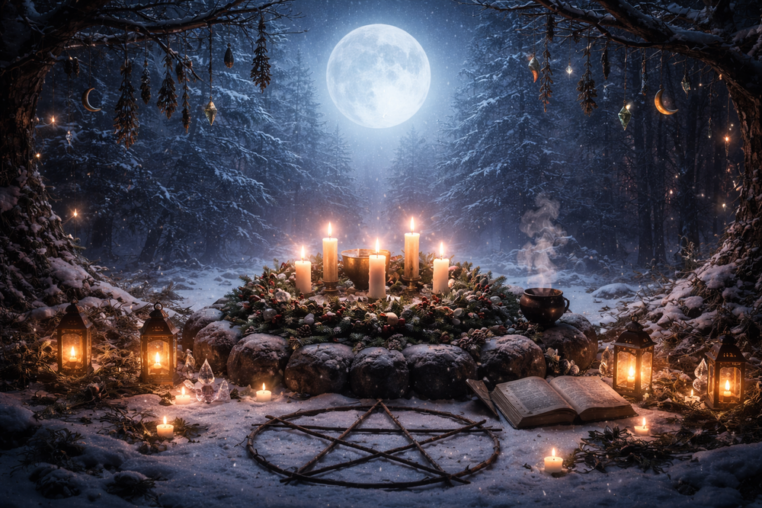
~ Create a Solstice Altar: Gather natural items like pinecones, evergreen branches, holly, stones, and feathers. Arrange them on a table with candles to create a seasonal focal point in your home.
Reflection and Intention-Setting
~ Darkness Meditation: Embrace the darkness rather than fighting it. Sit in a dark room and meditate on what you need to release, what needs to rest, and what you want to nurture in the returning light.
✍️ Solstice Journal Prompts
~ What darkness (literal or metaphorical) am I ready to emerge from?
~ What seeds of intention do I want to plant for the year ahead?
~ How can I honor both rest and renewal in my life?
~ What am I grateful for from this past season?
🪄 Year-End Release Ritual
Write down what you’re letting go of on pieces of paper and burn them safely in a fireplace or candle flame.
Traditional Festivities
~ Feast with Seasonal Foods: Prepare a meal using winter ingredients – root vegetables, winter squash, nuts, dried fruits, warming spices. Invite loved ones to share in abundance even in the season of scarcity.
~ Decorate with Evergreens: Bring holly, ivy, pine, cedar, or fir into your home. Many of our most cherished Christmas traditions grew out of these early solstice celebrations, including decorating with evergreens. These plants symbolize enduring life through winter’s death.
~ Exchange Meaningful Gifts: Rather than commercialized gift-giving, exchange handmade items, written blessings, or symbolic tokens that represent your wishes for loved ones in the coming year.
~ Tell Stories: Gather in the evening and share stories, myths, or memories. This ancient practice connects us to oral traditions that kept communities bonded through long winter nights.
Community Celebrations
Look for local solstice gatherings, drumming circles, or spiritual ceremonies in your area. Many pagan, Wiccan, and earth-based spiritual communities hold public celebrations. Yoga studios, meditation centers, and wellness spaces often host special solstice events.
Solstice Symbolism for Personal Growth
Beyond rituals and celebrations, the winter solstice offers powerful metaphors for personal transformation.
Embracing Darkness
The solstice reminds us that darkness is not something to fear but a necessary phase. Just as the earth needs winter’s rest, we too need periods of stillness, introspection, and withdrawal.
The Return of Light
After the longest night comes the slow but certain return of light. No matter how dark things seem, change is inevitable, and hope is always warranted.
Death and Rebirth
The solstice sits at the threshold between death (the old year waning) and rebirth (the sun’s return, the new year approaching). This liminal space is sacred and filled with possibility.
Cyclical Time
Modern culture often treats time as linear – always forward, always producing. The solstice reconnects us to cyclical time, where rest follows activity, and return follows departure.
A Moment of Global Unity
One remarkable aspect of the winter solstice is that regardless of where you live in the northern hemisphere, the winter solstice happens at the exact same time for all of us. At 10:03 AM EST on December 21st, people from New York to London to Tokyo will simultaneously experience the same astronomical moment. Areminder of our shared connection to this planet and to each other.
Your Solstice, Your Way
Whether you’re drawn to ancient rituals or prefer creating new traditions, whether you celebrate alone or with community, the winter solstice invites you to pause, reflect, and honor the turning of the wheel. This is a time to acknowledge where you’ve been, release what no longer serves you, and set intentions for the light that’s returning.
As you move through the shortest day of the year, remember, you’re participating in a celebration as old as human consciousness itself. Across thousands of years and countless cultures, humans have gathered on this day to affirm that darkness is temporary, that light always returns, and that hope is not foolish but fundamental to our survival.
Welcome the darkness. Honor the stillness. And prepare to greet the returning light.