 Written by
 The Qabalah (also spelled Kabbalah, Cabala, or other variations) stands as one of humanity’s most profound mystical traditions, offering seekers a systematic approach to understanding the divine mysteries that connect God, universe, and soul. Far from being a single, monolithic system, the Qabalah has evolved through centuries of spiritual inquiry, each era contributing its own unique perspectives and innovations to this rich tapestry of Jewish mysticism.
The Foundation: Core Concepts and Structure
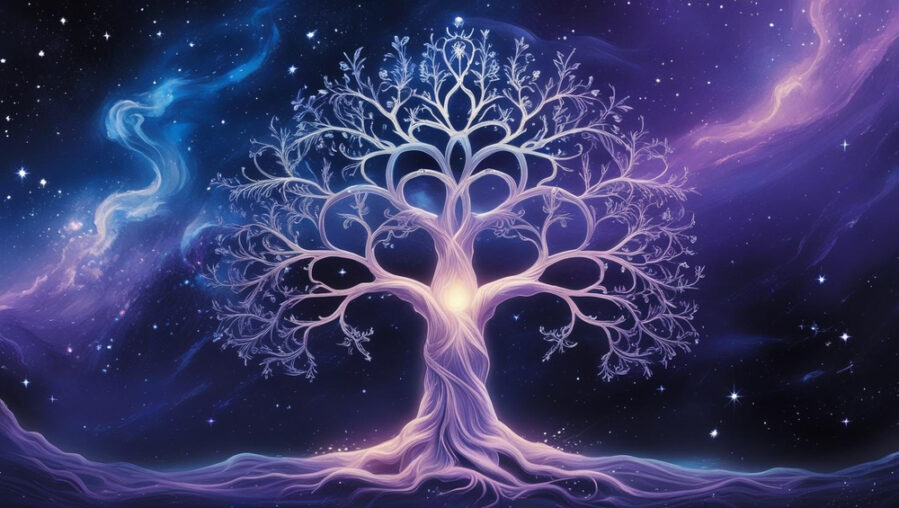
At the heart of Qabalistic teaching lies the Tree of Life (Etz Chaim), an intricate diagram consisting of ten interconnected spheres called sephiroth, linked by twenty-two paths. This sacred geometry maps the divine emanation from the highest spiritual source, Keter (Crown), down through various levels of consciousness and reality, culminating in Malkuth (Kingdom), our physical world.
The tradition encompasses several interconnected elements that work together to create a comprehensive spiritual system. The sacred texts, primarily the medieval Zohar alongside earlier works like the Sefer Yetzirah (Book of Creation), employ complex symbolism and allegory to explore divine mysteries. Gematria, the numerological system assigning values to Hebrew letters, reveals hidden connections between concepts sharing numerical equivalence. The cosmological framework of the Four Worlds describes different levels of reality, from pure spirit to physical matter, while practical applications focus on meditation, prayer, and ethical living as pathways to divine understanding.
Medieval Spanish Qabalah: The Golden Age of Mystical Innovation
The medieval period in Spain, roughly from the 12th to 15th centuries, witnessed what many consider the golden age of Qabalistic development. This era produced some of the tradition’s most influential texts and thinkers, fundamentally shaping how subsequent generations would understand Jewish mysticism.
The Spanish Qabalists developed sophisticated theological concepts that addressed fundamental questions about God’s nature and relationship to creation. They grappled with the apparent contradiction between God’s infinite, unknowable essence (Ein Sof) and the divine attributes described in scripture. Their solution involved the concept of divine emanation through the sephiroth. A process by which the infinite gradually manifests through increasingly defined stages until reaching the material world.
Key figures like Moses de León, traditionally credited with authoring the Zohar, created works of extraordinary literary and spiritual depth. The Zohar itself, written in Aramaic and presented as the teachings of the 2nd-century sage Rabbi Shimon bar Yochai, became the foundational text of theoretical Qabalah. Its pages are filled with mystical interpretations of biblical passages, exploring themes of divine sexuality, cosmic repair, and the soul’s journey through multiple levels of reality.
Spanish Qabalah also developed the concept of the Shekhinah, the divine feminine presence, in unprecedented detail. This tradition understood the Shekhinah as both the tenth sephirah (Malkuth) and as a dynamic aspect of divinity that could be in exile or union depending on human actions and cosmic conditions. This innovation added profound psychological and theological dimensions to Jewish understanding of the divine nature.
The Spanish school’s influence extended beyond mystical theory into practical spirituality. They developed elaborate systems of meditation on divine names, letter combinations, and sephirotic configurations. Their approach emphasized that proper spiritual practice could literally affect the divine realm, healing cosmic fractures and promoting divine unity.
Lurianic Qabalah: Revolutionary Cosmology from 16th-Century Safed
The destruction of Spanish Jewry in 1492 created both crisis and opportunity for Qabalistic development. Many Spanish Jewish refugees settled in Safed, a small city in northern Palestine that became an extraordinary center of mystical activity. Here, in the 16th century, Rabbi Isaac Luria (known as the Ari, “the Lion”) developed revolutionary ideas that would transform Qabalah forever.
Lurianic Qabalah introduced three fundamental concepts that radically reimagined the cosmic process: tzimtzum (contraction), shevirat ha-kelim (breaking of the vessels), and tikkun (repair). According to Luria’s teaching, creation began not with emanation but with divine contraction. God withdrew from a space to make room for creation. Into this vacated space, divine light was channeled through specially prepared vessels (the sephiroth), but the light was too powerful, causing the vessels to shatter and their fragments to fall into lower realms.
This cosmic catastrophe created our current, imperfect world, where divine sparks remain trapped within material husks. However, through proper spiritual practice, including ritual observance, meditation, and ethical behavior, human beings can liberate these sparks and participate in the cosmic repair (tikkun) that will ultimately restore divine unity and bring about messianic redemption.
Luria’s system was simultaneously more dramatic and more optimistic than earlier Qabalah. It provided a compelling explanation for the existence of evil and suffering while empowering every individual to participate meaningfully in cosmic restoration. The Lurianic emphasis on tikkun olam (repairing the world) has profoundly influenced modern Jewish thought, extending far beyond mystical circles into social justice movements and contemporary Jewish identity.
The Safed school also developed intense practices of spiritual purification and mystical meditation. Luria and his disciples engaged in elaborate rituals involving specific meditations on divine names, visualization practices, and even physical actions designed to elevate divine sparks. They created detailed maps of soul-root connections, explaining how individual souls relate to cosmic processes and to each other across multiple lifetimes.
Hasidic Interpretations: Democratizing the Divine
The 18th-century emergence of Hasidism in Eastern Europe marked another revolutionary development in Qabalistic evolution. Founded by Rabbi Israel ben Eliezer (the Baal Shem Tov), Hasidism took sophisticated Qabalistic concepts and made them accessible to ordinary Jews, emphasizing emotional connection to God over complex intellectual study.
Hasidic masters reinterpreted Lurianic concepts through the lens of popular spirituality and psychological insight. They taught that every moment and every action contained opportunities for spiritual elevation, that divine sparks could be found in the most mundane activities, and that sincere intention (kavanah) was more important than scholarly knowledge. This democratization of mystical practice allowed countless Jews to engage with Qabalistic spirituality without requiring years of esoteric study.
Different Hasidic schools developed distinct approaches to Qabalistic teaching. Chabad Hasidism, founded by Rabbi Schneur Zalman of Liadi, created systematic intellectual frameworks for understanding mystical concepts, producing works like the Tanya that remain central texts of Jewish spirituality. Breslov Hasidism, following Rabbi Nachman of Breslov, emphasized imagination, storytelling, and personal prayer as pathways to mystical experience. Other schools focused on music, dance, and ecstatic prayer as means of divine connection.
Hasidism also innovated the institution of the tzaddik, the righteous leader who serves as a channel between earthly and divine realms. This concept, rooted in Qabalistic understanding of how divine energy flows through properly prepared vessels, created new forms of spiritual community and religious authority that continue to influence Jewish life today.
Perhaps most significantly, Hasidism transformed the Qabalistic concept of divine immanence. While earlier traditions emphasized God’s transcendence and the difficulty of achieving mystical union, Hasidic masters taught that God could be found everywhere and accessed through proper awareness and intention. This shift made mystical experience seem achievable rather than reserved for an elite few.
Modern Adaptations: The Qabalah Beyond Judaism
The 19th and 20th centuries witnessed unprecedented interest in Qabalistic concepts among non-Jewish spiritual seekers, leading to various adaptations that, while inspired by Jewish sources, often developed in significantly different directions.
The Hermetic Qabalah, developed by occultists like Eliphas Lévi and later systematized by members of the Golden Dawn magical order, integrated Qabalistic symbols with ceremonial magic, tarot, astrology, and alchemy. This tradition maintained the Tree of Life as a central organizing principle but interpreted it through the lens of Western esoteric philosophy rather than Jewish theology. Practitioners developed elaborate systems of magical correspondences, using Hebrew letters and divine names in rituals designed to achieve spiritual transformation and magical effects.
Christian Cabala emerged during the Renaissance when scholars like Giovanni Pico della Mirandola and Johannes Reuchlin sought to use Qabalistic methods to prove Christian theological claims. This tradition continued evolving, eventually producing works that attempted to find Christian Trinity doctrine hidden within Jewish mystical texts. While intellectually sophisticated, Christian Cabalistic interpretations often fundamentally misunderstood the Jewish context that gave original meaning to Qabalistic concepts.
New Age movements of the late 20th and early 21st centuries have embraced simplified versions of Qabalistic symbolism, often focusing on the Tree of Life as a psychological model or self-help framework. These adaptations typically emphasize personal empowerment and individual spiritual development while removing the communal, halakhic (Jewish legal), and theological contexts that traditionally shaped Qabalistic practice.
Contemporary occult traditions continue developing syncretic systems that combine Qabalistic elements with various other spiritual and magical practices. Chaos magic, for instance, uses Qabalistic symbols as tools for achieving altered states of consciousness while remaining deliberately eclectic about theoretical commitments.
The Living Tradition Today
Despite centuries of adaptation and interpretation, traditional Jewish Qabalah continues as a living spiritual path within Orthodox, Conservative, and even some Reform Jewish communities. Contemporary teachers like Rabbi Adin Steinsaltz have made classical texts more accessible while maintaining their traditional context and meaning. Academic scholars continue uncovering new historical manuscripts and developing more sophisticated understandings of how Qabalistic ideas developed within their original cultural contexts.
Modern Jewish renewal movements have also embraced Qabalistic spirituality, creating new liturgies, meditation practices, and educational approaches that honor traditional sources while addressing contemporary spiritual needs. These developments demonstrate the ongoing vitality of authentic Qabalistic tradition even as various adaptations continue proliferating in wider spiritual markets.
The story of Qabalah’s evolution reveals how profound spiritual insights can transcend their original cultural boundaries while also showing how meaning can be transformed, sometimes enriched, sometimes diminished, through such transitions. Understanding these different streams helps contemporary seekers appreciate both the universal appeal of Qabalistic wisdom and the irreplaceable value of engaging with traditions in their original depth and context.
Whether approached through traditional Jewish study, academic historical investigation, or contemporary spiritual practice, the Qabalah continues offering seekers sophisticated tools for exploring the deepest questions of existence, consciousness, and spiritual development. Its enduring influence across cultures and centuries testifies to the universal human longing to understand our place within the grand mystery of existence.