
 Written by
 There is a particular quality to the light in late June.
It lingers. The days are long past their longest point, the summer solstice falls on June 21st this year, but the warmth still feels unhurried, unrushed, as though summer has just arrived and has not yet begun counting the days until it leaves. The earth is in full production. Things are ripening. The green has deepened from the tentative brightness of spring into something more substantial, more settled.
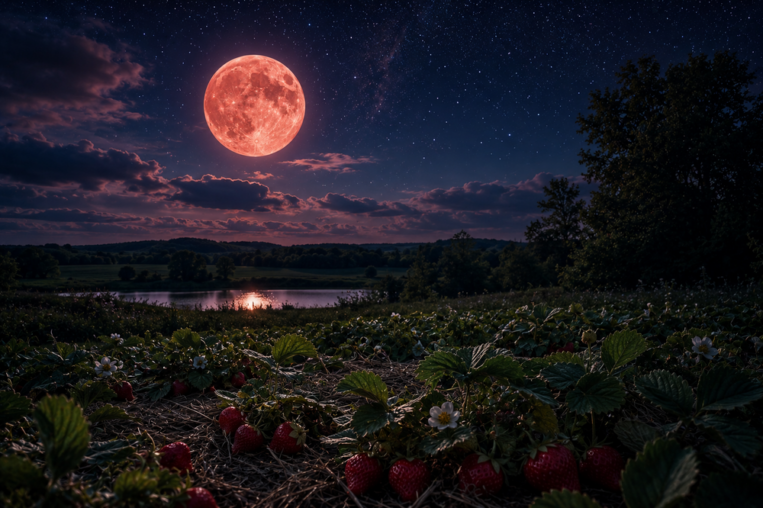
And on Monday, June 29th, the Strawberry Moon rises.
The Strawberry Moon is the first full moon of summer, following soon after the June 21st solstice. The name comes from a number of North American native tribes. Among them the Algonquin, Ojibwe, Dakota, Lakota, Chippewa, and Sioux. Who used it to mark the moment when wild strawberries reach peak ripeness and are ready to be gathered. The name is not about what the moon looks like. It is about what the land is doing when the moon rises.
Because the June full moon stays low on the horizon in the Northern Hemisphere, its light passes through a thicker layer of the Earth’s atmosphere, causing it to glow with a golden or reddish tint. So it does, in fact, look a little like a strawberry, deep, warm, close to the earth. But the name came first from the harvest, from the act of going out into the fields and finding what was ready.
That is the energy of this moon: ripeness. The recognition of what is ready. The act of gathering.
What the Strawberry Moon Carries
The Flower Moon on May 1st was about opening. The Blue Moon on May 31st was about what fell between the categories, the second look, the liminal pocket in the calendar.
The Strawberry Moon is something different again. It arrives three days before the month’s end, in the full heat of early summer, and it carries the energy of culmination. Not the culmination of ending, that belongs to autumn, but the culmination of ripening. The moment when the thing that was planted, and grew, and developed in the long season of growth, becomes what it was always becoming.
In the wild, ripeness is not a moment you can miss and recover from. The berry that is not gathered at the right moment is eaten by someone else, or falls, or ferments on the vine. Ripeness demands presence. It demands that you are paying attention and willing to act when the moment comes.
This is not a moon for hesitation. It is a moon for recognizing what is ready and reaching for it.
Alternative European names for this moon include the Honey Moon and the Mead Moon. June was traditionally the month of marriage, and the term “honeymoon” may be tied to this name. In Anglo-Saxon traditions, it was the Honey Moon or Mead Moon, marking the time to mow the meadows, while throughout much of Europe “Rose Moon” is the preferred name, indicating the full blossoming of roses in regions where strawberries aren’t as widespread. In China it is the Lotus Moon.
Honey. Roses. Lotus. Strawberries. The names from every culture converge on the same quality: sweetness that has been earned by the long work of the growing season. The reward that arrives not by chance but because something was tended, and the tending paid off.
Before You Write ~ Setting the Space
Summer evenings carry their own quality of light, and the Strawberry Moon rises into it slowly, golden, from the southeastern horizon. If you can, take your journal outside. Let the long evening settle around you before you begin.
The June full moon will hang close to the horizon, appearing larger and more golden than usual due to the thickness of atmosphere its light passes through. Watch it rise if you can. The low horizon moon has a different quality than the moon overhead. It feels close, present, almost companionable. It is worth sitting with for a few minutes before the writing begins.
Light your candle. Pour your water. Sit with the warmth of the evening on your skin and the awareness that something has ripened, in the world outside and in you, since the year turned.
Journal Prompts for the Strawberry Moon ~ June 29th
I. The Harvest Question
The Strawberry Moon is a harvest moon in spirit, even if not in name. It asks what is ready to be gathered.
– Cast your attention across the first half of this year – January through now. What has grown? Not what you hoped would grow, or what you worked hardest on, but what has actually, visibly, undeniably developed?
– What is ripe in you right now? What capacity, understanding, relationship, or creative work has reached the point where it is ready – where it would be a loss, not a virtue, to leave it ungathered any longer?
– Where have you been waiting for something to be more ready than it already is? Where is the hesitation, and what is it actually protecting you from?
– The berry on the vine at the right moment is sweet. The same berry left too long grows soft, then falls. What in your life is asking you to act now, before the moment passes?
II. The Sweetness ~ What Has Been Worth It
Every name for this moon in every culture reaches toward sweetness. This section is for honest accounting of what the long work has produced.
– What, this year or in the longer arc of your practice and your life, has turned out to be worth the effort? Not what you expected to be rewarding – what has actually, genuinely fed you?
– Where have you been so focused on what hasn’t arrived yet that you have failed to taste what is already here? Take a few minutes to simply name the sweetness that is present in your life right now, even if it is quieter than you wanted, or smaller, or differently shaped.
– Who or what deserves your gratitude at this moon? Name it specifically – not in the general terms of gratitude practice, but the particular people, circumstances, and moments that have made the last six months what they have been.
– What have you grown that surprised you? The development you didn’t plan for, didn’t work toward directly, but that arrived anyway – the fruit you didn’t plant but that grew from seeds you didn’t know you were scattering?
III. The Solstice Threshold ~ Light at its Peak
The Strawberry Moon rises just days after the summer solstice, the longest day of the year. It is the full moon closest to the peak of light.
– The solstice is the moment when the light is at its greatest before it begins to slowly withdraw. What is at its greatest in you right now – most illuminated, most expanded, most fully expressed?
– What do you want to do with the peak before the drawing-in begins? Not in a frantic sense, but in the way of someone who knows the season and wants to use it well – what is the work of this fullness?
– The solstice also marks a turning. After this the days will subtly shorten, the light will begin its slow retreat. What are you ready to begin releasing, even before it is time for the full release? What have you been carrying through the growth season that has served its purpose and is ready, gently, to be set down?
– Where is the light falling most clearly in your life right now – illuminating something that was previously shadowed or unclear? What does that clarity ask of you?
IV. The Ancestors at Midsummer
Midsummer is a threshold time. The veil does not thin at midsummer in the way it does at Samhain, but the peak of light and abundance is its own kind of portal.
– Which ancestors feel most present at this time of abundance and ripeness? Not necessarily the ancestors of your bloodline – who in the long chain of people who have contributed to your existence knew what it was to receive a harvest, to benefit from a season of growth paying off?
– What abundance did your ancestors work toward that you are now living? What did they build, endure, or make possible that has ripened into the life you have now? Name it as specifically as you can.
– What are you in the process of building – planting, tending, making – that you will not live to fully harvest, but that the ones who come after you will? What are you doing now that is for the future, for the children or students or community members or readers or practitioners who will come after you and benefit from what you are tending?
– Is there an ancestor whose gifts feel most active in you at this time of year – a lineage of gardeners, healers, makers, or harvesters that you can feel working through you? Write to them. Tell them what you have done with what they passed forward.
V. Rose Moon, Honey Moon, Lotus Moon
The European and Asian names for this moon are all about beauty and sweetness in their full expression. This section is for the soul rather than the practice.
– What is beautiful in your life right now? Not aspirationally, not potentially – what is genuinely, presently beautiful, and are you taking enough time to let it land?
– Where are you allowing yourself to receive? The Strawberry Moon is not a moon of effortful striving. It is a moon of harvesting what is ready, tasting what is sweet, resting in what has been built. Where are you good at receiving, and where do you deflect it?
– Write a love letter – to your practice, your life, your lineage, or yourself as a practitioner. Not aspirationally. For what is already here.
VI. The Closing ~ Into the Second Half of the Year
The Strawberry Moon falls at the end of June, the halfway point of the year. This is the natural place to take stock.
– Six months from now it will be December 29th. Who do you want to be then? Not what you want to have achieved – who do you want to have become? What quality, capacity, or understanding do you want to have deepened by the end of the year?
– What do you want to let the second half of this year be about? One sentence, if you can find it. The thing that is most true about where you are headed.
– End with this: At the Strawberry Moon, at the peak of the summer light, I acknowledge that I have grown…
Write whatever comes after that. Let it be honest. Let it be specific. Let it be sweet.
A Note on Ripeness
The Strawberry Moon does not ask you to have everything figured out. It does not ask for perfection or completion.
It asks for presence. For the willingness to look at what has grown and acknowledge it honestly. The things that ripened the way you hoped, and the things that grew differently than you expected, and the things that didn’t grow at all this season and perhaps need different soil or a different year.
The harvest is not only the sweetness. It is the honest accounting of what the season produced, so that you can tend next season more wisely.
But start with the sweetness. It is there. This moon says so.
The Strawberry Moon reaches its peak on Monday, June 29th at 7:57 p.m. EDT / 11:57 p.m. GMT. Look to the southeastern horizon at sunset and watch it rise: low, golden, warm, and close.