
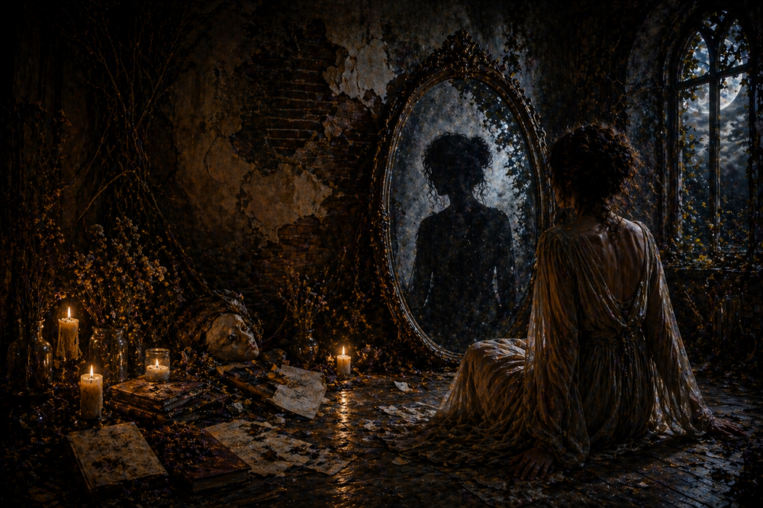

How Your Shadow Was Built ~ The Architecture of What You’ve Been Hiding From

You did not arrive in the world with a shadow.You were born with the full spectrum of what it means to be human. The capacity for joy and rage, for generosity and selfishness, for courage and cowardice, for tenderness and cruelty. All of it was there, undivided, in the undifferentiated wholeness of the infant self. No part of you was yet unacceptable, because you had not yet learned what acceptance required.Then the world taught you.It taught you through the expressions on your parents’ faces. Through what got rewarded and what got punished. Through the things that were said and, more powerfully, through the things that were never said. The feelings that nobody in your family had language for, the emotions that made the adults around you uncomfortable, the parts of you that were met with silence or withdrawal or correction rather than welcome. It taught you through your peer group, through your school, through your culture, through the religion or absence of religion you were raised in, through every message about who you were supposed to be that was delivered to you before you were old enough to question it.What could not be accommodated in the self you were allowed to have went somewhere else. Into the dark. Into the territory Carl Jung called the shadow. The unconscious storehouse of everything you were required to become unaware of in order to remain acceptable, loveable, and safe.This is not a metaphor. The shadow is a real psychological structure, and understanding how it was built is the beginning of understanding how to work with it. Jung’s Shadow ~ The Map We UseCarl Gustav Jung introduced the concept of the shadow in the early twentieth century as part of his broader model of the psyche, and it remains the most useful map we have for this territory. Not because it is the only map, but because it is the most honest about what is actually in the territory. Not just the frightening and the destructive, but the golden, the gifts, the strengths, the vital qualities that also got buried alongside the parts you were taught to be ashamed of.Jung’s definition is deceptively simple. The shadow is everything in the unconscious that the ego does not identify with. It is the part of the self that the conscious mind has decided is not me.What this means in practice is that the shadow’s contents are entirely personal. Your shadow is not the same as anyone else’s. It is the specific collection of qualities, impulses, capacities, memories, emotions, and desires that your particular history required you to disown. Some people have buried their anger. Others have buried their softness. Some have buried their ambition, or their sexuality, or their grief, or their joy. What gets buried is always a function of what the specific environment of a specific childhood required to be buried.This is why shadow work is not a universal inventory. It is a personal archaeology. How the Shadow Forms ~ The Three Primary MechanismsThe shadow does not form through a single dramatic act of repression. It forms through the slow, patient, ordinary processes of becoming a social being. Processes that are inevitable, necessary, and potentially very costly when they are not later examined.The first mechanism: Conditional acceptance.The most fundamental way the shadow forms is through learning that love and acceptance are conditional. That you are welcome as the version of yourself that behaves in certain ways and unwelcome as the version of yourself that doesn’t.This is not, at its most basic, a failure of parenting. It is simply the reality of socialisation. You cannot...

Membership Required

You must be a member to access this content.

View Membership Levels

Already a member? Log in here