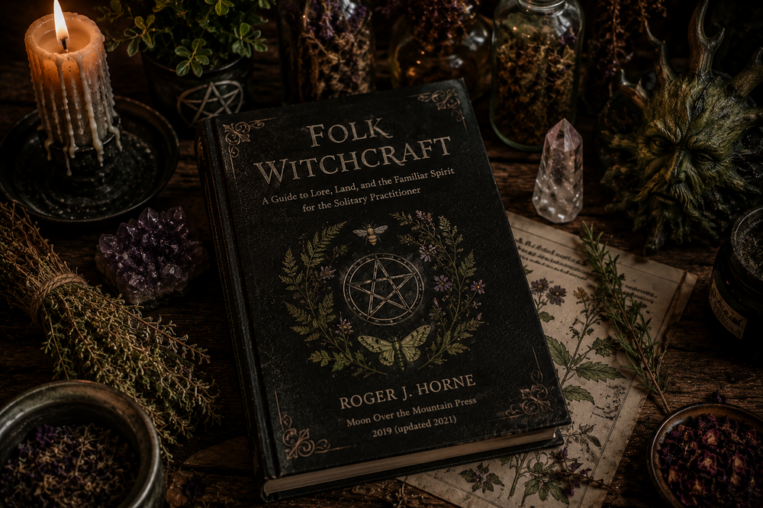

The image depicted here is an AI-generated representation of Folk Witchcraft: A Guide to Lore, Land, and the Familiar Spirit for the Solitary Practitioner – Roger J. Horne | Moon Over the Mountain Press, 2019 (updated 2021). As I do not have permission to republish any image of the book. What it is: A slim, rigorous, deeply practical guide to folk witchcraft rooted in animism, familiar spirit work, and land-based practice This book arrived in the community quietly. A small, independently published volume from a press most people hadn’t heard of, with a plain cover and no marketing budget to speak of. It found its audience entirely by word of mouth, passing between practitioners who pressed it on each other the way you press a book on a friend when you have just read something that articulates what you’ve been trying to articulate for years.Roger J. Horne comes from two specific lineages, Scottish cunning craft and Appalachian herb-doctoring. And Folk Witchcraft reflects both. It is, in the best possible sense, a book that knows exactly where it comes from. Horne is not assembling a synthesis of world traditions or constructing a universal framework. He is writing from within a specific current, clearly and without apology, and inviting the reader to find their own equivalent rather than simply adopt his.The book’s structure is deceptively simple. It covers animism and the spirit world, the working relationship with land and familiar spirits, traditional charming and spell-work, ecstatic practice and spirit-flight, seasonal observance rooted in actual folk tradition rather than Wiccan wheel-of-the-year, and practical techniques across all of these. There are over fifty rituals, charms, and exercises. The hand-drawn illustrations are Horne’s own and carry the quality of something made rather than produced.What distinguishes Folk Witchcraft from the majority of books in its category is the quality of mind behind it. Horne writes with rigor. He is precise about what is attested in historical sources and what is modern adaptation, honest about the limits of his knowledge, and consistently focused on cultivating the practitioner’s own capacity for direct experience rather than on providing a system to follow. One of the book’s central arguments, made implicitly throughout, is that working witchcraft cannot be learned entirely from books. That the real initiations come from direct relationships with land, spirit, and practice. And the exercises in the book are designed to build those relationships rather than substitute for them.The criticism sometimes made of this book, that it doesn’t guide the reader enough for a book with the word “guide” in the title, is fair in a narrow sense. There is no hand-holding here, no step-by-step beginner curriculum. But the criticism misses the point. Horne’s approach asks the practitioner to develop their own direct competence and discernment rather than following a prescribed path. For practitioners ready for that kind of relationship with their craft, this book is quietly transformative. For those expecting a more structured curriculum, it may frustrate.One note: if you can find the updated 2021 edition, that is the version to read. It includes revisions that sharpen several of the book’s central arguments and expand the working material.Who it’s for: Practitioners of any experience level who are drawn to animist, land-based, and spirit-centred approaches to the craft. Particularly valuable for those who feel their practice has become too abstract, too text-dependent, or too disconnected from the living world.Pair with: time outdoors, consistent altar work, and Alive with Spirits (Alive with Spirits: The Path and Practice of Animistic Witchcraft – Althaea Sebastiani | Weiser Books, 2023) for a complementary theoretical grounding in animism....
