 Written by
 Every November 16th, practitioners of modern witchcraft and paganism gather to honor Hekate, the ancient Greek goddess of crossroads, magic, and the liminal spaces between worlds. But while Hekate herself is an ancient deity with roots stretching back thousands of years, the celebration of her “night” on this specific date is actually a contemporary innovation. One that beautifully demonstrates how spiritual traditions evolve and adapt over time.
Understanding the Ancient Roots: Hekate’s Deipnon
To understand the modern Night of Hekate, we must first look to its ancient inspiration: Hekate’s Deipnon (meaning “supper” in Greek). This was a monthly observance held by the ancient Greeks on the dark moon, the darkest night of the lunar cycle when the moon was entirely invisible in the sky.
During the Deipnon, devotees would prepare special meals and leave them at crossroads as offerings to Hekate. These offerings typically included eggs, garlic, leeks, fish, bread, honey, mushrooms, and wine. The practice served multiple purposes – honoring the goddess, appeasing the restless spirits of the dead who were believed to roam with Hekate during this liminal time, and ritually purifying the home for the month ahead.
The dark moon was considered a threshold moment. A time between times when the veil between worlds grew thin. It was a period for release, renewal, and transformation, all domains over which Hekate held dominion.
The Modern Innovation: November 16th
Here’s where things get interesting. November 16th as “Hekate’s Night” appears to be a modern creation, likely dating back only a few decades within contemporary pagan and witchcraft communities. No ancient Greek calendars or historical records identify November 16th as a special festival day for Hekate.
So where did this date come from? The most plausible theory suggests that at some point, a practitioner celebrated the monthly Deipnon on a dark moon that happened to fall on November 16th. Over time, through word-of-mouth, online sharing, and the desire for a fixed annual celebration, that particular date became separated from its lunar origins and transformed into a yearly observance in its own right.
Some sources also note that mid-November traditionally marked the closing of the veil between worlds (following the thinning that occurred at Samhain/Halloween), making it a spiritually significant time that aligned well with Hekate’s role as guardian of thresholds. The timing also coincides with the Leonid meteor showers, adding a celestial dimension to the celebration.
Why This Matters (And Why It’s Okay)
Understanding that the Night of Hekate is a modern tradition doesn’t diminish its significance or validity. In fact, it highlights something beautiful about living spiritual traditions – they grow, adapt, and respond to the needs of their practitioners.
For many modern witches and pagans who observe the monthly Deipnon on each dark moon, November 16th has become something extra. A day to honor Hekate specifically as the Queen of Witchcraft, to gather with community (whether in person or in spirit), and to deepen their relationship with this complex and powerful deity.
The fixed date also serves practical purposes. Unlike the shifting lunar calendar, it’s easy to remember and allows practitioners scattered across the globe to feel connected in their simultaneous observance. In a world where modern paganism is often a solitary practice, having these shared markers in time creates a sense of community and continuity.
How the Night is Celebrated Today
Modern practitioners celebrate the Night of Hekate in ways that honor both the ancient Deipnon traditions and contemporary spiritual needs:
Offerings at the Threshold
Many leave food offerings at their doorstep or at actual crossroads. The doorway represents a symbolic crossroads – the boundary between private and public space, between the safety of home and the wider world beyond.
Home Purification
Taking inspiration from ancient practices, practitioners may cleanse their homes with incense, herbs, or smoke, ritually releasing what no longer serves them and preparing for renewal.
Prayer and Invocation
Devotees call upon Hekate with gratitude, seeking her wisdom and guidance. The night is considered especially powerful for magical workings, divination, and shadow work.
Community and Initiation
In some traditions, November 16th has become a traditional time for initiating new practitioners or deepening commitment to working with Hekate.
Feast and Sharing
The spirit of the Deipnon supper continues, with some preparing special meals in Hekate’s honor or sharing food with those in need as an act of devotion.
Hekate: Ancient and Ever-Relevant
While the specific November celebration may be modern, Hekate herself remains one of the most enduring figures in Western spiritual practice. Originally from Thrace (in the region of modern-day Turkey and Bulgaria), she was honored throughout the ancient world as a titaness who retained her powers even after Zeus and the Olympians rose to prominence.
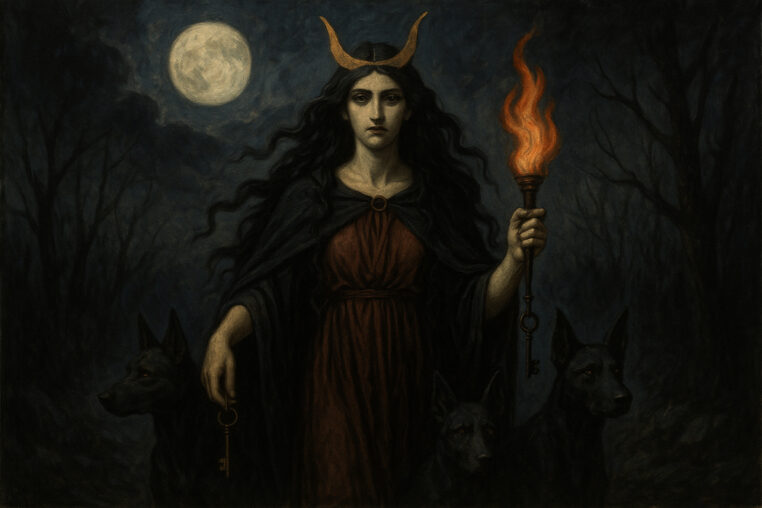
She is the keeper of keys, the torch-bearer who illuminates dark paths, the guardian of crossroads both literal and metaphorical. She protects those in transition – women in childbirth, souls traveling to the underworld, seekers navigating life’s difficult choices. She is the patron of marginalized people, of those who work magic, of anyone standing at a threshold wondering which path to choose.
In our contemporary world, these ancient roles remain remarkably relevant. Many people find themselves drawn to Hekate during times of major life transitions, when facing difficult decisions, or when doing deep psychological and spiritual work, what modern practitioners often call “shadow work.”
Living Tradition, Ancient Wisdom
The Night of Hekate on November 16th beautifully illustrates how ancient wisdom can speak to modern needs. Yes, it’s a contemporary invention. But it’s rooted in genuine ancient practice, serves real spiritual purposes, and has become meaningful to thousands of practitioners worldwide.
For those who observe the monthly Deipnon, November 16th is simply one more opportunity to honor the goddess. Perhaps with extra intention or community involvement. For others, it may be the primary or only time they focus specifically on Hekate throughout the year.
There’s no “wrong” way to approach this celebration, as long as it’s done with sincerity and respect. You might keep it simple with a small offering and a prayer, or create an elaborate ritual. You might celebrate alone or gather with others. You might focus on gratitude, on petition, on purification, or simply on deepening your connection with this ancient and powerful presence.
What matters is the intention. The willingness to stand at the threshold, to acknowledge the liminal spaces in our lives, and to invite Hekate’s torch to light our way through whatever crossroads we face.
Whether you’re new to honoring Hekate or a longtime devotee, may the Night of Hekate illuminate your path and may the goddess bless your journey through all of life’s transitions.