
Unlock the hidden messages from your subconscious mind and spiritual realm Core Content: What dream interpretation is and its historical significance How dreams work psychologically and spiritually Different types of dreams and their purposes Step-by-step interpretation process Common symbols and their meanings Magical approaches to dream work Practical Elements: Dream journaling techniques Herbs and crystals for dream work Advanced interpretation methods How to work with challenging dreams Building a personal dream practice Common interpretation mistakes to avoid The post balances: Scientific understanding with spiritual wisdom Universal symbols with personal meaning Theoretical knowledge with practical application Beginner-friendly guidance with advanced techniques The approach is respectful of both psychological and spiritual perspectives on dreams, emphasizing that the dreamer is the ultimate authority on their own dream meanings while providing tools and frameworks for deeper understanding. What Is Dream Interpretation? Dream interpretation is the ancient art of decoding the symbolic language of our dreams to gain insight into our subconscious mind, emotional state, and spiritual journey. Dreams have been recognized throughout history as bridges between the conscious and unconscious worlds, offering guidance, healing, and profound wisdom to those who learn to understand their messages. Unlike the random firing of neurons that some modern science suggests, dream interpretation approaches dreams as meaningful communications from our deeper self, spirit guides, or the collective unconscious. This practice recognizes that our dreaming mind speaks in symbols, metaphors, and archetypal images that carry personal and universal significance. The Ancient Wisdom of Dreams Throughout human history, dreams have been revered as sacred communications: ~ Ancient Egypt: Dreams were considered messages from the gods, with dream interpreters holding high positions in society~ Ancient Greece: The god Asclepius was said to visit people in dreams to provide healing guidance~ Indigenous Traditions: Many cultures view dreams as journeys of the soul and sources of spiritual guidance~ Biblical Tradition: Dreams are frequently mentioned as divine communications, from Jacob’s ladder to Daniel’s interpretations This rich heritage reminds us that dream interpretation is not a modern invention but an ancient practice that connects us to timeless wisdom traditions. How Dreams Work: The Mechanisms of Dream Language The Symbolic Mind Dreams primarily communicate through symbols rather than literal representations. A dream about flying might represent freedom, spiritual ascension, or the desire to rise above current circumstances. Understanding this symbolic language is key to effective dream interpretation. Personal vs. Universal Symbols Dream symbols operate on multiple levels: ~ Personal symbols: Unique to your life experience and associations~ Cultural symbols: Shared meanings within your cultural context~ Universal archetypes: Symbols that appear across cultures and time periods The Emotional Layer Dreams often process emotions that we haven’t fully acknowledged in waking life. The emotional tone of a dream—whether fearful, joyful, anxious, or peaceful—provides crucial information about what your subconscious is trying to communicate. The Prophetic Dimension Many practitioners believe dreams can provide glimpses of future possibilities or spiritual guidance. These prophetic dreams often carry a different quality. They feel more vivid, memorable, and significant than ordinary dreams. Types of Dreams and Their Meanings Processing Dreams These dreams help us work through daily experiences, emotions, and challenges. They might replay events from your day with symbolic variations, allowing your mind to process and integrate experiences. Example: Dreaming of being lost in a familiar place might represent feeling confused about a life situation you thought you understood. Healing Dreams Dreams can facilitate emotional, psychological, and even physical healing. They might offer comfort during difficult times or provide symbolic resolution to past traumas. Example: Dreaming of deceased loved ones often brings comfort and closure, representing the healing of grief. Guidance Dreams These… …
The Ten Commandments stand as one of humanity’s most enduring moral frameworks, transcending their biblical origins to influence spiritual traditions, magical practices, and ethical systems across cultures and millennia. While traditionally viewed through Judeo-Christian lenses, these ancient principles contain layers of esoteric wisdom that have captivated mystics, witches, and spiritual seekers far beyond conventional religious boundaries. Ancient Origins: More Than Meets the Eye According to biblical tradition, the Ten Commandments were first received by Moses on Mount Sinai, carved into stone tablets by divine hand. However, archaeological and historical evidence suggests a more complex origin story that reveals fascinating connections to ancient Near Eastern legal and spiritual traditions. The commandments appear in two slightly different versions within biblical texts, Exodus 20:1-17 and Deuteronomy 5:4-21, suggesting an evolution in their understanding and application. More intriguingly, similar moral and legal principles appear in earlier Mesopotamian codes, such as the Code of Hammurabi (c. 1750 BCE) and various Egyptian moral teachings, indicating that these ethical principles may have emerged from a broader ancient wisdom tradition. Archaeological discoveries at sites like Khirbet Qeiyafa have revealed Hebrew inscriptions containing moral injunctions that predate traditional biblical chronology, suggesting these principles were part of a living oral tradition long before they were codified in scripture. The famous silver amulets found at Ketef Hinnom, dating to the 7th century BCE, contain biblical verses that demonstrate how these teachings were used as protective talismans. A practice that bridges conventional religion and magical application. The physical creation of the tablets themselves carries profound symbolic significance. Stone, in ancient traditions, represented permanence, connection to earth energy, and the ability to hold and transmit spiritual power across time. The act of divine inscription suggests these weren’t merely legal codes but energetic transmissions, living principles that could influence both individual consciousness and collective reality. Esoteric Interpretations: Hidden Layers of Meaning Beyond their surface moral teachings, the Ten Commandments contain multiple layers of esoteric wisdom that have fascinated mystics and occultists for centuries. Each commandment can be understood as both practical guidance and spiritual technology for consciousness transformation. The First Commandment (“You shall have no other gods before Me”) speaks to the principle of focused intention and unified consciousness. In magical practice, this translates to the importance of clear will and undivided attention when working with spiritual forces. Scattered energy yields scattered results, while concentrated divine focus creates manifestation power. The Second Commandment (against idolatry) warns against mistaking symbols for reality – a crucial principle in witchcraft and magical practice. While images and representations can be powerful tools for focusing intention, the practitioner must never lose sight of the living forces behind the forms. This commandment teaches discernment between authentic spiritual connection and mere psychological projection. The Third Commandment (not taking the divine name in vain) reveals ancient understanding of the creative power of speech and names. In magical traditions, names carry vibrational essence. To speak divine names carelessly is to waste sacred energy and potentially invite unwanted consequences. This principle appears in virtually every magical tradition as the importance of respectful invocation and proper magical speech. The Fourth Commandment (observing the Sabbath) encodes profound wisdom about natural rhythms, energy cycles, and the necessity of regularly stepping outside ordinary consciousness. Many witches and pagans recognize this as guidance for honoring lunar cycles, seasonal transitions, and the importance of creating sacred time for spiritual renewal and magical working. The remaining commandments, honoring parents, prohibitions against murder, adultery, theft, false witness, and coveting, can be understood as energetic principles governing how personal power moves through relationships and community. Each violation creates energetic disturbance that affects not… …
Walk into any hotel and you’ll likely find that the 13th floor doesn’t exist. At least not officially. Many airlines skip row 13, and countless people avoid important events on Friday the 13th. But what if I told you that this widespread fear of the number 13 represents one of history’s most successful campaigns to demonize sacred feminine wisdom? The Making of a “Cursed” Number The mainstream fear of 13, known as triskaidekaphobia, didn’t emerge in a vacuum. Like many superstitions we take for granted, it has roots in the systematic suppression of pre-Christian spiritual traditions. The most commonly cited origin story points to the Last Supper, where 13 people gathered before Jesus’s crucifixion, with Judas supposedly being the 13th to take his seat. This Christian narrative helped cement 13’s reputation as harboring betrayal and death. But this explanation only scratches the surface of a much deeper cultural shift. During the centuries-long Christianization of Europe, many symbols and practices sacred to pagan traditions were deliberately reframed as evil or unlucky. The number 13, with its profound connections to lunar cycles and goddess worship, became a prime target in this spiritual makeover. The Moon’s Sacred Mathematics Here’s where things get interesting: there are approximately 13 lunar cycles in a solar year. For ancient peoples who lived by the rhythms of the moon, 13 wasn’t unlucky, it was the number that governed life itself. Traditional agricultural societies tracked planting, harvesting, and ritual observances by lunar months. Women’s menstrual cycles aligned with these same lunar patterns, creating a deep connection between the number 13, feminine wisdom, and the natural world’s rhythms. This lunar significance wasn’t lost on early pagan and witchcraft traditions. Many covens were structured around the sacred 13, twelve practitioners working with a high priestess, reflecting both the lunar months and the apostolic structure, but predating Christianity by millennia. The Witch’s Perspective: Reclaiming Sacred Numbers Talk to modern practitioners of witchcraft, Wicca, or other pagan paths, and you’ll discover a completely different relationship with 13. Rather than fearing it, many actively embrace it as a number of profound spiritual power. “Thirteen moons, thirteen cycles, thirteen opportunities for renewal,” explains one practitioner I spoke with. This perspective sees 13 not as an ending, but as completion that leads to new beginnings. The thirteenth moon cycle completing the year before the cycle begins anew. In many traditions, 13 represents the divine feminine in its full power. It’s the number of transformation, of death and rebirth in the spiritual sense. Where mainstream culture sees morbid finality, witchcraft traditions see the sacred spiral of existence, simply, endings that are always beginnings. The Psychology of Reclaimed Symbols There’s something deeply empowering about reclaiming symbols that were once used to diminish or frighten. When modern pagans embrace 13, they’re not just choosing a number, they’re rejecting centuries of messaging that taught them to fear feminine power, natural cycles, and pre-Christian wisdom. This reclamation extends beyond witchcraft communities. Many feminists, regardless of their spiritual beliefs, recognize the connection between fear of 13 and the broader cultural discomfort with feminine power and wisdom. The number becomes a small act of rebellion against patriarchal narratives. Living with Sacred Numbers Whether you’re drawn to witchcraft traditions or simply interested in the hidden histories behind our superstitions, the story of 13 offers a fascinating lens into how cultural narratives shape our reality. The next time you encounter the number 13, whether on a calendar, an address, or in daily life, consider pausing to reflect on its deeper meanings. Rather than reflexively feeling uneasy, you might choose to see it as a connection… …
Part 1 : From childhood dreams to whispered curiosities, I always felt a tug toward something deeper. Witchism wasn’t a word I knew then, but the pull was already there.
Part 3 : Growing up, I wrestled with religion. There were rules I couldn't follow, and truths that didn't match what I felt in my bones. Witchism became my way of reclaiming the divine on my own terms.
Part 4 : A book. A conversation. A tarot deck in a dusty shop. My journey truly began with one unexpected moment of resonance.
Part 5 : It took time to name myself “witch.” The world taught me to fear it. But slowly, I learned to untangle witchcraft from shame.
Part 6 : It’s not about power over—it’s about connection. With nature, spirit, ancestors, and myself. Witchism isn’t a religion. It’s a relationship.
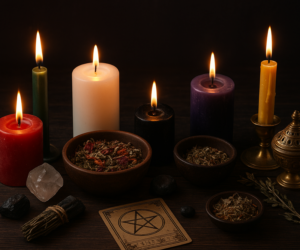
Part 7 : My altar started with a candle and a rock. Over time, rituals formed, tools gathered, and everything became a sacred act—from stirring tea to walking barefoot.
Part 8 : Books, people, spirits, and chance encounters have all shaped me. Some lessons were gentle. Others cracked me open. All of them mattered.