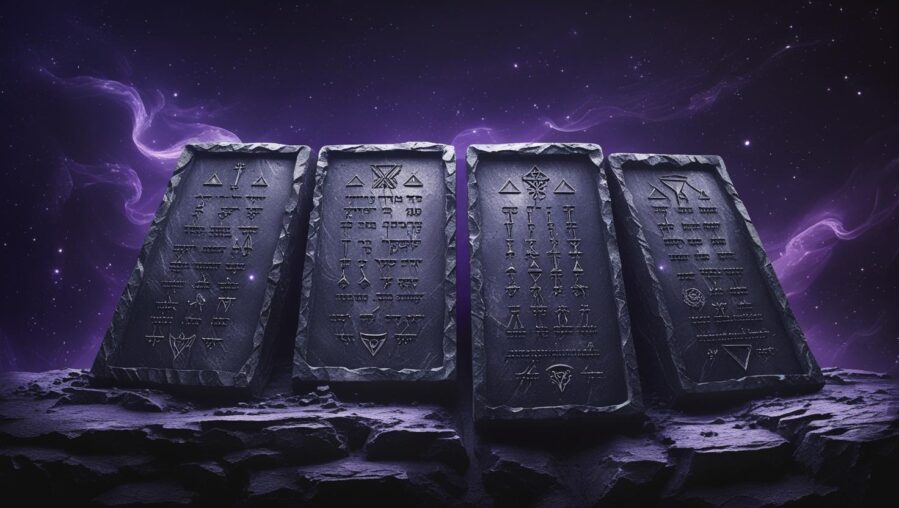

The Ten Commandments stand as one of humanity’s most enduring moral frameworks, transcending their biblical origins to influence spiritual traditions, magical practices, and ethical systems across cultures and millennia. While traditionally viewed through Judeo-Christian lenses, these ancient principles contain layers of esoteric wisdom that have captivated mystics, witches, and spiritual seekers far beyond conventional religious boundaries.Ancient Origins: More Than Meets the EyeAccording to biblical tradition, the Ten Commandments were first received by Moses on Mount Sinai, carved into stone tablets by divine hand. However, archaeological and historical evidence suggests a more complex origin story that reveals fascinating connections to ancient Near Eastern legal and spiritual traditions.The commandments appear in two slightly different versions within biblical texts, Exodus 20:1-17 and Deuteronomy 5:4-21, suggesting an evolution in their understanding and application. More intriguingly, similar moral and legal principles appear in earlier Mesopotamian codes, such as the Code of Hammurabi (c. 1750 BCE) and various Egyptian moral teachings, indicating that these ethical principles may have emerged from a broader ancient wisdom tradition.Archaeological discoveries at sites like Khirbet Qeiyafa have revealed Hebrew inscriptions containing moral injunctions that predate traditional biblical chronology, suggesting these principles were part of a living oral tradition long before they were codified in scripture. The famous silver amulets found at Ketef Hinnom, dating to the 7th century BCE, contain biblical verses that demonstrate how these teachings were used as protective talismans. A practice that bridges conventional religion and magical application.The physical creation of the tablets themselves carries profound symbolic significance. Stone, in ancient traditions, represented permanence, connection to earth energy, and the ability to hold and transmit spiritual power across time. The act of divine inscription suggests these weren’t merely legal codes but energetic transmissions, living principles that could influence both individual consciousness and collective reality.Esoteric Interpretations: Hidden Layers of MeaningBeyond their surface moral teachings, the Ten Commandments contain multiple layers of esoteric wisdom that have fascinated mystics and occultists for centuries. Each commandment can be understood as both practical guidance and spiritual technology for consciousness transformation.The First Commandment (“You shall have no other gods before Me”) speaks to the principle of focused intention and unified consciousness. In magical practice, this translates to the importance of clear will and undivided attention when working with spiritual forces. Scattered energy yields scattered results, while concentrated divine focus creates manifestation power.The Second Commandment (against idolatry) warns against mistaking symbols for reality – a crucial principle in witchcraft and magical practice. While images and representations can be powerful tools for focusing intention, the practitioner must never lose sight of the living forces behind the forms. This commandment teaches discernment between authentic spiritual connection and mere psychological projection.The Third Commandment (not taking the divine name in vain) reveals ancient understanding of the creative power of speech and names. In magical traditions, names carry vibrational essence. To speak divine names carelessly is to waste sacred energy and potentially invite unwanted consequences. This principle appears in virtually every magical tradition as the importance of respectful invocation and proper magical speech.The Fourth Commandment (observing the Sabbath) encodes profound wisdom about natural rhythms, energy cycles, and the necessity of regularly stepping outside ordinary consciousness. Many witches and pagans recognize this as guidance for honoring lunar cycles, seasonal transitions, and the importance of creating sacred time for spiritual renewal and magical working.The remaining commandments, honoring parents, prohibitions against murder, adultery, theft, false witness, and coveting, can be understood as energetic principles governing how personal power moves through relationships and community. Each violation creates energetic disturbance that affects not only individuals but the collective field in which magical and spiritual work...
