
 Written by
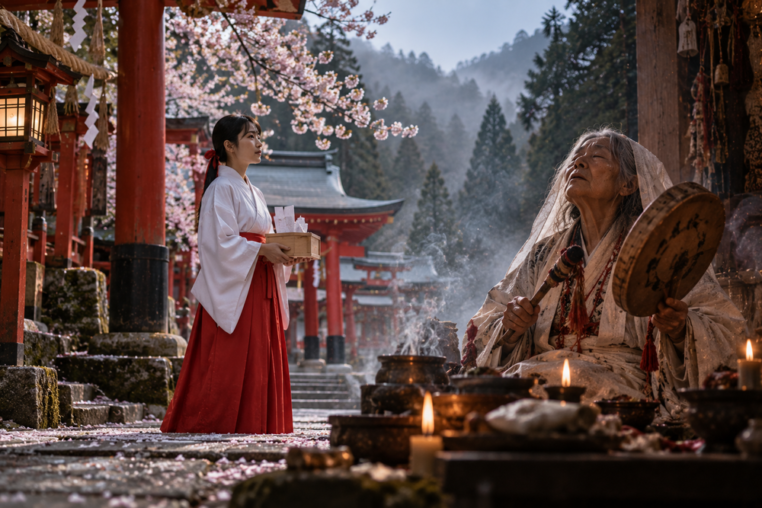
 In Japan, if you visit almost any Shinto shrine, you will encounter them: young women in white robes and deep red hakama skirts, moving quietly through the grounds, assisting priests, distributing talismans, performing sacred dances. They are called miko (巫女), and the image has become so familiar, so thoroughly absorbed into the aesthetic of Japanese religious life, that it is easy to mistake it for the whole story.
It is not the whole story.
The miko you see at the shrine reception desk, offering you a paper fortune and a smile, is the end point of a very long journey. At the beginning of that journey stands a very different figure: an ecstatic, a medium, a woman through whom the gods entered the world and spoke. The institution survived. The power was stripped out of it, piece by piece, over centuries of political pressure, religious consolidation, and finally an outright government ban.
And somewhere in the mountains of northeastern Japan, almost out of reach now, almost gone, there are women who kept the original function alive. They are called itako. They are nearly all old. When they die, there may be no one left to replace them.
This is the story of both.
The Kanji Tells You What They Were
The word miko (巫女) is written with two characters. The second, 女 (onna), means woman. The first, 巫 (fu or miko), is the character for shaman. It appears across East Asian cultures wherever the figure of the female spirit intermediary is named. We have already met it in this series in the Chinese wu (巫), the archaic shamanic practitioners whose tradition predates Taoism by millennia. (Read about the Wu here…)
This is not a coincidence. The Japanese words miko and fujo – “female shaman” and “shrine maiden” respectively – are both commonly written with the same compound of these two kanji: 巫 (shaman) and 女 (woman).
The character for shaman is shared across the Japanese and Chinese writing systems because the underlying current of practice they name is also, in its deep roots, shared. The miko tradition belongs to the same broad stream of female-led spirit intermediation that ran from Manchuria down through China, Korea, Japan, and out to the Ryukyu Islands. A tradition of women as the necessary threshold between the human world and the world that pressed against it.
The origins of the miko date back to the prehistoric Jomon period, approximately 10,500 BCE to 300 BCE, in Japan. We are not dealing with a recent or peripheral tradition. This is one of the oldest religious roles in Japanese history. Possibly the oldest. And it sits at the foundation of what would eventually become Shinto.
The Shaman Queen at the Origin
Before we reach the institutional miko of the shrine system, we need to pause at the figure who stands, half-legendary, at the very headwater of this tradition.
Himiko (170–247/248 CE), also known as the Shingi Waō – “Ruler of Wa, Friend of Wei” – was a shamaness-queen of Yamatai in ancient Japan. Early Chinese dynastic histories chronicle her tributary relations with the Cao Wei Kingdom and record that the Yayoi period people chose her as their ruler following decades of warfare among the kings of Wa.
The primary record is a Chinese chronicle from 297 CE, and it describes her in language that makes her function unmistakably clear. Himiko was a shaman queen who controlled a fragmented political structure of more than a hundred separate tribes, and she “occupied herself with magic and sorcery, bewitching the people.” The Chinese scribe did not intend that as a compliment. But it is an accurate description of someone whose political authority was inseparable from her spiritual function. A woman who ruled because she could access what no one else could.
Himiko’s name may itself be a Chinese corruption of himemiko, “princess-priestess,” or “lady shaman.” The word miko is right there in the name of the woman many scholars consider the earliest named ruler of Japan.
After becoming queen, Himiko was sequestered in a palace served by a thousand female attendants and a single male attendant. She maintained her diplomatic relations with the Wei emperor in China, who titled her the “Wa ruler friendly to the Wei” and sent her a golden seal with a purple cord, textiles, and bronze mirrors. The seclusion is significant. It maps onto the pattern of shamanic withdrawal we see in many cultures, the deliberate separation of the spirit worker from ordinary social contact as the price and condition of their access to the unseen.
In this way, the female miko who spoke with the voice of the kami would become, over the subsequent centuries, relegated to the humble shrine attendant she is today. Himiko represents the miko tradition at its fullest ancient power, before the long contraction began.
What the Ancient Miko Actually Did
In their original function, miko were not ceremonial assistants. They were something considerably more demanding.
One of the key responsibilities of ancient miko was kagura ceremonial dance, literally “kami entertainment.” Kagura was believed to encourage kami to descend and possess the miko dancing. In ancient Japan, miko received messages from the kami and often held positions of religious and political authority.
The possession, the kami actually entering the miko’s body and speaking through her, was not metaphorical. It was the point. The miko was a yorimashi, a vessel, a medium, a person whose trained body became the temporary home of the divine. Whatever the kami said through the miko had immediate political and social consequence, because the kami were not understood as remote abstractions. They were the forces that governed harvest, war, illness, and weather. To know what they wanted was to know what to do.
The kagura dance that survives in shrine ceremony today, the elegant, slow performance in red and white, originated as something rawer. A technology of invitation, a movement practice designed to open the performer to divine possession. Kagura is believed to have originated from the mythical dance performed by the goddess Ame-no-Uzume to lure Amaterasu, the sun goddess, out of her cave and bring light back to the world. The prototype for miko dance is a goddess coaxing another goddess out of hiding through performance. The cosmological stakes could not be higher.
Outside the formal shrine system, was another category of miko altogether. Aruki miko (歩き巫女), “walking miko“. Traveled between villages performing divination and spirit communication for ordinary people. These women were itinerant, unattached to institutions, working the roads between settlements and offering their services to whoever needed them. They represent the grassroots, uncontrolled, deeply popular face of the same tradition. The miko as village wise woman, wandering seer, accessible practitioner, rather than shrine fixture.
The Long Suppression
The history of the miko is, in significant part, a history of the progressive reduction of their authority by successive systems of power that found that authority threatening or inconvenient.
During the Nara period (710–794) and Heian period (794–1185), government officials tried to control miko practices, and the miko’s stature as a woman close to the kami diminished as a patriarchal, militaristic society took over. The introduction of Confucianism and Buddhism into Japan both carried structural pressures against the prominent public role of women as independent religious authorities. Neither system was specifically designed to suppress the miko, but both had that effect, because neither left much room for female spiritual authority that operated outside male institutional structures.
The final blow, or what was meant to be the final blow, came from an unexpected direction. After 1867, the Meiji government’s desire to create a form of state Shinto headed by the emperor, the shaman-in-chief of the nation, meant that Shinto needed to be segregated from both Buddhism and folk-religious beliefs. The restructuring of Shinto as state ideology required the elimination of the unruly, grassroots, women-led spirit practices that had characterized it for centuries.
In 1873, the government issued an edict called Miko Kindanrei (巫女禁断令), forbidding all spiritual practices by miko. An estimated two hundred miko were practicing at the time. Their livelihoods were abruptly made illegal. The state had decided that it was the emperor, not the women at the shrines, who held the mediating function between the divine and the human. And that the old female shamanic tradition was now, officially, superstition.
The ban was never formally repealed. Miko began returning to shrines around 1940, but when they did, they returned in a reduced form: as ceremonial assistants to male priests, performers of sacred dance, sellers of talismans. The original function – the possession, the trance, the kami speaking through a woman’s body – was not restored. That part of the tradition went underground, or north.
The Itako: What Did Not Disappear
In the Tohoku region of northeastern Japan, in the prefectures of Aomori, Akita, and Iwate, in the cold and remote north of Honshu – a different form of female spiritual practice survived. It survived partly because it was far from the centers of power, partly because the people who practiced it were already marginal by definition, and partly because the need they met was so fundamental and so persistent that no government ban could fully extinguish it.
The itako of Aomori Prefecture are female mediums, traditionally blind, known for channeling the spirits of the dead to communicate with the living.
In the harsh climate of northern Japan, blindness was historically a common affliction due to measles and malnutrition. With few economic opportunities available to them, young blind girls were often apprenticed to established shamans. This is the practical reality underneath the spiritual tradition: the itako lineage developed, in significant part, as a vocational path for women who would otherwise have had almost no path at all. Disability, poverty, and spiritual vocation became intertwined in the way they so often do in the history of marginalized practitioners. The people who fall outside ordinary social structures sometimes become the ones who move between worlds, because they already live at the threshold.
Unlike shamans who experience spontaneous spirit possession, itako acquire their abilities through rigorous, multi-year apprenticeships under an experienced mentor. The training is severe, involving ascetic practices, intensive memorization of chants, and extended periods of purification. The itako is not someone to whom the ability simply arrived. She worked for it, in the care of a teacher, within a lineage.
The central practice of the itako is kuchiyose, spirit channeling, the calling of the dead. During this ritual, the itako calls upon a specific spirit, whether an ancestor, a recently deceased relative, or even an unborn child, and by chanting sutras and rubbing irataka beads together to create a rhythmic, hypnotic sound, enters a trance. The spirit speaks through her. The living person sitting across from her hears, in the itako’s voice, the voice of whoever they came to find.
Historically, these women served as the unofficial community therapists, doctors, and spiritual counselors of rural northern Japan. When a family was disrupted, when someone grieved without resolution, when illness came and its cause was unclear, when a death had been sudden and the living couldn’t make peace with it – these were the moments the itako was for. Not a curiosity, an infrastructure.
Mount Osore: The Mountain at the Edge of the World
The most significant gathering of itako practice is at Mount Osore (恐山, Osorezan) – literally, “Mount Dread” – on the Mutsu Peninsula in Aomori. The name is accurate. The mountain is a volcanic landscape of sulfurous vents, barren grey rock, and acid lakes of an unearthly blue-green color. The Buddhist temple that sits at its center has existed there since the ninth century, and the site is understood, in both Buddhist and folk religious tradition, as one of the places where the boundary between the world of the living and the world of the dead is thinnest.
The itako were in the past blind women who, through training, learned the practices and then worked as mediums offering their services at the local festivals held regularly around the northern area of Tohoku, and annually at a major festival held at Mount Osore. A site said to have a powerful connection to the other world.
The festival, the Itako Taisai, draws thousands of people each year who come to sit with the itako and speak with their dead. The atmosphere, the volcanic rock, the smell of sulfur, the chanting women, the bereaved sitting close and listening, is one of the most genuinely liminal spaces in Japanese religious practice. Whatever you believe about whether the dead actually speak at Mount Osore, it is impossible to stand there and not feel that you are somewhere close to an edge.
What Is Being Lost
There are only a tiny handful of traditionally trained itako left alive in Japan, most of whom are well into their eighties and nineties. One specific practitioners’ association in Esashi recognizes only a handful of practitioners following historical traditions, and the last completely blind itako recorded was Nakamura Take, who was ninety years old.
The conditions that produced the itako, the prevalence of blindness from untreated childhood illness, the extreme economic marginality of disabled women in rural Japan, the density of folk religious belief in remote Tohoku communities, have changed, and changed irreversibly. Modern medicine, changed economic conditions, and the general modernization of rural Japan have all altered the context in which the tradition existed. New practitioners do occasionally appear, including sighted women who choose the practice, but the transmission of the older lineage, in its traditional form, is ending.
What that ending means is genuinely unclear. The itako tradition is not a fossil. It has adapted and continues to adapt. But the specific form it has taken, the specific voice through which the dead of rural Tohoku have spoken for centuries, is passing out of the world with the women who carry it.
The Thread Between Them
The miko and the itako are not, strictly speaking, the same tradition. The miko belongs to the shrine system, to Shinto, to the formal institutional structure of Japanese state religion. The itako exists outside that structure. Regionally specific, informally transmitted, rooted in folk practice and necessity rather than in temple organization.
But they share the same deep origin. They are both expressions of the same foundational understanding. That women can serve as the threshold between the living and the dead, between the human and the divine. That this capacity can be cultivated through training and discipline. That the community needs someone who can stand at that threshold and function there.
The miko tradition was captured, formalized, and then emptied of its original power by successive institutions that found unconstrained female spiritual authority inconvenient. The itako tradition survived because it was too remote, too marginal, too embedded in practical community need to be fully absorbed or suppressed. One became ceremonial. The other stayed functional.
Both are worth knowing. Both are part of the same story about what women have carried, what has been taken from them, and what has survived anyway. In cold mountains, in blind women’s hands, in the language of the dead.
For the Practitioner
The history of the miko is one of the clearest documented examples in world spiritual history of an institution being systematically stripped of its original function.
The capacity was real. The training was real. The function, the kami speaking through the woman’s body, the ancestors summoned and given voice, was real within the framework of the tradition. And it was not destroyed by disbelief. It was destroyed by a government decision that the emperor, not the women, would hold the mediating role. The spiritual function was not abolished. It was reassigned. Upward, to male institutional authority. And what remained of the miko was the ceremonial shell.
This is a pattern worth recognizing, because it recurs. The ecstatic, the medium, the possessed woman – these figures appear across world traditions and they are repeatedly subject to the same pressure. The pressure to become decorative, to perform the appearance of spiritual connection without the substance, to stand in white and red at the threshold without crossing it.
The itako offer a different kind of example. Not a resistant political movement, not a defiant assertion of tradition, but simply women who kept doing what their communities needed, in the places where the communities still needed it, for as long as they could.
There is a lesson in both.
The Miko tradition: origins in the Jomon period, Japan, c.10,500 BCE onward.
The Itako tradition: Tohoku region, Japan, Edo period onward, currently in terminal decline. Two expressions of one ancient function.
The woman who stands between the living and whatever presses against the boundary of the living world.
References
Blacker, Carmen. The Catalpa Bow: A Study of Shamanistic Practices in Japan. George Allen & Unwin, 1975. The foundational English-language scholarly study of Japanese shamanism, covering both miko and itako practice in depth.
Fairchild, William P. “Shamanism in Japan.” Folklore Studies, vol. 21, 1962, pp. 1–122. Sociological Institute, Nanzan University. Landmark survey of Japanese shamanic tradition; includes the 26-term taxonomy of shrine-attached miko roles.
Naumann, Nelly. “The Itako of North-Eastern Japan and Their Chants.” Nachrichten der Gesellschaft für Natur- und Völkerkunde Ostasiens (NOAG), vol. 152, 1992. Peer-reviewed ethnomusicological study of itako practice and oral transmission.
Josephson, Jason Ānanda. The Invention of Religion in Japan. University of Chicago Press, 2012. Covers the Meiji-era suppression of miko and itako practices, including the 1873 Miko Kindanrei edict and its context within state Shinto construction.
Breen, John, and Mark Teeuwen, eds. A New History of Shinto. Wiley-Blackwell, 2010. Academic overview of Shinto history including the evolving institutional role of miko through the Meiji period.
Tsunoda, Ryusaku, trans., and L. Carrington Goodrich, ed. Japan in the Chinese Dynastic Histories. Perkins Asiatic Monographs, 1951. Includes translations of the Wei Zhi passages describing Queen Himiko and the Yamatai federation.
Nippon.com. “Voices from the Other Side: Aomori’s Traditional Itako Mediums.” nippon.com, 2025. Documentary journalism covering the itako of Esashi and the last blind practitioner, Nakamura Take.
Rausch, Anthony. “Understanding the Tsugaru Itako.” Electronic Journal of Contemporary Japanese Studies, vol. 21, no. 2, 2021. Academic review of Sasamori Takefusa’s ethnographic study of itako practice in the Tsugaru District, Aomori Prefecture.