Mary Oneida Toups ~ The Witch Queen Who Made History (And Mystery)

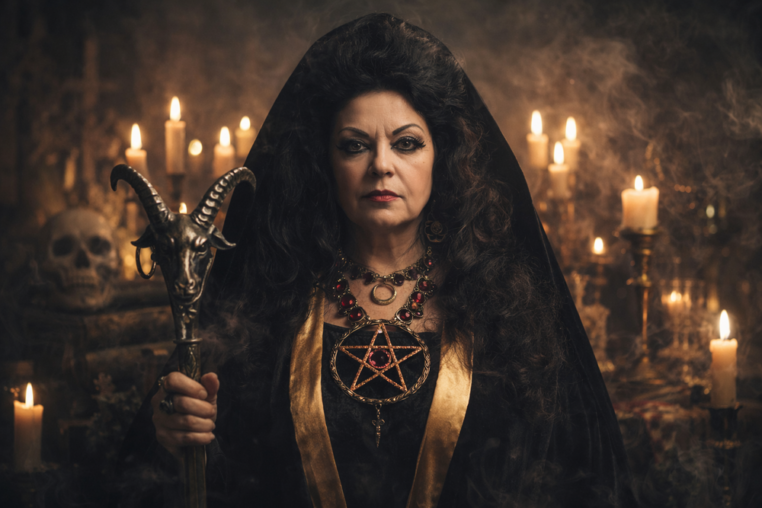
Before I begin this post, I want to mention that the image depicted here is an AI-generated representation of Mary Oneida Toups. I was unable to find a clear, freely available photograph of her. Mary was a mid-20th-century occultist known as the “Witch Queen of New Orleans,” but very few public photos exist online. Most available images are of paintings or portraits held in private collections. A painted portrait of her from the 1960s–70s, described as showing an elegant woman with dramatic brows and dark hair, survives in a private collection, but no clean photographic portraits are publicly available for reuse.I also struggled with how to categorize this post. After much consideration, I’ve placed it under “mythology”. Not because Mary wasn’t real, but because of what the word actually means. Mythology, at its core, refers to a collection of stories, beliefs, and narratives that shape how we understand a person, place, or concept. What we truly know about Mary Oneida Toups is limited to what was made public, the documented facts, the legal records, the published book. Everything else exists in the realm of story, speculation, and legend. In that sense, Mary has become mythological: a figure whose truth is inseparable from the tales told about her. Mary arrived in New Orleans with nothing but ambition and a vision. Within four years, she had chartered the first legally recognized Church of Witchcraft in Louisiana. Within seven, she’d published a book praised by Aleister Crowley’s former secretary. And then, at 53, she died under circumstances that remain disputed to this day – leaving behind no obituary, no known grave, and a legacy so shrouded in mystery that even her successors aren’t sure where fact ends and legend begins.This is the story of Mary Oneida Toups, the Witch Queen of New Orleans. And like any good witch’s tale, separating truth from myth requires some serious detective work.The Documented Facts ~ What We Actually KnowLet’s start with what’s verifiable – the paper trail, the public record, the things we can prove beyond the storytelling and speculation.Born: April 25, 1928, in Meridian, Mississippi, to Arthur Hodgin and Mary Ellen Killing. Born Oneida Hodgin, she was the youngest of four children.Life Before New Orleans: Here’s where the record gets sparse but suggestive. At some point before the mid-1960s, Mary (then Oneida Hodgin) had a son named Charlie. She later met and lived with a Navy man named David Berry in New Orleans for a few years, according to a former sister-in-law interviewed by researcher Alison Fensterstock. The couple went their separate ways in the mid-1960s.So Mary wasn’t a stranger to New Orleans, she’d lived there before, as a housewife and mother, in what appears to have been a conventional life. Then she left. What happened during those years between leaving David Berry and returning in 1968 as Mary Oneida Toups? That’s one of the many mysteries.Arrived in New Orleans (permanently): 1968, at age 39-40. She came with her husband Albert “Boots” Toups, a Cajun from the Lower Ninth Ward who was a high-ranking Freemason. The couple briefly ran a bar together on Decatur Street (at 1141 Decatur, now home to Café Angeli).Opened her first occult shop: September 1, 1970. The Witch’s Workshop at 521 St. Philip Street in the French Quarter. She sold oils, floor washes, spell kits, powders, candles, and yes, dried bats’ hearts. (She insisted on selling whole bats so customers could verify authenticity, explaining that people might substitute chicken hearts otherwise.)Chartered the Religious Order of Witchcraft: February 2, 1972 (Candlemas/Imbolc), with the Louisiana Secretary of State. This made it the first legally...

Membership Required

You must be a member to access this content.

View Membership Levels

Already a member? Log in here