
 Written by
 Deep in the woodlands of Fife, just minutes from the ancient city of St Andrews, lies a place where the veil between worlds grows thin. Hidden behind Dunino church sits an ancient pre-Christian holy site featuring an altar stone, a sacred well, and carved footprints etched into rock overlooking a stream. This is Dunino Den. A place where time layers upon itself, where ancient kings may have been crowned, where druids once performed their mysteries, and where modern pilgrims still leave offerings for spirits that have never left.
Descending Into Sacred Space
A narrow, winding set of stone steps carved into the rocks lead down into the den, pulling visitors deeper into the wooded ravine. These aren’t modern stairs. They’re worn smooth by countless feet over potentially thousands of years, each step a descent not just into geography but into history itself.
As you descend, the mundane world falls away. The canopy closes overhead. The sound of the Kinaldy Burn rushing below fills your ears. And suddenly, you’re standing before something that defies easy explanation. Massive rock faces covered in symbols, some ancient, some modern, all speaking to the same impulse – the need to mark sacred space, to communicate with what dwells beyond the visible.
The Altar Stone and the Well of Mysteries
At the heart of Dunino Den sits what locals call the Altar Stone. A massive crag that commands the space with quiet authority. Cut into this stone is a well or pool, and some sources claim this is where druids carried out rituals, though the truth of what happened here has been lost to time, wrapped in layers of folklore, Christian reinterpretation, and genuine mystery.
The well itself speaks to something primal. Our ancestors’ reverence for water emerging from stone, for the places where the earth opens and reveals its hidden depths. Whether it held water for baptisms, libations, or sacred washing, the well remains, still catching rainwater, still reflecting sky, still waiting.
Some tales claim darker purposes. Anti-pagan folklore suggests that druids made human sacrifices at these pools, with the pools filling up with blood. But these stories likely say more about early Christian attempts to demonize pagan practices than about historical reality. The well more likely served as what it appears to be: a sacred vessel, a portal, a place where offerings could be made to the powers below.
The Footprints: Where Kings Were Made
Perhaps the most enigmatic feature of Dunino Den is the carved footprint in the rock. It’s believed that Pictish kings were crowned on the stone, with carved footprints used during inauguration rituals such as the anointing of kings. This practice, standing in carved footprints as a symbol of stepping into power, of claiming sovereignty, appears at other ancient sites across Scotland and Ireland.
Imagine it – a young king-to-be, standing barefoot in these carved prints, feet fitting into the impression left by his predecessors, connecting himself to the land, to the ancestors, to the spirits of place. The footprint as portal, as contract, as sacred bond between ruler and realm.
The rock-cut pool, carved footprint, and incised cross all point to the Den being a place where sacred rites were conducted in ancient times. These weren’t separate traditions warring for dominance. They were layers of the same impulse, the human need to mark and honor the places where the sacred breaks through.
A Canvas of Symbols
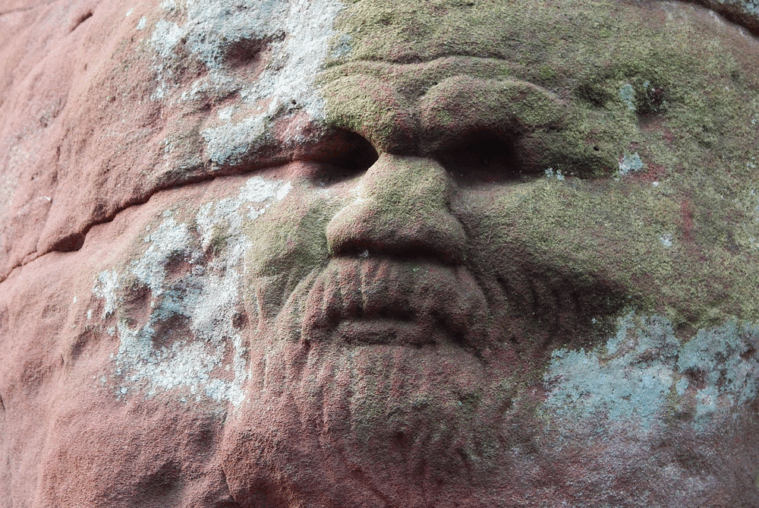
Celtic crosses, odd faces, and mystical symbols have been etched into the rocks throughout Dunino Den. Some are clearly ancient. The weathered crosses that speak to early Christian adoption of this pagan site, the mysterious faces that may represent the Green Man or older gods still. Others are more recent, carved by modern hands continuing an ancient tradition.
Walk the den and you’ll find:
~ Celtic crosses intertwining with older symbols
~ Faces peering from the stone – human, divine, or something between
~ Spirals and geometric patterns whose meanings we can only guess
~ Modern additions by neo-pagans, witches, and spiritual seekers
This layering is part of the den’s power. It’s not a museum piece, frozen in time. It’s a living sacred site, still accumulating meaning, still calling to those who feel the pull of the old ways.
The Offerings – Then and Now
Perhaps the most striking evidence that Dunino Den remains an active sacred site is the sheer volume of offerings left here. Pagan pilgrims venturing to the site leave offerings of all kinds hanging from the trees and tucked into crevices in the cliffs, from coins to ribbons to panties.
Walk through the den and you’ll find:
~ Coins pressed into bark and wedged between stones
~ Ribbons tied to branches in every color, red for protection, white for peace, green for healing
~ Small crystals and stones left on flat surfaces
~ Handwritten prayers and wishes wrapped in plastic to protect them from rain
~ Flowers, both fresh and dried
~ Candle stubs from nighttime rituals
~ Personal items offered as sacrifice or petition
Some believe these offerings are left to appease the fairies that lurk here. Those familiar with Scots mythology understand that such spirits can be intensely violent. The fairies of Scottish folklore aren’t Tinkerbell. They’re the Good Folk, the Gentry, beings of immense power who must be respected, honored, and sometimes placated.
The variety of offerings speaks to the variety of visitors. Practicing pagans leaving ritual offerings, curious tourists leaving coins, witches performing workings, people seeking healing or guidance leaving tokens of their intentions. All of them, whether they know it or not, participating in a tradition that stretches back beyond memory.
The Otherworld Connection
Dunino Den has earned its reputation as a “Gateway to the Otherworld” – that liminal space in Celtic tradition where the supernatural and natural worlds meet and mingle. Several factors contribute to this perception:
The geography itself
The site sits in a strip of natural woodland, rare in eastern Fife, alongside a deep section of the Kinaldy Burn. Ravines, especially those with water, have always been considered threshold places – neither fully land nor water, descending into earth, open to sky.
The layered history
Druid sites, Pictish royal ceremonies, early Christian adoption, centuries of folk practices, and modern pagan revival all exist here simultaneously. When so many generations have deemed a place sacred, that collective belief creates its own reality.
The atmosphere
There’s something about Dunino Den that affects people. The quality of light filtering through leaves. The sound of water over stone. The weight of all those symbols carved into rock. The presence of offerings. Many visitors report feeling watched, feeling welcomed, or feeling the hair rise on their arms – visceral responses to something they can’t quite name.
The Church Connection
Interestingly, Dunino Den sits directly behind Dunino Church, a small parish church that may itself stand on significant ground. It has been suggested that Dunino Church may occupy a site where a stone circle once stood, continuing the pattern seen throughout Britain where Christian churches were built on pre-Christian sacred sites.
This proximity isn’t coincidental. The early Christian church in Scotland often didn’t destroy pagan sites – it absorbed them, reconsecrated them, and wove Christian symbolism into existing sacred landscapes. The Celtic crosses carved into the den’s rocks are evidence of this synthesis, not conquest.
Visiting Dunino Den. What You Should Know
If you’re called to visit this sacred space, approach with respect and awareness:
Practical matters
~ The site is located near the village of Dunino, about 5 miles from St Andrews in Fife, Scotland
~ Park at Dunino church and walk straight into the woods for a few minutes to reach the altar, with steps down into the den sitting to the left
~ Take care when approaching the area, as there is a substantial drop from the top of the altar stone to the river below
~ The site is accessible year-round, but can be slippery when wet
~ Bring a flashlight if visiting in low light, the woodland can be quite dark
Spiritual considerations
~ This is an active sacred site for many people. Treat it as you would any place of worship
~ If you leave offerings, make them biodegradable when possible (natural materials, not plastic)
~ Don’t remove offerings left by others – they’re not yours to take
~ Be mindful of your energy and intention – many believe the spirits here are very much present
~ If you perform any workings, clean up completely afterward
~ Some practitioners recommend introducing yourself to the spirits of the place before exploring
What to expect
~ The site is relatively small but dense with features
~ You can see the carvings in the rocks. Some quite old, some done by visitors
~ The atmosphere is palpable. Even skeptics often report feeling something unusual here
~ You may encounter other visitors, from tourists to practicing pagans performing rituals
~ Take your time – the power of the place reveals itself slowly
The Living Mystery
What makes Dunino Den so compelling isn’t just its age or its history. It’s that the mystery remains alive. We don’t know for certain who carved the original footprints or when. We don’t know exactly what rituals were performed here, what prayers were spoken, what visions were sought. We don’t know which of the symbols are genuinely ancient and which are more recent additions to an ongoing tradition.
And perhaps that’s exactly as it should be. Sacred sites aren’t meant to be completely understood, neatly labeled, and filed away. They’re meant to remain mysterious, to remain active, to continue calling to those who need to hear them.
The Dunino Den was an ancient ceremonial site for Druids who carved mystical symbols into rocks for future generations to discover. Those future generations, us, continue to discover, continue to interpret, continue to add our own marks and offerings to the ongoing conversation between human and spirit, visible and invisible, past and present.
An Invitation From the Old Gods
Dunino Den doesn’t exist as a relic or a curiosity. It exists as a door that never fully closed, a phone line that’s still connected, a sacred space that hasn’t forgotten how to be sacred. The spirits that were honored here in ancient times haven’t left. The power that drew druids, kings, and early Christians to this ravine still pulses beneath the surface.
The offerings dangling from trees and wedged into stone crevices are proof that humans still recognize places where the veil is thin, where the Otherworld presses close, where you can leave a token and feel/know, that it was received.
Whether you visit as a pilgrim, a tourist, a practicing pagan, or simply as someone curious about the mysteries that persist in wild places, Dunino Den offers the same invitation it’s always offered:
Step down. Descend the ancient stairs. Stand in the footprints. Look into the well. Touch the carved symbols. Leave your offering.
And listen.
The spirits are still speaking.
They’ve been waiting for you to arrive.