 Written by
There is something a solitary practice cannot give you.
You can develop a great deal in isolation. The depth of attention that comes from long periods of uninterrupted individual practice, the sensitivity that grows from sustained solo work, the relationship with the inner life that develops in quiet – all of these are real and significant and not to be undervalued. There is a reason that hermits and solitaries appear in every major spiritual tradition as figures of genuine development.
But the solitary practice also has a ceiling that community, at its best, can raise.
The community that works, that genuinely supports and challenges and widens the individual practice, does things the solo practitioner cannot do for themselves. It provides the mirror of other people’s experience, which shows you things about your own experience that you cannot see from the inside. It provides the friction of genuine difference. Of people whose practice looks different from yours, whose questions are not your questions, whose answers do not always satisfy you. Which prevents the particular kind of stagnation that comes from only ever being in conversation with yourself. It provides the accumulated wisdom of practitioners who have been further along the path than you currently are, which saves you from having to reinvent everything from the first principle.
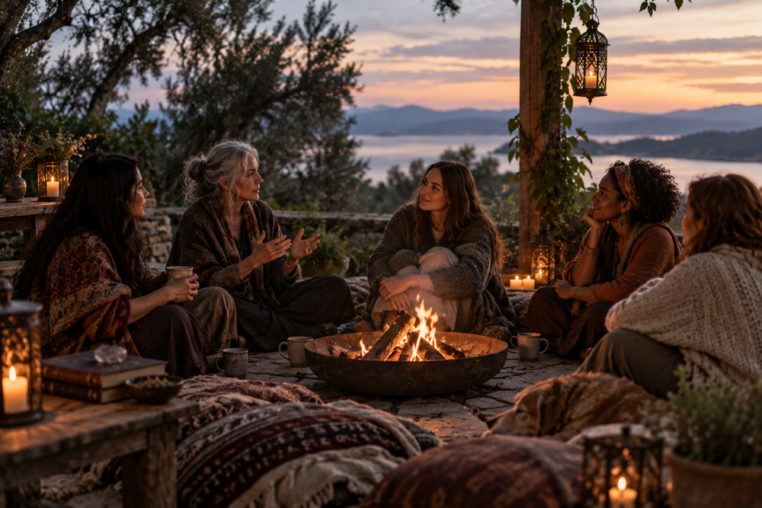
And it provides something harder to name: the quality of resonance that arises when people who are genuinely engaged in the same kind of work are in the same room. This quality, which is different from mere shared interest, different from social compatibility, more specific than liking the same things, is something you may have felt in a good ritual, or in a workshop with the right teacher, or in a conversation with a practitioner who is genuinely working the same territory you are. It is the sensation of being genuinely met in the place where you actually live.
That is worth seeking.
What Makes a Community Good
Not all communities that describe themselves as spiritual are doing the same thing. The range is wide. From the genuinely transformative to the actively harmful, with a great deal of varying quality in between.
The markers of a community worth your time and investment are not complicated, but they require honest assessment.
Does it tolerate disagreement? A community in which the central figure or the dominant group cannot be questioned, in which doubt is treated as failure of faith or commitment, in which leaving is framed as betrayal – this community has substituted group cohesion for genuine spiritual development. Healthy spiritual communities can hold disagreement. The tradition is big enough to contain multiple interpretations. Teachers can be questioned. People can leave.
Does it maintain appropriate authority structures? Teachers and elders have a role that is real and worth respecting. That role is not unlimited, does not extend into personal life decisions, and is not incompatible with the student eventually surpassing the teacher. The teacher who cannot celebrate the student’s development, who requires ongoing dependency, who positions themselves as the unique access point to the tradition, these are signs of something wrong in the structure.
Does it produce practitioners who function better in the world? This is the simplest and most reliable test. Genuine spiritual development tends to produce people who are more grounded, more generous, more capable of honest relationship, more functional in the ordinary dimensions of their lives. If a community produces people who are increasingly detached from ordinary reality, increasingly dependent on the community for their sense of self, increasingly unable to engage with people outside it – the development on offer is not what is being advertised.
Does it allow you to be where you actually are? The community that requires you to perform a stage of development you have not yet reached, or to suppress doubts you are genuinely having, or to present a version of your practice that is more advanced or more certain than what is actually true. This community is asking you to be less honest in its presence than you are alone. That is the opposite of what community is for.
The Difficulty of Community
Even good communities are difficult sometimes. This is not a sign that you have chosen the wrong one.
The friction of genuine encounter with other people – their different approaches, their blind spots, the ways their practice unconsciously challenges yours – is part of what community is for. The community that never produces friction is probably not producing much real development either.
The question is whether the difficulty is generative. Whether working through it produces something. Or whether it is simply corrosive, eroding your practice and your sense of self without producing anything in return.
You are allowed to leave communities that are not good for you. You are allowed to leave even good communities if the timing is wrong, or if you have learned what that community had to offer and the next stage of your development is calling you somewhere else. Community is a stage of the journey, not its destination.
Building Community When You Cannot Find It
Many practitioners, geographically isolated, or in traditions without established local communities, or coming to the practice at a point in life when building new community is structurally difficult, find themselves unable to access in-person spiritual community.
This is a real limitation and a real loss. It is worth naming rather than glossing over.
Online community, including spaces like CraftTalk, is not a substitute for in-person practice shared with people who can see your face and sit in the same room and do the work beside you. But it is also not nothing. The quality of genuine encounter that is possible in a written conversation between practitioners who are genuinely engaging is real, even across the screen. The mirror function, the friction function, the accumulated wisdom function – all of these can operate, imperfectly but genuinely, in digital community.
Use what you have. Build what you can. Keep looking for what is not yet available. The community that is genuinely right for you has a way of arriving when the conditions are ready. Which is to say, when you are.