
The Red String of Protection ~ Ancient Magic for Modern Times

A simple red thread tied around the wrist, it seems almost too simple to be powerful magic. Yet this practice has endured across cultures, continents, and millennia, making it one of the most widespread and enduring forms of protective magic in human history. From ancient Babylon to modern Hollywood, from Jewish mysticism to Latin American folk magic, the red string remains a potent symbol of protection against the evil eye, negative energy, and malevolent forces.

Historical Origins ~ Where Did Red String Magic Begin?
The red string protection tradition has multiple origin points across different cultures, each adding its own layers of meaning and practice to this ancient form of magic.

Ancient Mesopotamia and the Cradle of Civilization
Some of the earliest references to red thread protection come from ancient Mesopotamia, where red wool was used in protective rituals against demons and evil spirits. Archaeological evidence suggests that red threads were tied around doorposts, worn on the body, and used in healing rituals as far back as 3000 BCE.

Membership Required

You must be a member to access this content.

View Membership Levels

Already a member? Log in here

The Magic of Color ~ A Guide to Color Symbolism in Mystical Practice

Color has been woven into magical traditions across cultures for thousands of years. Each hue carries its own energetic signature, associations, and symbolic meanings that practitioners draw upon in spells, rituals, and meditation. Whether you’re selecting candles for a ritual, choosing crystals for healing work, or simply surrounding yourself with intentional energy, understanding color symbolism can deepen your practice.

White ~ Purity and Divine Connection
White represents purity, clarity, and spiritual enlightenment. In magical practice, white serves as a universal color that can substitute for any other when specific colors aren’t available. It’s associated with new beginnings, cleansing, and connection to higher consciousness.

How to Use: Burn white candles during full moon rituals or when cleansing a space with sage or incense. Wear white clothing for purification ceremonies. Use white crystals like clear quartz or selenite on your altar. Write intentions on white paper when seeking clarity or new beginnings.
Membership Required

You must be a member to access this content.

View Membership Levels

Already a member? Log in here

Building Your First Apothecary ~ A Beginner’s Essential Guide

Starting your herbal apothecary journey can feel overwhelming. Walk into any herb shop or browse online suppliers and you’ll find hundreds of plants, oils, tools, and supplies. All promising to be essential. The truth is, you need far less than you think to begin making effective remedies, tinctures, salves, and magical preparations.

This guide breaks down exactly what you need as a beginner, why you need it, and how to use it. Think of this as your apothecary starter pack – the foundation you’ll build on as your knowledge and practice grow.

Essential Tools ~ Your Apothecary Toolkit
Mason Jars and Glass Containers
What you need: A variety of sizes from 2 oz to quart-sized jars

Mason jars are the backbone of any apothecary. You’ll use them for storing dried herbs, making tinctures, infusing oils, creating herbal vinegars, mixing salves, and storing finished products. Glass is non-reactive, doesn’t leach chemicals, and allows you to see your preparations at a glance.

Membership Required

You must be a member to access this content.

View Membership Levels

Already a member? Log in here

The Witch’s Cupboard

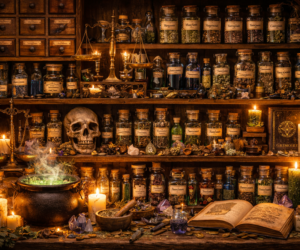
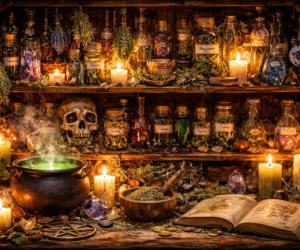
There’s something deeply satisfying about opening a wooden drawer to reveal dried lavender, rose petals, or carefully labeled jars of moon water. A witch’s cupboard, often called an apothecary cabinet or herbal pantry, is more than just storage. It’s a curated collection of magical tools, a living pharmacy, and a sacred space that connects modern practitioners to centuries of herbal wisdom.

The Historical Roots ~ From Apothecaries to Witches
The witch’s cupboard as we know it today has its roots in a much older tradition – the apothecary cabinet. The practice of apothecary work can be traced back to at least 2600 BC in ancient Babylon, where clay tablets recorded medical symptoms, prescriptions, and compounding directions. Ancient Egypt’s Papyrus Ebers, written around 1500 BC, contains over 800 prescriptions listing more than 700 different drugs.

By the Middle Ages, apothecary shops existed in Baghdad during the Islamic Golden Age around 754 AD, and were active in Al-Andalus by the 11th century. In medieval Europe, apothecaries weren’t quite doctors in the modern sense. They were herbalists, chemists, and skilled practitioners who stored and dispensed remedies. Their best weapon was a sturdy cabinet, usually made of oak and fitted with dozens of small drawers, each housing different ingredients from powdered beetle shells to dried wolfsbane to mercury.

Membership Required

You must be a member to access this content.

View Membership Levels

Already a member? Log in here

Intentions Over Tools ~ A Witch’s Truth

There’s a principle at the heart of all effective magic, yet it’s the one most often forgotten by beginners: your intention matters infinitely more than your tools.

Walk into any metaphysical shop and you’ll find it packed with aspiring practitioners clutching shopping lists. The perfect athame. Genuine rose quartz. Hand-carved wands from specific trees. Authentic herb blends. They believe that magic lives in these objects, that the right collection of tools will unlock their power.

This gets witchcraft fundamentally backwards.

The Beginner’s Trap
Every experienced practitioner has watched this unfold. The newcomer who spends hundreds on elaborate altar setups, crystals sorted by moon phase, premium incense imported from three continents, color-coded candles for every possible working. Their altar looks like it belongs in a magazine. Their spellwork produces nothing.

Membership Required

You must be a member to access this content.

View Membership Levels

Already a member? Log in here

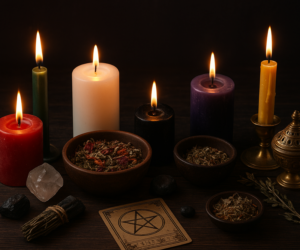
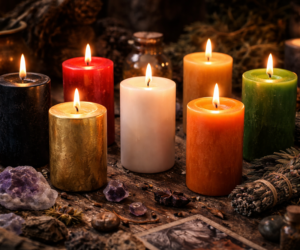
Candle Colors ~ Meanings and How to Use Them in Your Practice

Fire has always been sacred. It transforms, illuminates, consumes, and purifies. When you light a candle with intention, you’re working with one of humanity’s oldest tools for magic and prayer. The flame becomes a focal point for your will, carrying your intention into the universe as it burns.

But color matters. Each hue carries its own vibration, its own energy, its own particular way of working. Choosing the right candle color for your intention isn’t about rigid rules. It’s about understanding the language of color and speaking it fluently in your practice.

Here’s your guide to candle colors, what they mean, and how to work with them effectively.

White ~ Purity, Truth, and the Universal Substitute
Energy: Cleansing, purification, truth, protection, peace, spirituality, healing, new beginnings

Best Used For:
~ Cleansing and purifying spaces or yourself
~ Truth-seeking and clarity work
~ Protection rituals
~ Meditation and spiritual connection

Membership Required

You must be a member to access this content.

View Membership Levels

Already a member? Log in here

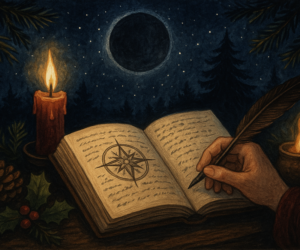
12 Days of Yule ~ Journal Prompts for Reflection and Magic

Use these journal prompts to deepen your Yule experience and create a record of your spiritual journey through the darkest days and into the returning light.

Tips for Journaling Through Yule
Create sacred space: Light a candle, burn incense, or play soft music before you begin writing.

Be honest: Your journal is for you alone. Write without censoring or judging yourself.

Don’t overthink: If a prompt doesn’t resonate, skip it or modify it. Trust your intuition.

Return and reflect: Consider revisiting these entries throughout the year to see how you’ve grown.

Make it magical: You can write with intention, charge your journal with crystals, or seal pages with wax and sigils.

Combine with ritual: Journal before or after your daily Yule activities to deepen the experience.

May your words be spells, your reflections be revelations, and your Yule journey be transformative.

Blessed writing.

Membership Required

You must be a member to access this content.

View Membership Levels

Already a member? Log in here

Meanings & Symbolism ~ Reclaiming the Language of Power

The word “witch” carries weight. Say it aloud and watch how the air changes. For centuries, it’s been used as an accusation, a threat, a death sentence. But before that, and increasingly now, it meant something else entirely. A person who walks between worlds, who knows the language of herbs and stars, who refuses to be limited by what others say is possible.

The symbols associated with witchcraft tell stories too. Some are ancient, rooted in pre-Christian traditions. Others emerged during the witch trials, assigned to witches by those who feared them. And some have been reclaimed in recent decades by those who wear the title proudly.

Let’s explore what these symbols mean, where they come from, and what they represent to those who practice the craft today.

The Witch Herself ~ What Does It Mean?
Before diving into symbols, we need to understand what “witch” actually signifies.

Etymology: The word likely derives from Old English “wicce” (feminine) and “wicca” (masculine), possibly related to “wiccian” meaning “to practice sorcery” or “witan” meaning “to know.” A witch is, fundamentally, one who knows. Particularly knowledge that exists outside acceptable channels.

Membership Required

You must be a member to access this content.

View Membership Levels

Already a member? Log in here

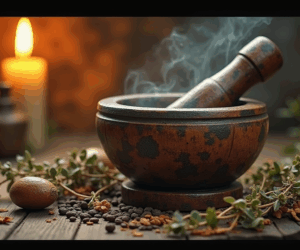
The Mortar & Pestle ~ A Witch’s Tool of Transformation & Breaking

In the world of witchcraft, few tools are as iconic or as deeply symbolic as the mortar and pestle. This ancient instrument has graced the altars and workspaces of healers, herbalists, and witches for thousands of years. But it’s more than just a practical tool for grinding herbs. It’s a powerful symbol of transformation, a vessel of alchemy, and an instrument through which destruction becomes creation.

The Ancient History of the Mortar & Pestle
The mortar and pestle is one of humanity’s oldest tools, dating back over 35,000 years. Archaeological evidence shows that ancient civilizations across the globe, from Egypt to China, from South America to Europe, used mortars and pestles to prepare medicines, grind grains, and create pigments and dyes.

In magical traditions, the mortar and pestle has always held a place of reverence. Ancient Greek witches used them to prepare pharmakeia (the root word for both “pharmacy” and “sorcery”). Medieval herbalists and wise women relied on them to create healing salves and magical preparations. In many cultures, the mortar and pestle was passed down through generations of healers, accumulating wisdom and power with each use.

The Symbolism ~ Breaking Down to Build Up
At its core, the mortar and pestle embodies one of the most fundamental principles of magic and alchemy: transformation through destruction.

Membership Required

You must be a member to access this content.

View Membership Levels

Already a member? Log in here

Black Kyanite: The Ultimate Stone for Grounding and Energy Cleansing

Black Kyanite is a powerful crystal that has become increasingly popular among energy workers, healers, and crystal enthusiasts. With its distinctive fan-like blade formations and deep charcoal color, this aluminum silicate mineral is not only visually striking but also renowned for its remarkable metaphysical properties.

What is Black Kyanite?
Black Kyanite is a variety of the mineral kyanite, which typically forms in blade-like crystal structures. Unlike its blue cousin, Black Kyanite contains traces of iron and other minerals that give it its dark coloration. It’s primarily found in Brazil, though deposits also exist in other parts of South America and Africa.

The stone’s unique structure features radiating blades that emanate from a central point, creating a fan or starburst pattern. This physical formation is believed to mirror its energetic properties. Radiating protective energy outward while simultaneously drawing in and grounding excess energy.

What Does Black Kyanite Do?

Membership Required

You must be a member to access this content.

View Membership Levels

Already a member? Log in here