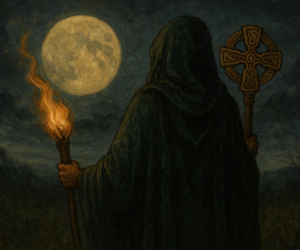

The Legend of Goody Cole: New Hampshire’s Most Famous Witch

In the annals of New England folklore, few figures loom as large or as mysteriously as Eunice “Goody” Cole of Hampton, New Hampshire. Her story represents one of America’s most enduring tales of witchcraft accusations, community fear, and the tragic consequences of superstition in colonial society.

A Life Marked by Suspicion
Eunice Cole arrived in Hampton sometime in the 1640s with her husband William. From the beginning, she was viewed with suspicion by her neighbors. Perhaps it was her sharp tongue, her poverty, or simply the misfortune that seemed to follow in her wake. But Goody Cole quickly became the community scapegoat for any unexplained illness, crop failure, or maritime disaster.

The accusations against her were typical of witch trials throughout New England: livestock dying mysteriously, butter failing to churn, children falling ill after encounters with the old woman. In a time when scientific explanations for natural phenomena were scarce, fear and superstition filled the void.

Trial and Punishment

Membership Required

You must be a member to access this content.

View Membership Levels

Already a member? Log in here

Hekate ~ The Goddess of Witches ~ A Guide to the Ancient Keeper of Keys

In the shadowed corners of ancient temples and the whispered traditions of modern witchcraft, few deities command as much reverence and caution as Hekate. Known as the Goddess of Witches, the Guardian of Crossroads, and the Keeper of Keys, Hekate stands as one of the most complex and powerful figures in the pantheon of ancient Greek religion and contemporary magical practice.

Who is Hekate?
Hekate (also spelled Hecate) is an ancient Greek goddess whose origins stretch back to Anatolia, possibly emerging from the goddess Hekataios mentioned in the works of Hesiod around the 8th century BCE. Unlike many Olympic deities who ruled from Mount Olympus, Hekate carved out her dominion in the liminal spaces, the thresholds, crossroads, and boundaries between worlds.

She is traditionally depicted as a triple-form goddess, sometimes shown with three bodies or three faces, each looking in a different direction. This trinity represents her ability to see past, present, and future, as well as her dominion over the three realms: earth, sea, and sky. In her hands, she often carries torches, keys, daggers, or serpents as symbols of her roles as light-bringer, gatekeeper, protector, and wielder of ancient wisdom.

What are Her Domains?

Membership Required

You must be a member to access this content.

View Membership Levels

Already a member? Log in here