 Written by
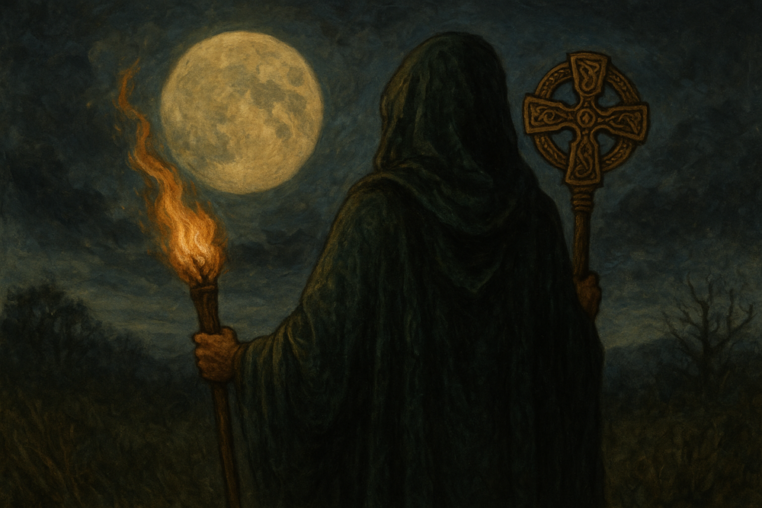
 In the shadowy corners of Scottish folklore lives a figure both feared and revered, Nicnevin, described as a witch or fairy queen who rides the night sky at Samhain, leading spirits, witches, and the dead in her wake. She is Scotland’s dark goddess, the hag queen, the mother of witches. Yet her story has been nearly lost to time, fragmented across centuries of poetry, witch trials, and whispered warnings.
The Mystery of Her Name
The origins of Nicnevin’s name remain debated, with multiple theories emerging from the linguistic fog of history. Some scholars suggest it derives from the Scottish Gaelic Neachneohain, meaning “daughter(s) of the divine” or “daughter(s) of Scathach,” while others propose NicNaoimhein, meaning “daughter of the little saint.”
Another interpretation links her name to the Gaelic Nic an Neamhain, “Daughter of Frenzy”. A fitting title for a goddess associated with the liminal chaos of Samhain night. Some scholars have even connected her to the Irish war goddess Neamhain, one of the Morrigan’s triple aspects, or to water spirits like the Nixie and Nokke.
The multiplicity of her names reflects the complexity of her nature. She is not one thing, but many things at once.
Her Earliest Appearance
The first known mention of Nicnevin appears around 1580 in a work by Alexander Montgomerie, a court poet under King James VI of Scotland. The same king who would later become infamous for his obsession with witch-hunting and authoring the Daemonologie.
In Montgomerie’s “Flyting” (a ritual exchange of poetic insults), Nicnevin appears accompanied by her nymphs, described as “venerable virgines whom the world call witches.” This early text portrays her not as a demon, but as a powerful figure who commands witches and possesses knowledge of charms and cunning.
After this, silence. For over two hundred years, Nicnevin disappears from the written record.
The Romantic Revival
She resurfaces in the early 1800s, reimagined by Romantic writers who were busy collecting and reconstructing Scotland’s fading folklore. Sir Walter Scott referred to her as “a gigantic and malignant female, the Hecate of this mythology, who rode on the storm, and marshalled the rambling host of wanderers under her grim banner.”
Later sources connected her to the Gyre-Carling, an old woman or ogress figure in Scottish tradition. And described her as wearing a long gray mantle and carrying a white wand with the power to transform water into stone and sea into dry land.
By the 19th century, she was called “the mother of glamour, and near-a-kin to Satan himself,” presiding over the Hallowmass Rades. The ghostly processions that rode through Scottish skies during the darkest nights of the year.
The Real Woman Behind the Legend?
One of the most intriguing theories is that Nicnevin wasn’t originally a goddess at all, but a real woman whose story became mythologized. In May 1569, an accused witch named Marion Nicneven (or Nikniving) was condemned to death and burned at the stake at St. Andrews, claiming that apothecaries had caused her arrest due to her superior healing powers.
Was she the origin of the legend? Or was she herself named after an already-existing mythological figure? The timeline is murky, complicated by the fact that “Nicneven” may have become a nickname for multiple women accused of witchcraft. A title bestowed upon those believed to possess extraordinary power.
Who Is Nicnevin? A Synthesis of Shadows
Drawing from the scattered fragments, a portrait emerges:
Queen of the Unseelie Court: Nicnevin rules over the darker fairies of Scotland, the Unseelie. Spirits who are neither wholly malevolent nor wholly benevolent, but dangerous, unpredictable, and powerful.
Leader of the Wild Hunt: She is associated with the Wild Hunt, riding through the night sky with her retinue of witches, spirits, and honking geese. Geese being her sacred animals, their cackling announcing her presence even when she remains invisible.
Goddess of Samhain: Her sacred night is Samhain (Halloween), the threshold between worlds when the dead walk and the veil thins. On this night, she grants wishes and answers petitions, making herself visible as she flies through the air.
Shapeshifter: She manifests as both a beautiful young woman and a dried-out old hag, embodying the dual nature of the goddess as maiden and crone, beauty and terror.
Mistress of Witchcraft: She governs magic, divination, glamour, charms, and the cunning craft. She is the patroness of those who work at the edges of society, those who speak to spirits and spin fate.
Connected to Fate and Weaving: Through her associations with the Gyre-Carling and Habetrot (a Scottish spinning spirit), she’s connected to the work of spinning and weaving. Ancient metaphors for fate itself.
Belief Systems and Cultural Context
Nicnevin exists at the intersection of multiple belief systems:
Pre-Christian Celtic Tradition: Her associations with Samhain, shape-shifting, and sovereignty over the land suggest ancient roots in Celtic goddess worship. Some traditions hold that Nicnevin is the daughter of the Cailleach, the ancient hag goddess who brings winter and shapes the Scottish landscape itself. This relationship creates a powerful lineage. The wise old woman passing her knowledge, power, and dominion to her daughter, ensuring the continuation of wisdom through generations. Both are tied to seasonal transitions and the earth itself, with the Cailleach representing the deep ancient power of the land and Nicnevin embodying its active, magical expression.
Norse Influence: Scotland’s history includes significant Norse settlement, and scholars have noted connections between Nicnevin and Germanic goddesses like Holda and Hel. Both associated with the dead, spinning, and leading spectral processions through the night.
Fairy Faith: In Scottish tradition, fairies were not cute winged creatures but powerful, potentially dangerous beings who existed in a parallel world that occasionally intersected with ours. Nicnevin as Queen of Elphame (the fairy realm) represents this older, more ambiguous understanding of the fairy folk.
Witch Trial Context: Following Scotland’s conversion to Christianity and brutal witch trials (second only to Germany in scope), Nicnevin was reclassified from goddess to both fairy and demon. Women accused of witchcraft claimed to have met her or the Queen of Elphame, been taught by her, or ridden with her on Samhain night.
Demonization: Like many powerful female figures in European paganism, Nicnevin was eventually cast as an enemy. A devil’s consort, a stealer of souls, a figure to frighten children. The Romans had once identified her with Diana; Christians made her a servant of Satan.
Working With Nicnevin Today
For modern practitioners drawn to Scottish witchcraft and folk magic, Nicnevin has experienced something of a revival. She represents:
~ Sovereignty and power for women who practice the craft
~ Connection to Scottish land and ancestors
~ The liminal spaces between worlds, seasons, and states of being
~ Protection during dark times, particularly the winter months
~ Skills in divination, glamour, and spirit work
Those who honor her today often do so at Samhain or on November 10th (Martinmas Eve, also called Old Halloween). Offerings might include feasts, toasts, or simply sitting at a crossroads and watching the night sky for signs of her passing.
Some leave out water blessed under the full moon, light gray candles, or work with goose feathers as sacred to her. Others simply speak her name into the dark and ask for her blessing on their witchcraft.
The Question That Remains
Perhaps the most interesting aspect of Nicnevin is that we cannot definitively say whether she was always a goddess, or became one through centuries of storytelling. Was she a real woman whose power became legend? A local folk devil conflated with older goddesses? An authentic pre-Christian deity whose worship went underground and emerged transformed?
The answer may be: all of these, and none of these. Nicnevin is what she has become through the collective imagination of Scotland. A figure of power, darkness, transformation, and sovereignty. She is the goddess you find at crossroads and thresholds, in the space between what we know and what we fear.
She rides the storm. She leads the dead. She shapeshifts between beauty and terror. And on Samhain night, if you’re very lucky, or very unlucky, you might hear the honking of geese overhead and know that the Queen of Witches is passing by.
Whether you bow your head in reverence or simply stand witness, that is between you and her.