
The Uninvited Practitioner: When Your Cat Becomes Part of Your Ritual

Every full moon, I set out water beneath the night sky. By morning, it’s transformed, as the tradition goes, into moon water, charged with lunar energy and intention. I keep this water in a small brass holder on my gratitude altar, refreshing it each evening as part of my practice.

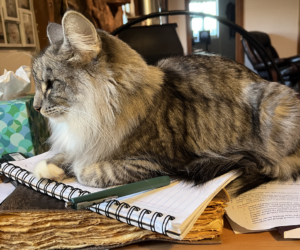
And every morning, without fail, Freyja jumps onto the altar and drinks it.

My cat has inserted herself into my ritual so completely that I’ve stopped questioning whether the water is really for me at all. She approaches the brass holder with the kind of reverence I’m still learning – no hesitation, no doubt, just pure presence. While I stumble through my gratitude practice some mornings, distracted and half-awake, she shows up with absolute certainty.

Who Practices for Whom?
I never asked Freyja if she wanted to be part of this. I never explained the full moon, or intention-setting, or why this particular water sits in this particular place. Yet she’s made it her ritual too, perhaps more faithfully than I have.

Membership Required

You must be a member to access this content.

View Membership Levels

Already a member? Log in here

What Your Sage Smoke Is Trying To Tell You ~ Reading the Language of Smoke

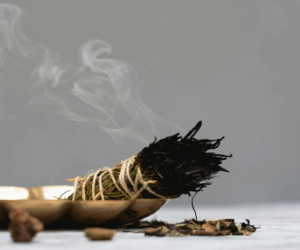
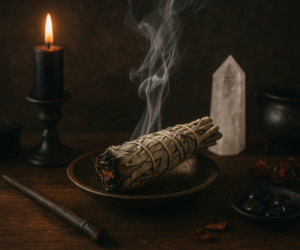
When you light sage to cleanse your space, have you ever noticed how the smoke moves? Sometimes it rises straight up in a thin, steady column. Other times it swirls wildly, dances sideways, or seems to gather in certain corners of your room. Many practitioners believe that smoke doesn’t just cleanse, it communicates.

Smoke reading, also called libanomancy or capnomancy, is an ancient form of divination practiced across cultures for thousands of years. The way smoke moves, the patterns it creates, and the directions it travels can offer insights into the energy of your space, the effectiveness of your cleansing, and even messages from the spiritual realm.

Let’s explore what your sage might be trying to tell you through its smoke.

The Basics of Smoke Reading
Before diving into specific patterns, it’s important to understand the fundamentals:

Set Your Intention: Before lighting your sage, take a moment to center yourself and state your intention clearly. Are you cleansing? Seeking guidance? Connecting with spirit?

Membership Required

You must be a member to access this content.

View Membership Levels

Already a member? Log in here

When to Burn Sage ~ A Guide to Smoke and Intention

There’s a bundle of white sage on my shelf that I reach for at specific moments. Not randomly, not habitually, but when something in my space or body feels like it needs clearing. Over time, I’ve learned that burning sage isn’t about following a rigid schedule. It’s about recognizing the moments when stagnation has settled in and smoke might help move it along.

Here’s when I’ve found sage burning most useful, and what I’ve learned about the practice along the way.

When You’ve Been Sick
Illness leaves a residue. Even after the fever breaks or the cough finally quiets, there’s often a heaviness that lingers in the bedroom where you spent days in bed, in the air that feels thick with the memory of being unwell. This is when I most instinctively reach for sage.

I burn it not to “cure” anything, but to mark the transition from sick to well. To tell my space (and myself) that we’re moving into a different phase. There’s something about the sharp, cleansing scent that feels like opening windows after a long winter, even when the windows are already open.

Wait until you’re actually recovering, though. Burning sage while you’re still in the thick of illness, especially respiratory illness, isn’t kind to already-irritated lungs.

Membership Required

You must be a member to access this content.

View Membership Levels

Already a member? Log in here

Embracing December’s Final Full Moon ~ The Cold Moon

On December 4th, 2025, the final full moon of the year will illuminate the winter sky in spectacular fashion. Known as the Cold Moon, this celestial event is also the last supermoon of 2025. Appearing brighter and larger than usual as the moon reaches its closest point to Earth. This powerful lunar event marks a profound moment of reflection and closure as we approach the end of the calendar year.

What is the Cold Moon?
The Cold Moon gets its name from the Old Farmers’ Almanac and reflects the frigid temperatures that arrive in the Northern Hemisphere during December. Native American tribes and early colonial Americans used this lunar marker to track the progression of winter and prepare for the coldest months ahead. Some traditions also call it the Long Night Moon, as it rises during the longest nights of the year, near the winter solstice.

This year’s Cold Moon is extra special, since it’s the final supermoon of 2025, meaning the moon will appear

Membership Required

You must be a member to access this content.

View Membership Levels

Already a member? Log in here

The Mortar & Pestle ~ A Witch’s Tool of Transformation & Breaking

In the world of witchcraft, few tools are as iconic or as deeply symbolic as the mortar and pestle. This ancient instrument has graced the altars and workspaces of healers, herbalists, and witches for thousands of years. But it’s more than just a practical tool for grinding herbs. It’s a powerful symbol of transformation, a vessel of alchemy, and an instrument through which destruction becomes creation.

The Ancient History of the Mortar & Pestle
The mortar and pestle is one of humanity’s oldest tools, dating back over 35,000 years. Archaeological evidence shows that ancient civilizations across the globe, from Egypt to China, from South America to Europe, used mortars and pestles to prepare medicines, grind grains, and create pigments and dyes.

In magical traditions, the mortar and pestle has always held a place of reverence. Ancient Greek witches used them to prepare pharmakeia (the root word for both “pharmacy” and “sorcery”). Medieval herbalists and wise women relied on them to create healing salves and magical preparations. In many cultures, the mortar and pestle was passed down through generations of healers, accumulating wisdom and power with each use.

The Symbolism ~ Breaking Down to Build Up
At its core, the mortar and pestle embodies one of the most fundamental principles of magic and alchemy: transformation through destruction.

Membership Required

You must be a member to access this content.

View Membership Levels

Already a member? Log in here

Childhood Habits That Were Actually Witchcraft

In the world of witchcraft, few tools are as iconic or as deeply symbolic as the mortar and pestle. This ancient instrument has graced the altars and workspaces of healers, herbalists, and witches for thousands of years. But it’s more than just a practical tool for grinding herbs. It’s a powerful symbol of transformation, a vessel of alchemy, and an instrument through which destruction becomes creation.

The Ancient History of the Mortar & Pestle
The mortar and pestle is one of humanity’s oldest tools, dating back over 35,000 years. Archaeological evidence shows that ancient civilizations across the globe, from Egypt to China, from South America to Europe, used mortars and pestles to prepare medicines, grind grains, and create pigments and dyes.

In magical traditions, the mortar and pestle has always held a place of reverence. Ancient Greek witches used them to prepare pharmakeia (the root word for both “pharmacy” and “sorcery”). Medieval herbalists and wise women relied on them to create healing salves and magical preparations. In many cultures, the mortar and pestle was passed down through generations of healers, accumulating wisdom and power with each use.

The Symbolism ~ Breaking Down to Build Up
At its core, the mortar and pestle embodies one of the most fundamental principles of magic and alchemy: transformation through destruction.

Membership Required

You must be a member to access this content.

View Membership Levels

Already a member? Log in here

Black Kyanite: The Ultimate Stone for Grounding and Energy Cleansing

Black Kyanite is a powerful crystal that has become increasingly popular among energy workers, healers, and crystal enthusiasts. With its distinctive fan-like blade formations and deep charcoal color, this aluminum silicate mineral is not only visually striking but also renowned for its remarkable metaphysical properties.

What is Black Kyanite?
Black Kyanite is a variety of the mineral kyanite, which typically forms in blade-like crystal structures. Unlike its blue cousin, Black Kyanite contains traces of iron and other minerals that give it its dark coloration. It’s primarily found in Brazil, though deposits also exist in other parts of South America and Africa.

The stone’s unique structure features radiating blades that emanate from a central point, creating a fan or starburst pattern. This physical formation is believed to mirror its energetic properties. Radiating protective energy outward while simultaneously drawing in and grounding excess energy.

What Does Black Kyanite Do?

Membership Required

You must be a member to access this content.

View Membership Levels

Already a member? Log in here

The Complete Grimoire: Pocket Spells for Daily Magic

A comprehensive directory of miniature rituals, protection gestures, and subtle enchantments for the modern practitioner

The Lost Art of Small Magic
Before grimoires were bound in leather and spells required elaborate preparation, magic lived in the body. In gestures passed down through generations, in the instinctive movements we make when something feels wrong, in the small rituals that protect us from forces we sense but cannot name.

These are pocket spells. Micro-enchantments. The magic you can perform standing in line at the grocery store, sitting in traffic, or lying awake at three in the morning when the air feels too thick and your thoughts won’t settle.

This grimoire collects them. The whispered protections, the boundary markings, the release rituals that require nothing but your body and your intention.

Part I: Protection & Psychic Defense
The Knock of Refusal

Membership Required

You must be a member to access this content.

View Membership Levels

Already a member? Log in here

Creative Ideas for Your Grimoire: A Guide for When You’re Stuck

There’s something magical about opening a blank grimoire for the first time. All that potential, all those empty pages waiting to be filled with your wisdom and experience. But then reality hits: you’re staring at that first page, pen in hand, and your mind goes completely blank.

What should you actually write in this thing?
If you’ve ever felt stuck or overwhelmed about what to include in your grimoire, you’re not alone. While the traditional approach is to fill it with correspondence tables and spell recipes (and those are certainly valuable), your grimoire can be so much more than a magical cookbook. It’s a living document of your personal practice, a mirror of your spiritual growth, and a legacy you’re creating one page at a time.

Let’s explore dozens of creative ideas to help you fill those pages with meaningful, practical, and deeply personal magical content.

Getting Started: The Foundational Pages
These are the entries that give your grimoire structure and make it uniquely yours:

Your Magical Name and Origin Story

Membership Required

You must be a member to access this content.

View Membership Levels

Already a member? Log in here

The Bounce Back Jar: Protection Without Cursing

Sometimes the best defense isn’t an offense, it’s a good mirror.

When negative energy comes your way, you don’t always need to retaliate with a hex or curse. Sometimes the most elegant magical solution is simply to return what doesn’t belong to you, sending those bad vibes ricocheting right back to their source. That’s exactly what the Bounce Back Jar does. It creates a protective barrier that reflects harmful intentions away from you and back where they originated.

Think of it as the magical equivalent of “return to sender.”

Why Choose a Bounce Back Jar?
There’s an important distinction between revenge magic and protective magic. A hex or curse actively sends harm toward someone, often requiring significant energy and potentially creating karmic consequences. A bounce back spell, on the other hand, is purely defensive. You’re not creating new negativity, you’re simply refusing to accept someone else’s.

Membership Required

You must be a member to access this content.

View Membership Levels

Already a member? Log in here