 Written by
 She stood at the gallows and refused to convert.
The British colonial authorities had captured her after two years of eluding them across the hills of Mashonaland. They had tried her for murder, found her guilty, and sentenced her to hang. They offered her, as they had offered her ally Sekuru Kaguvi, the possibility of a Christian death. The consolation of a new religion, the last rite of the civilization that had invaded her land, confiscated her people’s cattle, and imposed a tax on the very act of existing in one’s own home.
Kaguvi converted. Nehanda did not.
She is reported to have wept at his conversion. Not out of fear for herself, but out of grief that he had, in her understanding, abandoned his people at the last moment. She died as she had lived: as a medium of the Nehanda spirit, as a Shona woman who had organized a national uprising against the most powerful empire in the world, and as someone who understood that her death was not an ending.
Her last words, as recorded across oral tradition: My bones will rise.
They did.
The Spirit That Would Not Die
To understand Nehanda Charwe Nyakasikana, you have to understand that she was not only herself.
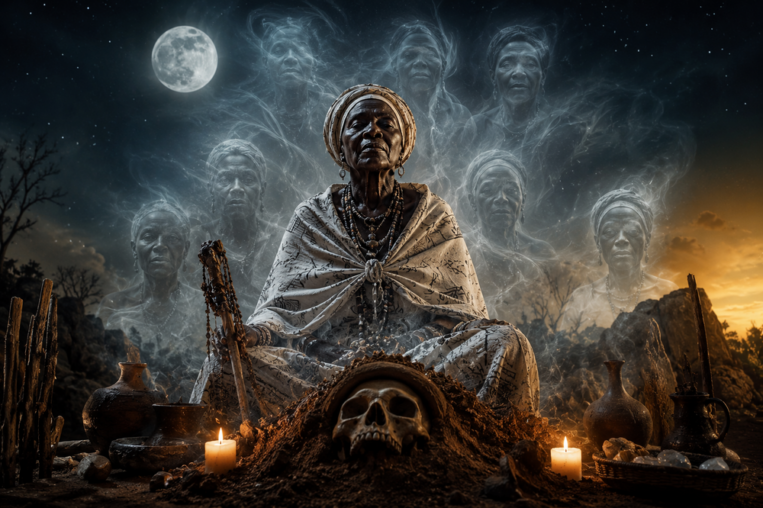
She was the living vessel of the Nehanda mhondoro. One of the great ancestral spirits of the Shona people, a royal mudzimu or lion spirit that had been moving through human mediums for centuries. The first Nehanda, according to tradition, was a daughter of Nyatsimba Mutota, the founder of the Munhumutapa state, who lived in the fifteenth century. When she died, she became a mhondoro: a spirit of such power and such royal lineage that it continued to act in the world by possessing the bodies of living women who were identified as her mediums.
Each medium was understood to speak with the voice and personality of the original Nehanda. They were not playing a role. They were not channelling in the modern New Age sense, as an external influence coming through. They were possessed, fully, authentically, in the Shona understanding, by an ancestral presence that had never fully departed from the world of the living.
As medium of the spirit Nehanda, Charwe Nyakasikana made oracular pronouncements and performed traditional ceremonies that were thought to ensure rain and good crops. This was not the role of a village wise woman. This was the role of someone who stood at the fulcrum of the community’s relationship with its ancestral powers. The keeper of the connection between the living Shona and the forces that governed rainfall, harvest, protection, and the continuation of the people.
A Life Before the Uprising
Nehanda Charwe Nyakasikana was born around 1840 in the Chishawasha district of central Mashonaland. She was the daughter of Chitaura, the younger son of Shayachimwe, founder of the Hwata dynasty in the upper Mazowe Valley.
She was identified as a svikiro, a spirit medium, and possessed by the Nehanda spirit in 1884. From that moment, she was no longer simply a woman living in the hills around Mazowe. She was the central node of communication between the Zezuru Shona people and their most powerful ancestral spirit.
She at first promoted good relations between the Zezuru people and early European settlers. This was the posture of someone who understood the political landscape and was attempting to navigate it. It was not naivety. It was the pragmatism of a spirit medium who understood her role as one of maintaining balance and protecting her people. And who recognised, for a time, that accommodation might serve that purpose.
What changed that calculus was not a spiritual vision but a political reality.
By 1894, the British had imposed what they termed the “hut tax” against the native populations. In addition to the hut tax, they began to impose forced relocation and forced labour camps. The land was being taken. The cattle were being confiscated. The people were being forced to work for the colonisers. Everything that the Nehanda spirit was understood to protect – the land, the harvest, the community, the relationship between the living and the ancestors who watched over them – was under direct assault.
The First Chimurenga
In June 1896, both the Ndebele and Shona people rose up in what became known as the First Chimurenga – the first nationwide armed resistance to British colonisation.
Together with the mediums of the other two mhondoro, Mukwati in Matabeleland and Sekuru Kaguvi in western Mashonaland, Nehanda organised and led the resistance of her people until she was captured. She was not a symbolic figurehead. She was an active organiser, moving through the communities under her spiritual authority, communicating the will of the ancestral powers, and providing the framework of meaning that sustained armed resistance in the face of overwhelming military force.
The Chimurenga lasted until late 1897, when the Shona and Ndebele peoples were defeated after running out of supplies. Nehanda was captured in December 1897.
Her trial began in March 1898. The charge was murder. Specifically, the killing of H.H. Pollard, a Native Commissioner known for his cruelty to the local population. She maintained her innocence. The colonial court found her guilty.
She was hanged on 27 April 1898.
But not before she had said what she needed to say.
The Bones That Rose
The promise Nehanda made at the gallows – my bones will rise – was not a metaphor to the people who heard it. It was a statement about the nature of the mhondoro spirit, which had never belonged to any single medium and could not be killed by killing one medium. It was a prophecy about the continuation of the resistance. And it was an act of spiritual leadership. A final declaration that the connection between the Shona people and their ancestral powers remained intact regardless of what the British courts decided.
After independence was won, Nehanda Charwe Nyakasikana was widely celebrated in Zimbabwe. Her image was often seen above portraits of the new President Robert Mugabe. A maternity hospital and schools were named after her, and she continues to be a potent symbol of militant anti-colonialism.
During the Second Chimurenga, the liberation war of the 1970s, freedom fighters explicitly invoked Nehanda’s name and her prophecy. Guerrilla commanders sought out the spirit mediums of the mhondoro for guidance and legitimacy, following the same pattern of relationship between living leadership and ancestral authority that had defined the First Chimurenga.
She is seen as a symbol of resistance for her work and legacy in various liberation movements in the 19th and 20th centuries. In 2021, a statue of Mbuya Nehanda was unveiled in central Harare, the capital of the independent Zimbabwe she did not live to see but whose existence she, in some genuine sense, made possible.
What Nehanda Carries for Practitioners
For those of us working within a framework that takes ancestral spirits seriously. That understands the dead as genuinely present, genuinely powerful, and genuinely invested in the living. Nehanda’s story is not ancient history. It is an active demonstration of several things that are easy to understand intellectually but difficult to fully inhabit.
That the ancestral spirit does not die with the body of its medium.
That spirit work and political reality are not separate domains. The Nehanda mhondoro was a power that governed rain and harvest and protected the people from harm. And when the people were under harm from colonial invasion, the spirit worked through its medium to organize resistance. The spiritual and the political were not different categories. They were one thing.
That the commitment to one’s ancestral powers can be maintained in the face of everything. The colonial army, the court, the gallows, the offer of a different tradition’s consolation. Nehanda’s refusal to convert was not stubbornness. It was an act of spiritual integrity performed for the benefit of a people who needed to see that integrity demonstrated.
And that some promises – my bones will rise – are the kind that the spirit world keeps.
Nehanda Charwe Nyakasikana, c.1840 – 27 April 1898. Grandmother of Zimbabwe. Vessel of the Nehanda mhondoro. She did not convert. She did not recant. Her bones rose.