 Written by
She arrived at the farm as winter was closing in. Greenland was in the grip of famine. Hunters were returning empty-handed, and some were not returning at all. The farmer Thorkel had invited her, a seeress, a völva, known by the name Þorbjörg, called lítilvölva: the little seeress. She came to tell the people what was coming. She came because she was what you sent for when the world went dark and you needed someone who could see beyond it.
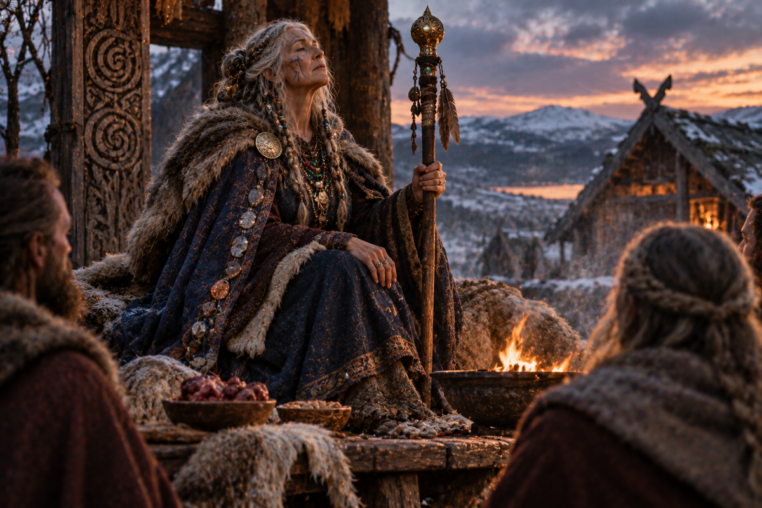
The saga describes her arrival in precise detail. She wore a blue cloak set with stones all the way down to the hem. She wore a necklace of glass beads. She carried a staff with a brass-ornamented knob set with gems. She sat on a raised seat, the seiðhjallr, the high platform, cushioned with hen feathers. She was given a special meal of hearts of animals. And that night, after the ritual preparations were made, she was asked if any woman present knew the varðlokkur, the ward songs, the chants required to invite the spirits and hold them close enough for the seeress to hear.
Only one woman admitted she did: a young Christian woman named Guðríðr Þorbjarnardóttir, who was reluctant to participate in pagan rites but was persuaded that her help would serve the community. She stood in a circle of women and sang the varðlokkur so beautifully, the saga says, that the spirits came. And Þorbjörg listened, and when she came out of her trance, she told the people that the famine would soon end, that the sickness afflicting them would lift faster than anyone expected, and that spring would come.
She then told Guðríðr her future, two good marriages, the founding of a great family, a long life of significance, and dismissed her with a blessing.
This account, from the Saga of Erik the Red, is the most detailed description of a seiðr ritual to survive from the Norse world. It is not a myth. It is not a cosmological poem. It is a scene from a saga that, whatever its literary embellishments, was understood by its audience as a description of something that actually happened. The kind of thing that actually happened, the kind of women who actually did it. Because such women existed, and their communities knew how to receive them.
The Name and What It Means
The word völva comes from Old Norse and means “staff-bearer” or “wand-bearer,” from vǫlr (staff or rod) and the feminine ending -va. The name is the function: she is defined by what she carries. The staff was not a decorative accessory. It was the primary symbol and tool of the völva’s practice.; The physical marker of her identity, the object that accompanied her in life and, as the archaeological record confirms, in death.
The sagas describe the völva as a travelling specialist. A woman who moved between communities offering divination, prophecy, and magical services in exchange for hospitality and payment. She was not attached to a specific temple or household. She was mobile, which made her both socially liminal, outside normal domestic structures, and enormously socially powerful, because her services were valuable and she could go where they were needed.
This mobility is important. The völva did not belong to any one household or community. She belonged to the road between them. She arrived when she was needed, performed what she came to perform, and moved on. Her freedom from ordinary social structures gave her a different kind of authority. The authority of someone who stood outside the usual hierarchies, whose allegiance was to the practice itself rather than to any particular lord or community.
She was also, in most of the sources, treated with significant respect. The völva was both feared and respected in Norse society. She exercised seiðr and was supposedly in direct contact with Odin, the Allfather. To receive a völva well was not merely courtesy. It was practical. You needed her to be willing to do her work. And the work, done well, could tell you whether your voyage would prosper, whether your harvest would recover, whether the person you were about to fight had the advantage.
The Practice: What Seiðr Was
Seiðr is believed to be a form of magic which is related to both the telling and the shaping of the future. That dual nature, seeing fate and potentially influencing it, is what made seiðr practitioners both indispensable and, to some, threatening. The völva did not merely observe what was coming. She could, in principle, reach into the weave of fate and alter it.
The practical mechanics of seiðr, as the sagas describe them, involved a specific physical posture. Seated on the high seat, specific songs sung by attendants to create the conditions for the trance, and a trance state during which the seer accessed knowledge beyond ordinary waking experience. The varðlokkur that Guðríðr sang in Greenland were not background music. They were a technology . A sonic structure designed to draw the spirits close enough for the seeress to communicate with them. Without the songs, the spirits would not come, or would not stay. The völva needed the community’s participation to do her work. The ceremony was not a solo performance. It was a collective act of invitation.
In Norse mythology, seiðr was associated with both the god Óðinn. Simultaneously responsible for war, poetry, and sorcery. And the goddess Freyja, a member of the Vanir who was believed to have taught the practice to the Æsir. This is theologically significant. In the Norse worldview, the original teacher of seiðr was a goddess. Odin learned it from Freyja, which meant that the practice had a feminine origin even when a male practitioner took it up. And male practitioners who practiced seiðr were regarded with ambivalence at best. The practice was considered inherently feminine, and a man who did it too fully was seen as having crossed into territory that was not his by nature.
This gendering of the practice explains why the völva tradition was so specifically and persistently female. It was not merely custom. It was cosmology. The ability to enter the trance, to hold the high seat, to receive what the spirits offered. This was understood as something women’s nature made them suited for, in a way that men’s did not.
The Völuspá: The Greatest of All Prophecies
The most celebrated völva in all of Norse literature is nameless. She is the speaker of the Völuspá, the “Prophecy of the Seeress”, one of the oldest and most significant poems in the Norse canon, preserved in the Poetic Edda.
In the poem, Odin summons a dead völva from her grave to tell him the history of the cosmos and its fate. She complies, with magnificent authority. She speaks from before creation. Describing the void before the world existed, the formation of the earth, the first gods and the first conflict, the coming of humanity. And she carries the account forward to Ragnarök, the end of the gods, the destruction and the renewal that follows. She tells the Allfather everything. She tells him things he clearly did not want to know.
The poem’s power comes partly from the völva’s absolute authority over what she knows. She is not petitioning Odin. She is not subordinate to him. She knows what he has come to find out, and she dispenses the knowledge in her own time and on her own terms. This is the völva at her fullest extent. Not a supplementary figure, not an assistant to male religious authority, but the keeper of knowledge that even the god of knowledge had to come and ask for.
She ends the poem with the word Mun hon søkkua – “she sinks down.” The vision is complete. The völva returns to whatever place she came from. Odin is left with what she has told him.
The Archaeological Record: The Staffs in the Ground
The völva is not only a literary figure. She is a historical one, confirmed by physical evidence that has been accumulating across decades of Scandinavian archaeology.
Archaeologist Neil Price writes that Scandinavian archaeologists have found more than fifty graves that contain metal staffs closely resembling the saga descriptions of a sorceress’s main attribute. These are not decorative objects. They are iron staffs, often beautifully ornamented, buried with women in high-status graves across Scandinavia. Their presence in the burial record means that the communities who interred these women understood the staff as essential to their identity. Something that needed to go with them.
The völva burial from Köpingsvik, on the Swedish island of Öland, contained an 82 cm long iron staff with bronze ornamentation and a small house represented on top. At Hagebyhöga in Östergötland, Sweden, another seeress was buried with her staff, horses, a carriage, and Arabic bronze jugs, along with a small piece of silver jewellery shaped like a woman with a large necklace. A figure interpreted as Freyja wearing the Brísingamen.
In the grave from Fyrkat, Denmark, henbane was found. A plant with hallucinogenic properties well-documented in the ethnobotany of trance practices. The Oseberg burial from Norway contained the bodies of two women, along with a wooden staff or wand and cannabis seeds in a purse.
Based on these finds, it is now believed that one of the Fyrkat women was a völva on the royal staff of King Harald Bluetooth. A seeress attached to a royal household. Not merely itinerant, but retained, valued enough to be buried with the full markers of her identity and the high-status goods that spoke to her position. The archaeology confirms what the sagas describe. These women were real, they were recognized as a distinct social category, and they were treated, in life and death, with commensurate respect.
Þorbjörg in Greenland: The Scene in Full
We should return to Þorbjörg, because her account in the Saga of Erik the Red is the most vivid and complete portrait of a völva at work, and it rewards careful attention.
She was one of nine sisters, all völvur, and by the time she came to Greenland she was the last one living. This detail is worth pausing on. The others had died, the tradition that had sustained them was thinning, and she continued alone. She was an itinerant practitioner, moving between farms, offering what she had to offer. Other texts suggest that formerly such priestesses travelled with a group of younger people, perhaps in training, but at this period Þorbjörg alone remained. The transmission was already attenuating. She was the end of something, and she knew it, and she kept going.
When she arrived at Thorkel’s farm, she was given the high seat and the special meal. The hearts of animals, the ritual foods of her tradition. She spent the night in the high seat. The next day the community gathered and the ceremony was prepared. Guðríðr sang the varðlokkur. The spirits came. Þorbjörg sat in her trance and received what they offered.
What she returned with was specific, practical, actionable: the famine would end, the spring would come, the sickness would lift faster than feared. Individual fortunes were told. Specific futures were named. The community that had waited through a hungry winter received not consolation but information . The kind of information that comes from someone who has actually been somewhere and looked.
When the ceremony was over and Þorbjörg had told the people what she had seen, she blessed Guðríðr for her beautiful singing and predicted her future with apparent warmth. The saga records that everything she said came true.
The Christianization and the Suppression
The völva tradition did not survive the Christianization of Scandinavia intact. The practice of seiðr gradually declined after the Christianization of Scandinavia. The new religion had no framework for itinerant female prophets with iron staffs and animal-heart meals and communities of women singing spirits into presence. What the völva did – operating independently of male religious authority, accessing knowledge through trance and spirit communication, claiming a cosmological function that placed her in direct conversation with gods and dead – was precisely what the incoming system needed to eliminate.
The suppression was not immediate or uniform. Norway, Iceland, Sweden, and Denmark Christianized at different speeds and with different levels of coercion. But the trajectory was consistent. By the high medieval period, the seiðr tradition had been driven underground, its practitioners either absorbed into folk practice under different names or condemned as practitioners of ergi. A concept that combined transgression, unmanliness, and moral disorder, applied to the practice that the tradition itself had always understood as specifically feminine.
What survived did so in folk practice, in fragments of saga literature written down by Christian scribes who sometimes preserved more than they intended, and in the burials that the soil kept faith with until modern archaeology learned how to read them.
For the Practitioner
The völva is one of the most fully documented shamanic roles in the Western tradition. She gives us something rare: a figure confirmed by both literary and archaeological evidence, operating in a historical society we know in reasonable detail, whose practice can be described with some precision rather than merely gestured at.
What the saga account of Þorbjörg offers, specifically, is a picture of how community-held prophecy actually worked. It was not a solo performance by a single exceptional individual. It required collective participation . The singing of the varðlokkur, the preparation of the high seat, the offering of ritual food, the gathered community whose presence and intention helped create the conditions for the work. The völva brought the capacity. The community brought the container. The ceremony was the meeting of the two.
This is a model that recurs across traditions in this series. The shaman, the medium, the seeress – these figures rarely work alone. They work at the intersection of their own trained ability and the community’s willingness to hold the space that makes the ability possible. Þorbjörg could not do what she came to do without Guðríðr’s reluctant song. The spirits needed the song to arrive. The community needed to want the truth badly enough to participate in calling it.
There is a lesson in that for anyone who works at a threshold between worlds, or who holds space for others who do. The container is never just the practitioner. The container is always, in some form, the community gathered around them.
Þorbjörg lítilvölva came to Greenland in a famine winter, sat in the high seat, went where she went, and came back with what the people needed to know. Then she blessed the woman whose singing had helped her, and moved on.
The Völva tradition: Norse and Germanic shamanic practice, late Scandinavian Iron Age through Viking Age, c.500–1100 CE. Þorbjörg lítilvölva, attested in the Saga of Erik the Red, fl. late 10th–early 11th century CE. The oldest named völva in the literary tradition is the unnamed speaker of the Völuspá, speaking from before creation itself.
References
Price, Neil. The Viking Way: Magic and Mind in Late Iron Age Scandinavia. Oxbow Books, 2002; revised edition 2019. The foundational scholarly study of seiðr and the völva tradition, drawing together textual, ethnographic, and archaeological evidence.
Larrington, Carolyne, trans. The Poetic Edda. Oxford World’s Classics, Oxford University Press, 1996; revised edition 2014. Includes Völuspá and the other primary poetic sources for the völva tradition.
Hreinsson, Viðar, ed. The Sagas of Icelanders. Penguin Classics, 2000. Includes the complete translation of Eiríks saga rauða (Saga of Erik the Red) containing the account of Þorbjörg lítilvölva.
National Museum of Denmark. “The Magic Staffs of the Viking Seeresses.” natmus.dk. Archaeological documentation of völva burials including Köpingsvik, Fyrkat, Hagebyhöga, and Oseberg, with material analysis.
Simek, Rudolf. Dictionary of Northern Mythology. Trans. Angela Hall. D.S. Brewer, 1993. Comprehensive reference for Norse religious and mythological terminology including seiðr, völva, and varðlokkur.
Heide, Eldar. “Spinning Seiðr.” In Old Norse Religion in Long-Term Perspectives, eds. Anders Andrén, Kristina Jennbert, and Catharina Raudvere. Nordic Academic Press, 2006. Peer-reviewed study of the relationship between textile work, fate-weaving, and seiðr practice.
Sturluson, Snorri. Ynglinga Saga. In Heimskringla. Trans. Alison Finlay and Anthony Faulkes. Viking Society for Northern Research, 2011. Primary source for the account of Freyja teaching seiðr to Odin.