 Written by
 Long before we had smartphones buzzing with notifications and digital calendars syncing across devices, humans tracked time by watching the moon. The lunar cycle, that reliable 29.5-day journey from new moon to full and back again, provided our ancestors with a natural clock, a planting guide, and a sacred rhythm that shaped everything from festivals to fishing expeditions.
Even now, when we’re surrounded by artificial light and climate-controlled environments, something in us still responds to the moon. We feel the pull toward introspection during the dark moon, the surge of energy as she waxes full. Whether you’re setting intentions, making moon water, planning rituals, or simply trying to understand why you feel restless on certain nights, understanding the moon calendar can help you work with these natural rhythms instead of against them.
Understanding the Lunar Cycle
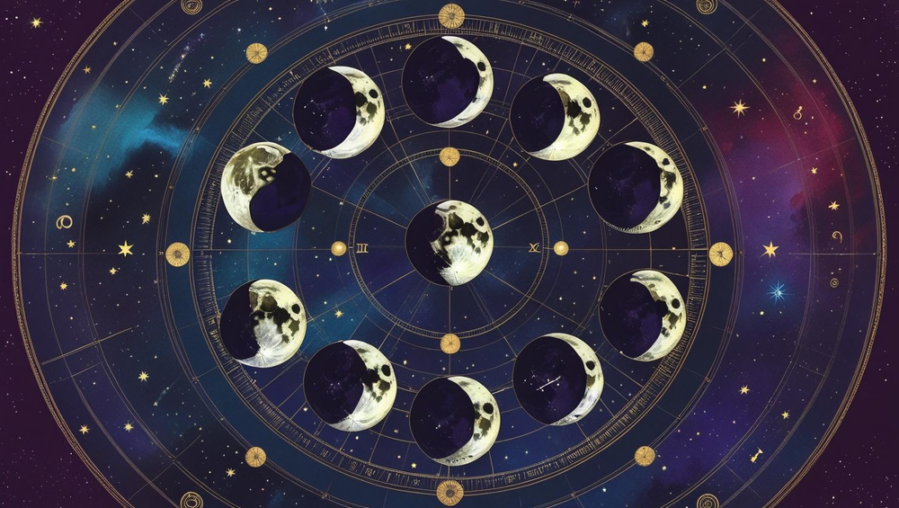
The moon doesn’t produce her own light, she reflects the sun’s. As she orbits Earth every 29.5 days, the angle of sunlight hitting her surface changes, creating the phases we observe from down here. This cycle, called a synodic or lunar month, has eight distinct phases:
New Moon
The moon sits between Earth and the sun, invisible to us. This is the dark moon, the blank slate, the moment of new beginnings.
Waxing Crescent
A sliver of light appears, growing. The moon is building energy, gathering momentum.
First Quarter
Half the moon is illuminated. This is a time of action, of overcoming obstacles, of making decisions.
Waxing Gibbous
More than half full now, still growing. The moon is approaching her peak, refinement and adjustment happen here.
Full Moon
The Earth sits between the sun and moon, and her entire face glows. This is the moment of culmination, revelation, full power.
Waning Gibbous
Just past full, the moon begins to release. This is a time for gratitude, for sharing what you’ve learned.
Last Quarter
Half illuminated again, but shrinking now. Time to let go, to release what no longer serves.
Waning Crescent
A thin sliver remains before darkness returns. This is the moment of rest, surrender, completion.
The Full Moons of 2026
Each month’s full moon carries its own traditional name, most originating from Native American, Colonial American, and European traditions. These names reflect seasonal changes and the natural world’s rhythms.
Wolf Moon ~ January 3
Named for the howling of hungry wolves in the depths of winter. This is the first full moon of the year, a time for setting foundations and acknowledging what you’re hungry for.
Snow Moon ~ February 1
February’s heavy snowfall inspired this name. Under this moon, we honor stillness, the quiet work that happens beneath frozen ground.
Worm Moon ~ March 3 (Total Lunar Eclipse)
As the earth thaws, earthworms emerge. This moon marks the transition into spring, the return of life, the promise of growth. 2026’s Worm Moon features a total lunar eclipse visible from North and South America, Asia, Australia, and the Pacific. A powerful time for transformation and shadow work.
Pink Moon ~ April 2
Named for the pink wildflowers (moss phlox) that bloom in early spring. This moon celebrates beauty emerging from dormancy, color returning to the world.
Flower Moon ~ May 2
Flowers bloom abundantly in May. Under this moon, we celebrate fertility, creativity, and the full expression of our gifts.
Strawberry Moon ~ May 31 (Blue Moon)
Marks the strawberry harvest season. 2026 gives us a rare Blue Moon—the second full moon in May. This is a powerful time for manifestation and breaking from convention, honoring both sweetness and the unexpected.
Buck Moon ~ June 30
Male deer grow their new antlers in July. This moon speaks to growth, masculine energy, and the pride of summer’s peak.
Sturgeon Moon ~ July 29
Named for the abundant sturgeon fish in the Great Lakes. This moon honors the harvest from water, the nourishment that comes from depth.
Harvest Moon ~ August 28 (Partial Lunar Eclipse)
The full moon closest to the autumn equinox, traditionally providing light for farmers harvesting crops. This is about reaping what you’ve sown, gathering abundance. A partial lunar eclipse adds intensity to this moon’s transformative energy.
Hunter’s Moon ~ September 27
Following the harvest, this moon lit the way for hunters preparing for winter. Time to pursue what sustains you, to be strategic about survival.
Beaver Moon ~ October 26
Beavers build their winter dams in November. This moon encourages preparation, creating shelter, building what will protect you through dark times.
Cold Moon ~ November 25
The long, cold nights of December inspired this name. Under this moon, we honor the dark, the quiet, the wisdom of winter.
Long Night Moon ~ December 23
The full moon nearest the winter solstice, when nights are longest. This moon asks us to find light in the deepest darkness and trust in the return of the sun.
The New Moons of 2026
While full moons get most of the attention, new moons are equally powerful. They’re the moment of planting seeds, setting intentions, beginning cycles. Here are 2026’s new moons:
~ January 18 (Capricorn)
~ February 17 (Aquarius) ~ Annular Solar Eclipse
~ March 19 (Pisces)
~ April 17 (Aries)
~ May 17 (Taurus)
~ June 15 (Gemini)
~ July 14 (Cancer)
~ August 12 (Leo) ~ Total Solar Eclipse
~ September 11 (Virgo)
~ October 11 (Libra)
~ November 9 (Scorpio)
~ December 9 (Sagittarius)
New moons are ideal for journaling intentions, starting projects, making commitments, or simply sitting in the dark and listening to what wants to emerge.
Special Lunar Events in 2026
Blue Moon
May 31 marks a rare Blue Moon. The second full moon in a single month. This happens roughly every 2-3 years and offers a powerful opportunity for manifestation and breaking patterns, especially sweet given its timing during the Strawberry Moon season.
Eclipses 2026 is a significant eclipse year with four major events
~ Annular Solar Eclipse ~ February 17 (Aquarius new moon): Visible from South Africa, South America, and parts of the Atlantic. Solar eclipses bring new beginnings and unexpected changes.
~ Total Lunar Eclipse ~ March 3 (Virgo full moon): Visible from North and South America, Asia, Australia, and the Pacific. This is the last total lunar eclipse until 2028-2029. Lunar eclipses are cosmic reset buttons for release and shadow work.
~ Total Solar Eclipse ~ August 12 (Leo new moon): Visible from Europe, North America, Greenland, Iceland, and parts of the Atlantic. This is a powerful time for new beginnings related to leadership and self-expression.
~ Partial Lunar Eclipse ~ August 28 (Pisces/Harvest Moon): Visible from North America and parts of South America. This adds intensity to the traditional Harvest Moon energy of completion and gathering.
Eclipses are threshold moments, times when unexpected change and revelation accelerate transformation. Many practitioners approach eclipse energy with caution, using it for deep work rather than everyday spell casting.
Thirteen Full Moons
2026 has 13 full moons instead of the usual 12, thanks to the Blue Moon in May. This extra lunation offers an additional opportunity for manifestation work and lunar connection.
Working With the Moon Calendar
The beauty of the moon calendar is that it gives you a natural rhythm to work with, whether you’re:
Setting intentions: New moons are for planting seeds of what you want to grow.
Making moon water: Full moons charge water with lunar energy. Set it out overnight and use it for rituals, watering plants, or drinking as a way to internalize lunar wisdom.
Planning rituals: Align your spiritual practices with the moon’s phases for amplified energy.
Tracking your own cycles: Notice how your energy, emotions, creativity, and even sleep patterns shift with the moon’s phases. Many people find they’re more outward-focused during the waxing moon and more introspective during the waning.
Gardening: Traditional farmers planted above-ground crops during the waxing moon and root vegetables during the waning moon, following the belief that the moon’s gravitational pull affects water in soil just as it affects tides.
Timing decisions: Need to start something new? Wait for the new or waxing moon. Need to release or end something? The waning moon supports letting go.
Beyond the Calendar. Your Personal Lunar Practice
The moon calendar is a tool, not a rule. You don’t need to do something special for every single moon phase. Some months, you’ll feel called to mark the full moon with ritual and intention. Other months, you might barely notice it passing.
What matters is developing your own relationship with lunar time. Notice when you naturally look up and see her. Pay attention to how your body and energy respond to her phases. Use the calendar as a reference point, but let your intuition guide how deeply you engage.
The moon has been turning her face toward Earth for billions of years. She’s patient. She’ll keep cycling through her phases whether you’re watching or not. But there’s something profound that happens when you start paying attention – when you realize you’re part of a rhythm much older and larger than yourself.
The calendar is just the beginning. The real practice is learning to feel the moon’s pull in your own body, your own life, your own unfolding. She’s been waiting for you to look up.
2026 ~ A Year of Lunar Power
With 13 full moons including a Blue Moon, four powerful eclipses marking threshold moments, and the last total lunar eclipse until 2028, 2026 offers rich opportunities for lunar work. This is a year to deepen your relationship with the moon’s wisdom, to track your own cycles alongside hers, and to let her ancient rhythm guide you through whatever transformations are coming.
Mark your calendar. Set out your water. Watch the sky. The moon is already watching you.