 Written by
 The Mysterious World of Runes
Runes have captivated human imagination for over two millennia, serving as both a practical writing system and a mystical tool for divination. These angular symbols, carved into stone, wood, and metal by ancient Germanic and Nordic peoples, represent one of humanity’s most enduring connections to ancestral wisdom. Today, runes continue to fascinate people worldwide, bridging the gap between historical scholarship and contemporary spiritual practices.
Whether you’re drawn to their historical significance, their artistic beauty, or their potential for personal insight, understanding runes requires exploring their rich cultural heritage, complex symbolism, and the ongoing debates surrounding their modern applications.
The Historical Foundation of Runes
Origins and Development
The runic alphabet, known as the futhark (named after its first six letters: F-U-Th-A-R-K), emerged around the 2nd century CE among Germanic tribes. The earliest inscriptions appear on artifacts like the Vimose comb from Denmark and various weapon parts found across Scandinavia and northern Europe.
Runes evolved through several distinct periods:
Elder Futhark (2nd-8th centuries CE): The original 24-rune system, primarily used for short inscriptions on weapons, jewelry, and memorial stones. These runes served practical purposes – marking ownership, honoring the dead, and recording significant events.
Younger Futhark (9th-11th centuries): A simplified 16-rune system that emerged during the Viking Age. Despite having fewer symbols, this system handled the growing complexity of Old Norse language through contextual interpretation.
Anglo-Saxon Futhorc: An expanded system used in England, eventually growing to 33 runes to accommodate the sounds of Old English.
Archaeological Evidence
Thousands of runic inscriptions have been discovered across Europe, from Norway’s famous runestones to smaller artifacts like the Berga runestone in Sweden. The majority of historical runic inscriptions are surprisingly mundane, recording names, ownership, or simple statements like “Thorfast made good runes.”
However, some inscriptions hint at magical or religious applications. The Lindholm “amulet” features repetitive runic sequences that scholars interpret as magical formulas, while certain bracteates (thin gold medallions) combine runic inscriptions with mythological imagery.
Understanding the Runes: Individual Meanings and Symbolism
The Elder Futhark: The Original 24
The traditional Elder Futhark consists of 24 runes divided into three groups of eight, called aettir (families). Each rune carries multiple layers of meaning – literal, symbolic, and mystical.
First Aett (Freyr’s Aett)
Fehu (ᚠ) ~ Cattle, Wealth
Represents moveable wealth, abundance, and social status. In ancient times, cattle were the primary measure of prosperity. Symbolically, it suggests the beginning of prosperity and the energy needed to acquire and maintain resources.
Uruz (ᚢ) ~ Aurochs, Strength
Named for the wild ox, this rune embodies raw, untamed power and vitality. It represents physical strength, determination, and the primal forces of nature. In divination, it often indicates the need for courage and endurance.
Thurisaz (ᚦ) ~ Giant, Thor’s Hammer
A complex rune representing both destructive and protective forces. Associated with Thor’s hammer Mjolnir, it embodies the power to break through obstacles but warns of potential chaos. It suggests both defense and conflict.
Ansuz (ᚨ) ~ God, Odin
Connected to divine communication and wisdom. Represents the breath of Odin that gave life to humanity, symbolizing inspiration, knowledge, and spiritual insight. Often interpreted as a sign of incoming messages or revelations.
Raidho (ᚱ) ~ Riding, Journey
Symbolizes travel, both physical and spiritual. Represents rhythm, movement, and the importance of the journey itself rather than just the destination. Suggests progress and forward momentum in life.
Kenaz (ᚲ) ~ Torch, Knowledge
The rune of illumination and controlled fire. Represents creativity, inspiration, and the light of knowledge dispelling darkness. Associated with craftsmanship, artistic ability, and the transformation of raw materials into something valuable.
Gebo (ᚷ) ~ Gift
Symbolizes the sacred act of giving and receiving. Represents reciprocity, partnership, and the bonds that unite communities. In relationships, it suggests balance and mutual exchange.
Wunjo (ᚹ) ~ Joy
Represents happiness, harmony, and fulfillment. The culmination of the first aett, it suggests the joy that comes from achieving balance between material prosperity and spiritual well-being.
~~~
Second Aett (Heimdall’s Aett)
Hagalaz (ᚺ) ~ Hail
A rune of disruption and sudden change. Like a hailstorm, it represents forces beyond our control that can be destructive but ultimately clearing. Often indicates necessary upheaval or testing.
Nauthiz (ᚾ) ~ Need, Necessity
Represents constraint, hardship, and the lessons learned through adversity. While challenging, it suggests that difficulty can lead to innovation and personal growth. The fire-drill aspect emphasizes creating something vital through friction.
Isa (ᛁ) ~ Ice
Symbolizes stillness, preservation, and hidden potential. Like water frozen in winter, it represents a pause in activity that preserves energy for future growth. Can indicate patience or stagnation, depending on context.
Jera (ᛃ) ~ Year, Harvest
The rune of natural cycles and earned rewards. Represents the patient work of farming, planting, tending, and harvesting. Suggests that effort invested wisely will yield results in due time.
Eihwaz (ᛇ) ~ Yew Tree
Associated with the World Tree Yggdrasil and the boundary between life and death. The yew tree’s longevity and toxic/medicinal properties make it a symbol of transformation and endurance through difficulty.
Perthro (ᛈ) ~ Dice Cup, Mystery
Perhaps the most enigmatic rune, often associated with fate, chance, and hidden knowledge. Represents the unknowable aspects of existence and the role of mystery in human experience.
Algiz (ᛉ) ~ Elk, Protection
A powerful protective rune, often compared to the antlers of an elk or raised hands in defense. Represents connection to divine protection and the ability to ward off negative influences.
Sowilo (ᛊ) ~ Sun
The rune of success, vitality, and life force. Represents achievement, honor, and the energy needed to accomplish goals. Unlike some runes, Sowilo is considered wholly positive.
~~~
Third Aett (Tyr’s Aett)
Tiwaz (ᛏ) ~ Tyr, Justice
Named for the god Tyr, who sacrificed his hand to bind the wolf Fenrir. Represents sacrifice for the greater good, justice, courage in leadership, and the warrior’s honor.
Berkano (ᛒ) ~ Birch, Rebirth
Associated with the birch tree, new beginnings, and feminine fertility. Represents growth, renewal, and the nurturing aspects of nature. Often linked to family and new ventures.
Ehwaz (ᛖ) ~ Horse
Symbolizes partnership, trust, and cooperation. Horses were essential to ancient Germanic peoples, representing the relationship between human and animal. Suggests teamwork and shared progress.
Mannaz (ᛗ) ~ Human
Represents humanity itself, community, and social cooperation. Emphasizes the importance of human connections and our role within the larger community. The rune of the social self.
Laguz (ᛚ) ~ Water
The rune of intuition, emotions, and the unconscious mind. Water’s fluid nature represents adaptability and the life-giving properties of emotional and psychic energy.
Ingwaz (ᛜ) ~ Ing, Fertility
Associated with the god Ing (Freyr) and represents male fertility, inner growth, and potential energy gathering before manifestation. A rune of gestation and internal development.
Dagaz (ᛞ) ~ Day
Represents breakthrough, enlightenment, and the dawn of new understanding. The balance point between night and day symbolizes transformation and awakening consciousness.
Othala (ᛟ) ~ Inheritance, Homeland
The final rune represents ancestral property, heritage, and the accumulated wisdom of generations. Symbolizes what we inherit from our ancestors and what we pass to future generations.
Runic Divination: Methods and Practices
Traditional Approaches
Historical sources provide limited but intriguing glimpses into ancient runic divination. Tacitus, writing in the 1st century CE, described Germanic tribes casting marked lots for guidance, though he didn’t specifically mention runes.
The Hávamál, a collection of Old Norse poetry attributed to Odin, contains verses that suggest runes were used for magical and divinatory purposes:
“I know a ninth: if need arises
to save my ship upon the sea,
I can still the wind upon the waves
and put all the sea to sleep.”
Modern Divination Methods
Contemporary runic divination has developed various approaches, drawing inspiration from both historical hints and modern innovation:
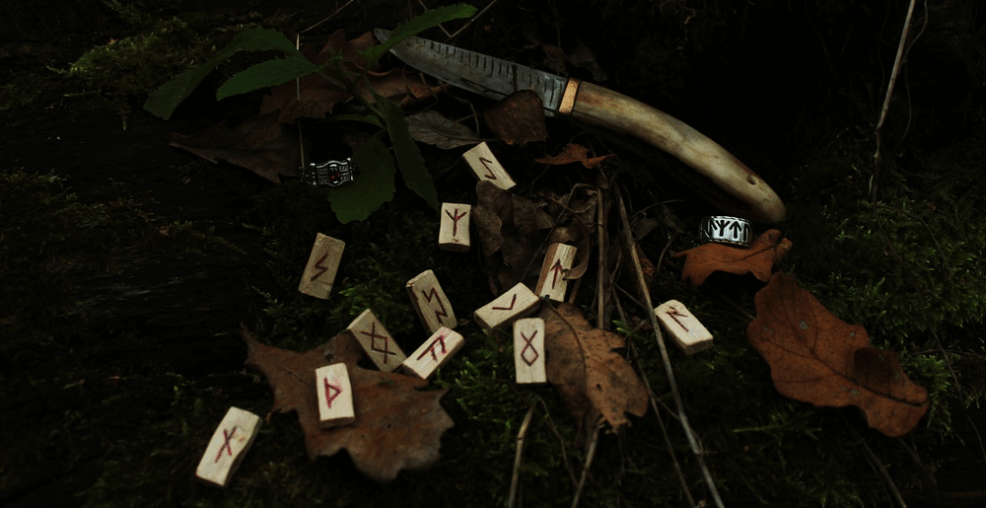
Single Rune Draw: The simplest method, drawing one rune for daily guidance or to answer a specific question. This approach focuses on meditation and deep interpretation of a single symbol.
Three-Rune Spread: Often interpreted as past-present-future or situation-action-outcome. This method provides a more complex reading while remaining manageable for beginners.
Five-Rune Cross: Arranged in a cross pattern representing the current situation, challenges, distant past, possible future, and the probable outcome.
Nine-Rune Grid: A comprehensive spread using the sacred number nine, providing detailed insight into multiple aspects of a situation.
Runic Wheel: A circular arrangement of runes representing different life areas – health, relationships, career, spirituality, etc.
The Divination Process
Experienced practitioners emphasize several key elements:
Preparation: Creating a sacred space, clearing the mind, and formulating clear questions. Many practitioners use meditation or ritual cleansing before readings.
Casting Methods: Runes can be drawn from a bag, cast onto a cloth, or selected intuitively. Each method carries different energetic implications.
Interpretation: Combining traditional meanings with intuitive insights and contextual relevance. The relationship between runes in multi-rune spreads adds layers of meaning.
Integration: Translating runic guidance into practical action and ongoing contemplation.
Cultural and Religious Significance
Germanic and Nordic Traditions
In ancient Germanic culture, runes served multiple functions beyond mere writing. They were carved into weapons to bring victory, inscribed on medical instruments for healing, and placed on ships for safe passage. The belief in runic power was deeply integrated into daily life.
The connection between runes and the god Odin is central to their mystical reputation. According to the Hávamál, Odin discovered the runes through self-sacrifice, hanging himself from Yggdrasil for nine days and nights. This myth establishes runes as divine wisdom obtained through suffering and dedication.
Shamanic Connections
Modern scholars have noted similarities between runic practices and shamanic traditions worldwide. The emphasis on sacrifice for wisdom, the use of symbols for magical purposes, and the practice of divination through marked objects appear in many cultures.
The concept of seidr, a form of Norse magic associated with prophecy and fate manipulation, likely incorporated runic symbols and practices. Archaeological evidence suggests that some individuals served as specialist practitioners of runic magic and divination.
Contemporary Spiritual Movements
Runes have found new life in various modern spiritual contexts:
Asatru and Heathenry: Reconstructionist religions seeking to revive ancient Germanic spiritual practices often incorporate runic work as both historical study and living practice.
Neo-Paganism: Many Wiccan and general pagan practitioners use runes alongside other divination tools, appreciating their connection to earth-based spirituality.
New Age Spirituality: Runes have been adapted into broader spiritual frameworks emphasizing personal growth and intuitive development.
Secular Applications: Some people use runes purely as psychological tools for reflection and decision-making, without religious or magical beliefs.
The Positive Aspects of Runic Practice
Personal Development Benefits
Enhanced Intuition: Working with runes can develop intuitive faculties and trust in inner wisdom. The practice of interpretation requires accessing non-rational ways of knowing.
Cultural Connection: For people of Northern European ancestry, runes provide a tangible link to ancestral traditions and ancient wisdom.
Meditative Focus: The contemplative nature of runic study and divination naturally develops mindfulness and present-moment awareness.
Symbol Recognition: Learning runic meanings enhances symbolic thinking and the ability to recognize patterns and connections in daily life.
Historical Understanding: Studying runes opens doors to ancient history, linguistics, and archaeological discoveries.
Practical Applications
Decision Support: Many practitioners find runic guidance helpful when facing difficult choices, not as deterministic answers but as tools for exploring different perspectives.
Creative Inspiration: Artists, writers, and creative professionals often use runes to overcome blocks and access new ideas.
Stress Management: The ritual aspects of runic practice can provide calming routines and stress relief through focused attention.
Community Building: Runic study groups and workshops create opportunities for like-minded individuals to connect and share experiences.
Educational Value: Learning about runes provides insights into language development, cultural evolution, and human symbolic expression.
Therapeutic Potential
Some therapists and counselors have explored runes as therapeutic tools:
Narrative Therapy: Runes can help clients explore their life stories and identify new perspectives on challenges.
Jungian Analysis: The archetypal imagery of runes resonates with Jungian concepts of the collective unconscious and symbolic healing.
Mindfulness Practice: The contemplative aspects of runic work align with mindfulness-based therapeutic approaches.
The Negative Aspects and Legitimate Concerns
Historical Misappropriation
Nazi Exploitation: Perhaps the most serious concern involves the appropriation of runic symbols by Nazi Germany and subsequent white supremacist movements. The SS used modified runic symbols, and various runes have been co-opted by racist organizations.
Nationalist Abuse: Some nationalist and extremist groups have claimed runes as symbols of racial superiority, completely distorting their historical context and meaning.
Cultural Theft: Concerns exist about the appropriation of runes by people with no connection to Germanic cultures, potentially trivializing sacred symbols.
Pseudohistorical Claims
Fabricated Origins: Some modern runic systems claim ancient authenticity while being largely contemporary inventions. The “Witches’ Runes” and various “Celtic” rune sets lack historical basis.
Exaggerated Powers: Unrealistic claims about runic abilities. Predicting specific events, controlling outcomes, or guaranteeing particular results, mislead practitioners and create unrealistic expectations.
Historical Distortion: Romanticized portrayals of ancient Germanic culture often ignore the complexities and challenges of historical reality.
Psychological Concerns
Dependency Issues: Some individuals may become overly reliant on runic guidance for decision-making, avoiding personal responsibility and critical thinking.
Confirmation Bias: The tendency to interpret runic messages to confirm pre-existing beliefs or desired outcomes can prevent genuine insight and growth.
Delusion of Control: Believing that runic practice provides control over uncontrollable events can lead to disappointment and poor life choices.
Social Isolation: Excessive focus on esoteric practices might contribute to isolation from mainstream social connections and support systems.
Commercial Exploitation
Marketing Manipulation: The commercialization of runes through expensive courses, “certified” programs, and magical products often exploits people’s spiritual seeking.
False Promises: Commercial runic products sometimes promise guaranteed results or supernatural abilities that cannot be delivered.
Quality Concerns: Mass-produced rune sets may lack the craftsmanship and intention that practitioners consider important for effective use.
Scholarly Perspectives and Academic Research
Linguistic Studies
Academic runologists focus primarily on runes as a writing system, studying their evolution, regional variations, and relationship to other alphabets. Major research centers include universities in Scandinavia, Germany, and the UK.
Recent discoveries continue to expand our understanding. The 2021 find of a runestone in Småland, Sweden, challenged existing theories about runic spread and usage patterns.
Archaeological Insights
Archaeological evidence provides the most reliable information about historical runic use. Key findings include:
Practical Applications: Most historical inscriptions serve mundane purposes. Like marking ownership, recording names, or making simple statements.
Geographic Distribution: Runic inscriptions appear across a vast area from Greenland to Romania, indicating widespread literacy among certain social groups.
Social Context: Evidence suggests that runic literacy was not limited to elites but extended to craftspeople, traders, and ordinary citizens.
Anthropological Analysis
Anthropologists study runes within their cultural context, examining their role in ancient Germanic society and their modern revival. This research reveals how symbols gain and lose meaning across time and cultural boundaries.
Studies of contemporary runic practitioners provide insights into modern spiritual seeking and the human need for connection with ancestral traditions.
Modern Applications and Future Directions
Educational Uses
Historical Education: Runes serve as engaging entry points for learning about medieval European history, linguistics, and archaeology.
Cultural Studies: Examining runic traditions helps students understand how cultures preserve and transmit knowledge across generations.
Art and Design: Contemporary artists incorporate runic aesthetics into modern works, creating bridges between ancient and contemporary expression.
Technological Integration
Digital Fonts: Unicode now includes standardized runic characters, enabling digital preservation and study of runic texts.
Database Projects: Online databases compile runic inscriptions from around the world, making them accessible to researchers and enthusiasts.
Virtual Reality: Some projects use VR technology to recreate ancient runic sites and contexts for educational purposes.
Therapeutic Applications
Bibliotherapy: Some therapists incorporate runic symbolism into reading and writing exercises for clients exploring personal growth.
Art Therapy: The visual and symbolic aspects of runes provide creative outlets for expression and exploration.
Mindfulness Training: The contemplative aspects of runic practice align with evidence-based mindfulness interventions.
Responsible Practice and Ethical Considerations
Cultural Sensitivity
Respectful Approach: Learning about the historical and cultural context of runes before using them for personal practice.
Avoiding Appropriation: Understanding the difference between respectful engagement and superficial borrowing from other cultures.
Acknowledging Sources: Recognizing both ancient origins and modern innovations in runic practice.
Critical Thinking
Balanced Perspective: Maintaining awareness of both potential benefits and limitations of runic practice.
Scholarly Grounding: Basing understanding on reliable historical and archaeological evidence rather than popular myths.
Personal Discernment: Developing the ability to distinguish between genuine insight and wishful thinking in interpretations.
Ethical Guidelines
Honest Representation: Being clear about what runes can and cannot do, avoiding unrealistic promises or claims.
Professional Boundaries: If offering readings to others, maintaining appropriate therapeutic and ethical boundaries.
Continuing Education: Staying informed about new archaeological discoveries and scholarly research on runic traditions.
Runes in the Modern World
Runes represent a fascinating intersection of ancient wisdom and contemporary seeking. Their journey from practical writing system to mystical tool reflects humanity’s enduring desire to find meaning and guidance through symbols and tradition.
The historical reality of runes, as tools used by ancient peoples for communication, record-keeping, and possibly divination, provides a foundation for modern practice. Yet contemporary runic work necessarily involves interpretation and innovation, creating new meanings while honoring ancient roots.
The challenges surrounding runic practice -from historical misappropriation to commercial exploitation – remind us of the importance of approaching these symbols with respect, knowledge, and critical thinking. At their best, runes offer a contemplative practice that can enhance self-awareness, provide comfort during difficult times, and connect us to the wisdom of our ancestors.
Whether approached as historical artifacts, spiritual tools, or psychological aids, runes continue to speak to something deep in human nature. Our need for symbols that help us navigate the complexities of existence. Their angular forms, carved by ancient hands into stone and wood, remind us that people have always sought ways to preserve and share wisdom across the generations.
In our rapidly changing world, runes offer both continuity with the past and tools for facing an uncertain future. They invite us to slow down, contemplate, and trust in wisdom that transcends the immediate pressures of modern life. Used responsibly and respectfully, runes can serve as bridges between ancient wisdom and contemporary insight, helping us honor both our heritage and our ongoing journey of growth and understanding.
The story of runes is ultimately a human story. Of our persistent effort to find meaning, create beauty, and pass wisdom to future generations. In this light, whether carved in stone by a Viking craftsman or drawn from a modern rune bag by a contemporary seeker, these symbols continue their ancient work of connecting us to something larger than ourselves.