

Marie Laveau ~ Where History Meets Mythology in the Voodoo Queen of New Orleans

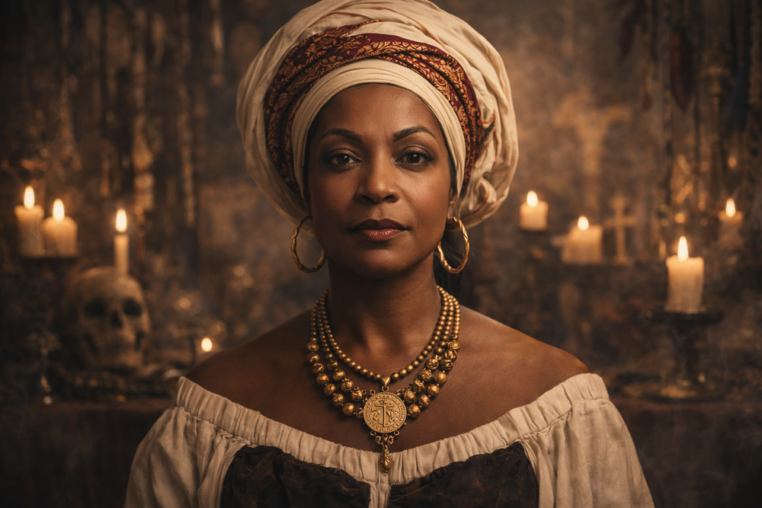
The image depicted here is an AI-generated representation of Marie Laveau. Very few verified photographs of her exist, in fact, none that we can confirm. Several 19th-century paintings of unidentified Creole women wearing tignons have been labeled as portraits of Laveau, but by the 1940s, any portrait of an unidentified woman of color in a head wrap was simply assumed to be her. The real Marie Laveau was never photographed, and likely never sat for a formal portrait.I also wrestled with how to categorize this post and ultimately placed it under “mythology.” Mythology doesn’t mean “untrue”, it refers to a body of stories and narratives that shape our understanding of a subject. What we genuinely know about Marie Laveau is limited to what appears in official records: birth certificates, marriage documents, census records, newspaper accounts. The rest – her magical abilities, her network of power, her spiritual practices – exists as story, speculation, oral history, and legend. Marie has become mythological in the truest sense: a figure whose reality is woven inextricably with mystery. She is called the Voodoo Queen of New Orleans. Her tomb is one of the most visited graves in America. People still mark three X’s on cemetery walls, begging for her intercession from beyond the grave. Songs have been written about her. She appears in novels, TV shows, horror films, and tourist ghost tours. She is worshiped and feared, romanticized and demonized, studied and sensationalized.But who was Marie Laveau, really?The answer is far more complicated, and far more interesting, than the legend suggests.The Documented Facts ~ What We Actually KnowLet’s begin with what can be verified through official records – the paper trail that survives two centuries of storytelling.Born: September 10, 1801, in the French Quarter of New Orleans, Louisiana. At the time of her birth, Louisiana was still under Spanish colonial administration, though France had recently reclaimed it by treaty.Parents: Her mother was Marguerite D’Arcantel (sometimes spelled Darcantel), a free woman of color of African, European, and Native American ancestry. Her father’s identity is less certain – likely either Charles Laveau (a white Creole) or Charles Laveaux (a free man of color). The confusion stems from inconsistent spelling in surviving records and the fact that Marguerite was unmarried at the time of Marie’s birth.Family Background: Marie was the first of her maternal line to be born free. Her great-grandmother Marguerite was enslaved, likely transported from Senegal to Louisiana aboard the last French slave-trading vessel, the St. Ursin, in 1743. Her grandmother Catherine endured three owners before finally purchasing her freedom in 1795, taking the name Catherine Henry. Catherine’s daughter, Marguerite Henry (Marie’s mother), was manumitted in 1790 by Henry Roche-Belaire.First Marriage: On August 4, 1819, at age 18, Marie married Jacques Paris, a free man of color from Saint-Domingue (Haiti), who had emigrated to New Orleans following the Haitian Revolution. Their marriage certificate, preserved in St. Louis Cathedral, includes the names of both her parents. The marriage was officiated by Père Antoine (Antonio de Sedella), the beloved Spanish Capuchin friar who would remain connected to Marie throughout her life.Children with Jacques Paris: Two daughters, Félicité (born 1817, before the marriage) and Angèle (born 1822). Both are presumed to have died in childhood, as they disappear from historical records.Jacques Paris Disappears: Between 1822 and 1824, Jacques Paris vanishes from city records. He is believed to have died in Baton Rouge in 1823, though there’s no death certificate. On Félicité’s 1824 baptismal certificate, Marie is referred to as “the Widow Paris” – a designation she would use for the rest of her life.Second Partnership: Around 1826, Marie...

Membership Required

You must be a member to access this content.

View Membership Levels

Already a member? Log in here