 Written by
 Every culture has a story about what happens when you go too far into the forest.
Not the forest that is merely trees and darkness and the absence of paths – but the deeper forest, the one that represents in the symbolic logic of the human imagination the place beyond the reach of ordinary rules. Where the social structures that tell you who you are do not follow. Where the protections of the known world fall away. Where what you encounter depends entirely on what you are, stripped of everything circumstantial.
The Slavic tradition has a name for what lives at the heart of that forest. And she has been there for longer than the stories about her.
Who She Is
Baba Yaga appears across the folklore traditions of Russia, Ukraine, Poland, and the broader Slavic world with a consistency that suggests a common origin far older than any of the specific stories that have survived. She is not one character with one story – she appears in dozens of distinct tales, sometimes alone, sometimes as one of three sisters all sharing her name, sometimes as an obstacle, sometimes as a helper, sometimes as both in the same story.
The name resists easy translation. Baba in Slavic languages means an old woman, a grandmother, or a midwife – one of the women traditionally present at the thresholds of birth and death. Yaga is more contested: it may relate to words meaning illness, horror, or the serpentine – or it may connect to the Proto-Slavic root for forest, wood, the wild place at the edge of the known world.
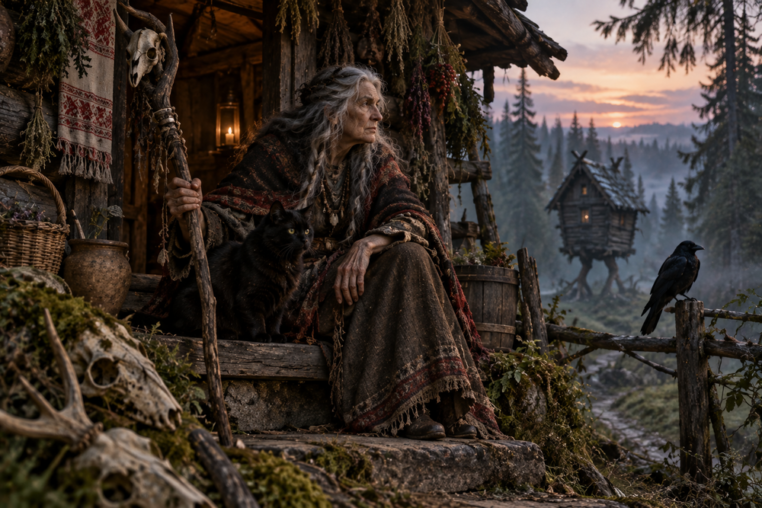
She is, in every sense, a threshold figure. Her hut stands at the boundary between the human world and the other world – the realm of the dead, the deep forest, the place where ordinary rules do not apply. It stands on chicken legs and rotates. It has no windows. Sometimes it faces the forest; sometimes it faces you.
When a hero comes to her for help or knowledge, they must first prove themselves worthy of the encounter by performing specific tasks, by demonstrating the right kind of courage and intelligence and respect for the old law. Those who approach her correctly receive what they came for. Those who don’t provide excellent dinner.
This is not arbitrary cruelty. It is the logic of initiation. The one who approaches the wild threshold being must be ready. The unprepared are destroyed – by their own inadequacy, not by malice.
The Old Slavic Religion Beneath the Stories
Slavic paganism, the pre-Christian religious tradition of the peoples who would become Russian, Ukrainian, Polish, Czech, Serbian, and Croatian, among others, was systematically suppressed after the Christianisation of Kievan Rus’ in 988 CE and the subsequent expansion of Christianity throughout Slavic lands.
What survived the suppression survived in fragments. In folklore, in seasonal customs, in folk magic practices that continued beneath the surface of official Christianity, and in the figures that persisted in the collective imagination. Because they were rooted too deeply to be extracted entirely.
Baba Yaga is one of these figures. She is almost certainly the descendant of a much older religious tradition. Possibly a goddess, possibly a figure associated with the dead, possibly the memory of the old women who were the keepers of spiritual knowledge in pre-Christian Slavic communities. Scholars have connected her to the Slavic goddess of death, to the crone aspect of a triune goddess, to ancient forest spirits, to the ancestral dead.
What is clear is that her characteristics – the chicken-legged hut, the mortar and pestle, the fence of bones, the specific ritual logic that governs how she can be approached – are too consistent across too many independent folk traditions to be the invention of any single storyteller. They are the trace of something old, something that the Christian missionaries who arrived in Slavic lands tried to suppress and could not quite eradicate.
The fence of skulls around her hut, which glow at night with their eye-sockets, was the fence between the world of the living and the world of the dead. To stand outside her gate is to stand at the boundary between life and death and ask what is on the other side.
The Mortar and the Pestle
The mortar and pestle are the most distinctive elements of Baba Yaga’s iconography, and the most interesting to examine.
A mortar, a vessel for grinding, is one of the oldest domestic tools in human existence. It is the instrument through which plants are reduced to their essential qualities, through which the herbalist extracts what is useful from what merely carries it. The pestle is its partner: active force working within the containing vessel.
In Slavic folk magic, the mortar and pestle appear repeatedly in the context of healing and transformation. The wise woman who knows her plants uses them to prepare the remedies that cannot be prepared any other way. The grinding is the work. The vessel is the space in which the work happens.
That Baba Yaga travels in a mortar – that her vehicle through the sky is the instrument of transformation – tells you something about what she is. She is not merely an old woman who flies. She is transformation itself, moving through the world, leaving no tracks, sweeping away the evidence of her passage.
The birch broom is similarly significant. Birch is one of the sacred trees of the Slavic tradition. Associated with spring, with new beginnings, with purification. To sweep with birch is to clear the way, to erase the old so the new can come. Baba Yaga erases her own tracks not to hide but to ensure that where she has been cannot be followed. The threshold she guards is one-directional. You cross it deliberately. You do not drift back across it unconsciously.
The Three Guardians
In many of the tales, the hero’s journey through Baba Yaga’s territory is marked by encounters with three riders: the White Horseman of dawn, the Red Horseman of day, and the Black Horseman of night.
They are her servants. She commands the cycle of day and night. She governs time, or rather, she governs the territory within which time operates differently, where the rules that apply in the ordinary world do not hold, where what you do and who you are matter more than any external circumstance.
This is the territory that initiates enter. This is what the deep forest represents in the fairy tale logic that is never merely fairy tale. The place where you encounter what you actually are, stripped of the social scaffolding that usually tells you who you are, and discover whether you are capable of the thing the story requires.
Baba Yaga tests. She does not grade on a curve. And what she reveals in the testing is not whether you are powerful or brave in the conventional sense. But whether you have the specific quality that she recognizes as genuine: the willingness to serve, to listen, to respect what is older than you, to ask the right questions.
She feeds the heroes who succeed. In many tales, she gives them a bath, a meal, and a bed, the old obligations of hospitality, before sending them on their way with the magical object or knowledge they need. She does not do this because she is kind. She does it because the successful initiate has earned the hospitality of the threshold. They have proven they belong there, at least temporarily, at least long enough to receive what they came for.
Baba Yaga and the Witch’s Craft
The connection between Baba Yaga and the European witch tradition runs in several directions.
She is clearly a witch figure. The old woman with supernatural powers, living at the edge of the community, feared and consulted in equal measure. She is also clearly not the witch of the Inquisition, the woman accused, the woman burned. She is far older than that construction, and she operates in a different register entirely.
In the Russian witch-figure of the ved’ma (the one who knows) Baba Yaga’s characteristics appear in a more human form. The old woman of the village who knows plants and healing and the language of the dead, who can be consulted for help with the kinds of problem that ordinary institutions cannot address, who is treated with respect and some fear because the knowledge she holds is real and the consequences of disrespecting it are real.
The znakhar and znakharka (the cunning men and women of the Slavic folk tradition) worked in the same territory, with the same foundational understanding: that illness and misfortune have causes that exceed the purely physical, and that addressing them requires access to a form of knowledge that comes from somewhere beyond ordinary human learning.
Baba Yaga is the mythological figure at the centre of that territory. She is what the forest at the edge of the village contains, distilled into a single image: the wild, ancient, consuming, transformative power that knows more than the village does, that has existed longer than any institution, that can help if you come correctly and destroy you if you don’t.
She is not something to be romanticised. She is something to be taken seriously.
The Practice She Points Toward
For practitioners drawn to the Slavic tradition, or simply to the archetype Baba Yaga embodies, what she points toward is this:
There is knowledge that cannot be acquired by ordinary means. It lives at the edge, at the boundary between the familiar and the wild, between the human world and the non-human world, between the living and the dead. To reach it, you have to be willing to go to the edge. To stand outside the chicken-legged hut. To knock.
And then to do the work correctly. To know that what you encounter at the threshold is not obligated to help you, is genuinely dangerous, and will give you exactly what you earned – no more, no less, with absolute honesty about whether you earned it.
That is the Baba Yaga encounter. That is what every encounter with genuine power at the threshold actually is.
The mortar is grinding. The broom is sweeping. The fence of skulls is glowing.
You are at the edge of the forest. You know what you came for. The question she has always asked, the question the threshold has always asked, is whether you are ready to receive it.
Baba Yaga. The wild old woman. The bone-legged grandmother. The one who tests. She is not a fairy tale character who happens to be frightening. She is what real contact with the threshold actually is – terrifying, generous, honest, and older than everything else.