 Written by
 The desert heat is not metaphor. It is her breath.
She comes with the sun at its most brutal. The white, annihilating noon of the Egyptian summer when the sand radiates upward and the air itself seems to burn and there is nowhere to hide and nothing to do but submit to it. She comes with the simoom, the poison wind that moves across the desert like a living thing, carrying plague and fever and the smell of something ancient and without mercy. She comes when the lioness bursts from the reeds at the watering hole, and the world reduces itself, in a single shocked instant, to the irreducible fact of power.
Her name is Sakhmet in the original Egyptian. From sekhem, meaning power, might, the force that cannot be resisted. She is usually translated as She Who Is Powerful, and this is accurate as far as it goes, but it does not go nearly far enough. Power in Sekhmet’s case is not the power of authority or rank or accumulated influence. It is something more fundamental. The power of a force of nature that predates human categories and will outlast them, that does not require your permission or your belief, that simply is in the way that fire is and plague is and the desert is.
She is the goddess of war, of destruction, and of healing. She is the Eye of Ra. The solar fire made personal, directed, and when necessary, turned against the enemies of creation itself. She is the patron of surgeons and physicians. She is the one who sends plague and the one who can call it back. She is the destroyer and the healer and she has never once apologized for being both at exactly the same time.
Every culture has a goddess of this kind – the one who contains both the wound and the cure, both the burning and the balm – but Sekhmet is one of the oldest. She has been worshipped without interruption for more than four thousand years. She is still being called upon. She has not grown smaller with age.
Who is Sekhmet?
Sekhmet is one of the most ancient deities in the Egyptian pantheon, with cult centres attested from the earliest dynastic periods. Her worship was centred primarily at Memphis, where she formed a divine triad with Ptah (the creator god, the craftsman of the universe) as his consort. And Nefertem (the god of the lotus and of healing perfumes) as her son. This triad is theologically rich: the destroyer married to the creator, their child being the sweet fragrance of the healing lotus. Even her domestic arrangements speak in paradox.
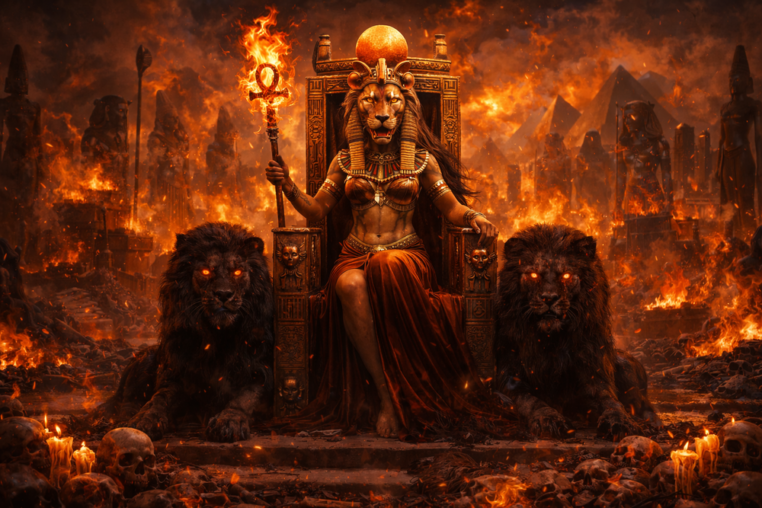
Her iconography is among the most recognisable in the Egyptian canon. A woman’s body, powerful and upright, with the head of a lioness, crowned with the solar disc and the uraeus serpent that marks her as a force of divine fire and royal power. She is most often depicted in red – the color of blood, of fire, of the desert, of the fiercest aspect of the sun. Her statues were made in enormous numbers during the reign of Amenhotep III (roughly 1390–1352 BCE), who commissioned hundreds, some accounts say over seven hundred, of black granite Sekhmet statues for the temple of Mut at Karnak, one for each day and night of the year. The sheer scale of this devotion speaks to how seriously she was taken, and to how much the Egyptians believed was at stake in keeping her appeased.
She is intrinsically connected to the concept of the Eye of Ra, the solar fire that Ra sends forth as his agent and weapon. When Ra grew old and humanity began to mock and rebel against him, he sent his Eye, in the form of Sekhmet, to punish the transgressors. She went. She went with absolute, ungovernable ferocity. She killed. She drank blood. She could not stop. The entire human race stood to be annihilated.
The gods, in desperation, flooded the fields with beer dyed red with ochre so that it looked like blood. Sekhmet, frenzied and insatiable, drank it all and fell into a stupor. When she woke, the killing rage had passed. Humanity survived.
This myth is one of the oldest destruction-and-salvation narratives in recorded religion. It is also one of the most psychologically honest. The same force that protects creation is capable of destroying it, and the line between the two is not always clear until it has already been crossed. Sekhmet does not have an off switch. What she has is the capacity to be redirected. But only with wisdom, care, and an understanding of what is actually driving the fire.
Her connection to Hathor is essential and often overlooked. In many versions of the Eye of Ra myth, Sekhmet and Hathor are the same goddess – two aspects of the solar feminine principle, one terrible and one radiant. Hathor is love and beauty and music and intoxication. Sekhmet is war and plague and the burning desert wind. The Egyptian theological mind did not see these as contradictions. They saw them as the full truth of a single enormous power. The gentle and the devastating are not opposites. They are the same energy, differently expressed.
What Are Her Domains?
War and Righteous Destruction
Sekhmet is the protector of the pharaoh in battle. She walks before the armies, her breath the desert wind, her arrows the carriers of plague and fever into the enemy ranks. But her war is not the war of conquest or of ego. It is the war of ma’at – of cosmic order against chaos, of what is right against what seeks to destroy it. She does not make war carelessly. She makes it completely. The distinction matters.
Plague, Disease, and the Arrows of Pestilence
Her priests were among the most sophisticated medical practitioners in the ancient world. The wab priests of Sekhmet, the pure ones, the purified, were physician-priests who served both the goddess and the sick, understanding that the deity who sent disease was also the one who held the cure. To heal in her tradition was to negotiate with the source of illness itself, to understand its nature deeply enough to call it back. This is still the logic of inoculation – fighting fire with fire, summoning a controlled version of the destroyer in order to prevent the uncontrolled one.
Healing and Medicine
Every plague she sends, she can withdraw. Every wound she inflicts, she understands completely. The same heat that burns can cauterise. The same fire that destroys can purify. Sekhmet is the patron of surgeons, physicians, bone-setters, and those who work at the extreme edge of what the body can survive. She is not a gentle healing goddess. She is not the cool cloth on the fevered brow. She is the one who burns the infection out.
Solar Fire and the Scorching Eye
She is the fierce, noon-heat aspect of the sun. Not the generative warmth of the morning sun (that belongs to other deities) but the white, overwhelming blaze of midday when shadows disappear and there is nothing to hide behind. She governs the solar current in its most uncompromising form: the light that reveals, the heat that purifies, the fire that cannot be argued with.
Protection of the Divine Order
Ma’at, the Egyptian concept of cosmic truth, justice, balance, and order, is what Sekhmet ultimately serves. She is the enforcer of what is right. The pharaoh was her ward. Egypt was her charge. The cosmic order was her responsibility. She did not destroy for the pleasure of destruction but because some threats to order are so serious they require total response. She is the goddess you call when you need something genuinely, thoroughly defended.
Transformation Through Fire
Gold is made in heat. The desert, for all its killing power, is also a place of extraordinary clarity. Nothing survives there that is not essential, nothing remains that is not real. Sekhmet’s transformations are not gentle, but they are genuine. She burns away what does not belong. What survives her is stronger than it was.
Sexuality and the Fierce Feminine
Though less emphasised than her martial aspects, Sekhmet is a goddess of the full, fierce feminine, including its erotic dimensions. The lioness is one of the great symbols of female power and desire across African traditions, and Sekhmet carries this current strongly. Her sexuality, like everything else about her, is not delicate or decorative. It is elemental.
A Word of Caution: Invoking Sekhmet
Before you call her name, understand what you are calling.
The myth of the Eye of Ra is not merely a story about a goddess who got out of hand one time and had to be stopped with enchanted beer. It is a theological statement about the nature of divine power when it encounters human transgression. And about how easy it is for righteous response to become indiscriminate destruction. Sekhmet did not set out to kill everyone. She set out to punish those who had wronged Ra. She could not stop.
Practitioners who work with Sekhmet seriously describe an energy that is unlike almost anything else in the Egyptian pantheon:
~ Intensity without warning – she does not ramp up gradually; she is simply present, fully, immediately, and the full weight of her is present from the first moment
~ The burning out of falsehood – anything in you or your situation that is not true, that is maintained through self-deception or comfortable denial, will come under pressure. She has no tolerance for what is not real
~ Activation of anger and righteous fury – particularly anger that has been suppressed or told it has no right to exist. She does not recognize the social contract that requires you to be calm about things that deserve rage
~ Physical heat and intensity – many practitioners report physical sensations of warmth, pressure in the chest or solar plexus, a feeling of the air thickening. These are not imagination
~ Acceleration of change – situations that have been stagnant have a way of breaking open when Sekhmet is present. Not always in the way you expected or wanted
~ Demands for integrity – she will not remain in the presence of hypocrisy. If you are calling her for protection while refusing to act in alignment with what you know is right, she will make that dissonance very uncomfortable very quickly
She is also, and this is important, a goddess who responds to reciprocity. The ancient Egyptians understood that the gods were not simply power dispensers to be appealed to in need. They were parties to an ongoing relationship that required consistent attention, offering, and respect. Sekhmet in particular responds to regularity of practice and the seriousness with which you take the relationship.
Do not call her in emergency after months of ignoring her. Come to her consistently, with offerings and attention, and she will be present when you genuinely need her. Treat her as a vending machine for power and she will make very clear, in ways you will not enjoy, that she is not one.
The Importance of Intent
Sekhmet is a goddess of ma’at. Of cosmic order and right action. This means she is not available as a weapon of ego. She will not assist in attacks motivated by personal spite, by jealousy, by the desire to harm someone simply because they have hurt you. What she will assist in is the genuine defense of what is right, the protection of what is sacred, the removal of what genuinely threatens the order of your life or the lives of those you are responsible for.
The distinction between righteous anger and ego-driven rage matters enormously when working with her. She embodies the former completely. She has no interest in the latter. If you come to her with a request that is really about your wounded pride dressed up as justice, she is quite capable of showing you that. And the showing will not be comfortable.
Come with clarity. Come with honesty about your actual motivations. Come with a genuine need that is aligned with what is real and true and right. If you have that, she is one of the most powerful protectors in the entire ancient world.
The Wab Priests ~ Her Living Tradition
One of the most striking aspects of Sekhmet’s worship in ancient Egypt was the sophistication and longevity of her priestly tradition. The wab priests – the pure ones – who served her at Memphis and at her subsidiary temples throughout Egypt were simultaneously clergy and physicians, combining ritual practice with what was, for its time, remarkably advanced medical knowledge.
The Edwin Smith Papyrus, one of the oldest medical texts in the world (c. 1600 BCE, though likely copied from earlier sources), describes surgical procedures and medical treatments of considerable sophistication. And its practitioners operated under Sekhmet’s aegis. The wab priests diagnosed, treated, and when treatment failed, performed the necessary rites for the dead. They understood that life and death were not opposing forces to be kept separate but a continuum to be navigated with skill and appropriate spiritual preparation.
This integration, of the healer and the destroyer, of the medical and the spiritual, of the scientific and the sacred, is Sekhmet’s most enduring theological legacy. It tells us something profound: that the ancient Egyptians did not see the destructive and healing aspects of her nature as a paradox to be explained away. They saw them as two expressions of the same fundamental power, and they trained their most skilled practitioners to work with both.
The Myth of the Near-Destruction ~ Reading It Honestly
The story of Sekhmet’s rampage and the beer-flood requires careful reading, because it is easy to misread it in ways that diminish her.
She is not a force that lost control and needed to be tricked into stopping. Or rather – she is that, but that is not the whole story. The near-destruction of humanity happens because Ra’s initial response to human transgression was to send his most absolute weapon. The fault is not only Sekhmet’s. It is also Ra’s.. The decision to respond to human imperfection with annihilation rather than proportion.
What the myth actually teaches is about the danger of calling down absolute power in response to relative wrongdoing. Sekhmet is the Eye of Ra — she is the total, unmitigated solar force. She does not do partial. She does not do calibrated. When she is sent, she goes completely. Ra sent her for punishment, and what he got was extinction, because that is what happens when you use extinction-level force in a situation that requires something more measured.
The practitioner’s lesson is clear: call her with precision and for genuine need. She will respond completely. Make sure the situation warrants completeness.
Where Do We Find Her?
In the Ancient Egyptian Temples
The great cult centre at Memphis, where she formed her triad with Ptah and Nefertem. The massive collection of her statues at the temple of Mut in Karnak. Some of the most extraordinary surviving religious sculptures in the ancient world. The temple of Kom Ombo, where she shared worship with Sobek. The temples at Esna and Bubastis, where her cat-goddess sister Bastet received worship in forms that both overlapped and contrasted with Sekhmet’s fiercer nature.
In the Medical Tradition
The Edwin Smith Papyrus and the Ebers Papyrus, two of the oldest surviving medical texts anywhere in the world, both operate under Sekhmet’s spiritual authority. To read them is to encounter her in the form she herself would perhaps most value: as the source of the knowledge that keeps the body alive.
In the Syncretic World
During the Hellenistic period, Sekhmet was syncretised with Greek goddesses of similar power. Most notably Artemis in her fiercer, hunting aspect, and occasionally with Athena as goddess of war and strategy. She was also associated with the fierce solar goddesses of Nubia and other parts of Africa, connecting her to a broader tradition of powerful, sun-associated, lion-headed divine feminine power that runs through African religious history.
In Contemporary Practice
Sekhmet has seen a significant revival in contemporary paganism, Kemetic Orthodoxy (the reconstructed Egyptian religion), and eclectic witchcraft. She is widely honoured in feminist spiritual circles as one of the great archetypes of fierce, unapologetic feminine power. Practitioners working with solar magic, protection magic, healing, or the transmutation of anger into useful energy find her one of the most potent presences available to them.
She is present wherever lions are. Wherever desert heat distorts the air above the sand. Wherever a surgeon makes the decision that the only way to save a life is to cut into it. Wherever someone who has been told to be calm and quiet and small finally stops being calm.
Her Symbols and Correspondences
Number ~ 7 (associated with completion and power in Egyptian numerology) ~ also the number of the arrows of Sekhmet’s plague
Colours ~ Red (blood, fire, desert, the fierce sun), gold and solar yellow, black (the colour of Egyptian soil after the Nile flood, renewal after destruction), deep orange
Animals ~ The lioness above all others; the cobra (the uraeus, symbol of divine fire and royal protection); the vulture (the southern crown, the goddess Nekhbet, with whom she shares aspects); the serpent
Sacred Object ~ The sekhem sceptre (the staff of power from which her name derives); the solar disc; the sistrum (the ritual rattle used in her worship and in appeasing her fierce aspect); the ankh in her hands (the power of life held by the one who also holds death)
Moon Phase ~ The full moon in her solar intensity; also the dark moon when her fierce, unseen aspect is strongest
Time of Day ~ Noon ~ the white, shadow-killing height of the sun; and the hottest days of summer
Season ~ The height of summer; in Egyptian terms, the season of Shemu – the dry, fierce season before the Nile flood
Planet ~ The Sun, Mars (war, blood, fever, the body in extremity)
Direction ~ South ~ the direction of Nubia, of the deep desert, of the fierce heat; also East, where the sun rises in power
Element ~ Fire, above all; secondarily, Air (the desert wind, the simoom, the burning breath)
Offerings ~ Red beer or red wine, red meat (particularly beef, sacred to the solar goddesses), fresh blood-red flowers (red roses, red poppies, hibiscus), frankincense and myrrh burned heavily, red candles, solar images, images of lions, turquoise (sacred to Egyptian goddesses generally and to Sekhmet specifically), lapis lazuli
Incense ~ Frankincense (the incense of the sun, burned in massive quantities in Egyptian temples), kyphi (the complex Egyptian temple incense, a recipe involving honey, wine, raisins, and over a dozen resins and aromatics), myrrh, dragon’s blood, cinnamon
Herbs ~ Cinnamon (fire and heat), ginger, bay laurel (the solar herb), saffron, red peppers. Herbs of heat and fire and the solar current; also aloe vera (which heals burns – the paradox made botanical)
Sacred Stone ~ Red jasper (blood and fire), carnelian (the solar stone of the Egyptians, worn as protection and power), amber (solar resin, captured fire), garnet
Sacred Number of Statues ~ Amenhotep III commissioned 730 statues, one for each day and night of the year, as an act of sustained magical protection and appeasement
Working With Sekhmet ~ A Place to Begin
Begin at noon. Step outside into direct sunlight, as much direct sunlight as your climate allows, and feel the full weight of it on your skin without retreating into shade. Stay there for as long as you can. Not to suffer but to feel what she is. The unmitigated force of it. The way it does not adjust itself to your preference.
This is her first teaching: she does not moderate herself for your comfort. You must learn to receive what she is rather than expecting her to become what you can handle.
When you are ready for formal working: a noon or a full moon. Red candles, as many as you have. An offering of red wine or red beer, red flowers, frankincense burning until the room is thick with it. Her image or a lion’s image at the centre.
Approach her with your full self. Not the acceptable version, the whole version, including the anger you have been told is too much, the power you have been told is unfeminine or unseemly or frightening to others. She does not want the edited version. She wants what is real.
Tell her what needs protecting. Tell her what needs burning away. Tell her where you have been told you are too much, and watch what she does with that.
Ask her for the healing that comes through fire. Ask her for the clarity that comes when everything false has been consumed. Ask her to help you understand the difference between destructive rage and righteous power. Because she embodies that distinction, and she can teach it in a way that nothing else can.
Then be prepared to run hot for a while. She does not turn down easily once she has been genuinely invited in.
Sekhmet in the Modern World
The world is full of women who have been told they are too fierce. Too direct. Too angry. Too much.
Sekhmet was worshipped for over four thousand years. She was given hundreds of statues by one of the most powerful rulers in the ancient world, not to celebrate her ferocity, but to contain it, to maintain a living relationship with it, because the Egyptians understood that the fire that destroys is also the fire that heals, and that a culture which refuses to make a place for the destroyer within its religious imagination is a culture that has no honest account of the world.
She was the surgeon and the plague-sender. The protector and the annihilator. The one who stood before the army and the one who called physicians to the bedside. She was never asked to be only one of these things. She was honoured precisely because she was all of them.
For those who carry anger they have been told to suppress – anger at injustice, anger at violation, the white-hot rage of someone who has been diminished or harmed and told to respond with composure – she is the oldest affirmation that your fire is not a problem. It is power. What matters is whether you can direct it.
She is not asking you to burn everything down. She is asking you to understand your own heat well enough to use it with precision.
She is asking you to stop apologising for being powerful.
She has been asking that, from the desert and the noon sun and the red heat of the sickroom, for four thousand years.
She is still asking.
She stood before the armies with the desert wind at her back.
She walked into the plague and knew every one of its names.
She was the wound and the surgeon’s hand.
She was the fire that destroyed and the fire that purified.
She has never been one thing.
She has never been asked to be.
She is the Eye of Ra and she is looking directly at you.
She has always been looking directly at you.
Further Reading and Study
~ The Ancient Egyptian Pyramid Texts – the oldest religious texts in the world, in which Sekhmet appears in her most ancient form
~ Egyptian Religion – Siegfried Morenz; the foundational scholarly introduction to the theology of the Egyptian gods
~ The Complete Gods and Goddesses of Ancient Egypt – Richard Wilkinson; an essential reference for her iconography, cult centres, and mythological roles
~ Sekhmet and Bastet: The Feline Powers of Egypt – Lesley Jackson; the most focused scholarly study of her specifically
~ Awakening Osiris: The Egyptian Book of the Dead – Normandi Ellis translation; for the deeper current of Egyptian death and transformation theology in which she participates
~ Shamanic Mysteries of Egypt – Nicki Scully and Linda Star Wolf; for a contemporary shamanic approach to working with Egyptian deities including Sekhmet
~ Offering to Sekhmet – various contemporary Kemetic practitioners; for practical modern devotional approaches
~ The Eloquent Peasant and Other Stories – ancient Egyptian literary texts; for the concept of ma’at that is at the heart of Sekhmet’s purpose