 Written by
 We talk a great deal, in ancestor work, about inherited wounds.
About the patterns that were passed down through blood and behaviour and the quiet catastrophes of family history. The silence that became a survival strategy and outlived the danger that made it necessary. The hypervigilance that protected your grandmother and now runs in your body like a program nobody consented to install.
This is important work. The inherited wound is real, and reckoning with it honestly is one of the most significant things a practitioner can do, for themselves, and for the lineage they carry forward.
But there is another inheritance, and it tends to receive far less attention.
Your ancestors also passed down their gifts.
The Gift Side of the Equation
Epigenetics, the field that has given Western science its slow, surprised route to what magical practitioners have always known, does not only document the transmission of trauma. It documents the transmission of resilience. Of adaptive capacity. Of survival intelligence so hard-won that the body decided to encode it in a form that could outlast the individual life.
Your ancestors who survived the unsurvivable did not only pass you their fears. They passed you the capacity that allowed them to survive.
The grandmother who went silent to survive passed you, along with that silence, the intelligence that knew when to be still. The grandfather who ran through the forest rather than face certain death passed you, along with the hypervigilance, the animal acuity that reads a situation accurately in the moment that matters. The great-great-grandmother who kept the family alive through famine passed you, along with the scarcity fear, the resourcefulness that finds what is needed in conditions of genuine lack.
These are gifts. They came wrapped in wounds, and the wrapping often obscures the gift, but the gift is there. Part of the work of ancestor practice, a part that tends to be underemphasized, is learning to distinguish the two.
Recognising Your Inherited Gifts
This is subtle work. It requires a different quality of attention than the wound-inventory most shadow work begins with.
To identify your inherited gifts, you are not looking for what is easy or comfortable. You are looking for what is strong in you. And then tracing it back to where it came from.
Ask: what have I always been able to do that others seem to find genuinely difficult?
Not the things you’ve worked hard to develop, though those matter too, but the things that seemed to arrive already present. The intuitive reading of other people’s emotional states. The ability to remain steady when others destabilize. The capacity to find beauty in difficult circumstances. The gift of narrative. Of being able to tell the truth about hard things in a way that transforms rather than merely reports. The instinct for plants, for animals, for the natural world. The ability to move between different social worlds without losing yourself in any of them.
These are not accidents. They are inheritances. Trace them.
Ask: who in your lineage had this quality?
You may not have met them. But in the family stories, the ones told casually, at tables, as examples rather than as history, there are clues. The ancestor who everyone said “had a way with people.” The one who was known for their practical intelligence in a crisis. The one who kept a garden that people came from far away to see. The one who told stories that people carried with them for years.
The gifts pass through blood in ways that research is still working to fully understand, but that practitioners have been working with for as long as there have been practitioners.
The Healer’s Lineage
One category of inherited gift deserves particular attention in this space.
Many practitioners come to the craft with a history of healers in their lineage. Not always under that name, not always in forms the mainstream would recognize, but present. The local woman who knew herbs and where to find them. The grandmother who was called when a baby was coming or a death was approaching. The man in the community who was sought out for counsel in ways that had no official category. The one who worked with the land and seemed to understand things about it.
These were practitioners. Not always within formal traditions, not always with coherent frameworks, but working with the same fundamental realities that all practitioners across all traditions are working with – the connection between the physical and the subtle, the relationship between the living and the dead, the intelligence in nature, the possibility of healing through means that go beyond the purely material.
If you come to this work feeling that you are picking up something old rather than starting something new, you are probably right. The gift of the lineage is recognising itself in you.
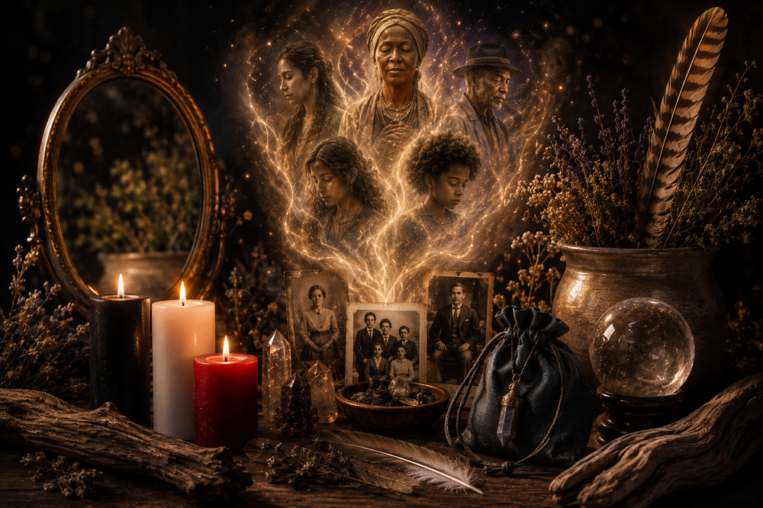
Sitting with your ancestor altar and specifically asking – who in my lineage held this gift before me? Can you come forward and work with me? – is one of the most powerful things a practitioner can do. Not to borrow from the past but to enter into a collaborative relationship with it. To receive the transmission that has been waiting.
Working With Inherited Gifts in Practice
Recognising a gift is different from knowing how to work with it. The gift often arrives in rough form, not refined, not integrated into a conscious practice. It needs development.
Name it. Gifts that are not named tend to operate unconsciously. Which is not the same as working. The empathy that was never identified as a gift becomes the practitioner who absorbs everyone else’s emotional states and doesn’t know what’s theirs and what isn’t. The intuitive knowing that was never named becomes the practitioner who dismisses their own accurate perceptions because they don’t have a framework for taking them seriously.
Name the gift. Write it down. Say it aloud. I have inherited the capacity for [specific thing]. This came to me through my lineage. I am in the process of learning to work with it consciously.
Develop it deliberately. The inherited gift is a capacity, not a finished skill. It grows through practice, through study, through the kind of conscious attention that distinguishes a practitioner from someone who is merely gifted. The person with natural pitch still needs to learn to sing. The person with inherited empathic sensitivity still needs to learn to work with it as a tool rather than be overwhelmed by it as a burden.
Return it to the lineage. This is the part that most gift-work frameworks miss, and it may be the most important part.
Your ancestor passed this gift forward because gifts that are used continue. Because the intelligence encoded in your lineage is not meant to end with you. What you do with what was given to you feeds back into the ancestral field. Which is not a metaphor. The work you do, the people you affect, the tradition you carry and develop and transmit forward – this is your contribution to the lineage as much as your reckoning with its wounds.
The ancestors who held this gift before you are watching to see what you do with it. Not with judgment. With something more like the particular quality of attention that a craftsperson gives to work that passes through many hands before it reaches its final form.
🪄A Practice: The Gift Inventory
Sit at your altar, or in a space where you feel the presence of your lineage.
Light a white candle. Bring a journal.
Begin by breathing deliberately until you feel settled. Then write in response to these prompts, not analytically, but as freely as you can, letting the first things that come arrive without censoring them:
~ What I have always been able to do that others find difficult is…
~ The quality in me that I know came from somewhere before me is…
~ When I imagine the healers, wise ones, and practitioners in my lineage, what I sense they could offer me is…
~ The gift I am in the process of learning to work with consciously is…
~ What I will do with this gift, how I will use it and pass it forward, is…
Sit with what you’ve written. Then address your ancestors directly: name the gift, thank them for it, and ask for their continued support in developing it well.
The relationship between you and your ancestral gifts is a living one. Like all living things, it grows when it is fed.
The wound is real and deserves honest attention. But so does the gift. Both are yours. Both came from the same lineage. Both are asking to be worked with.