 Written by
 A note before we begin: Aboriginal and Torres Strait Islander cultures contain the world’s oldest continuous living traditions. They are not relics or historical curiosities. They are living knowledge systems belonging to sovereign peoples with ongoing relationships to their country, their law, and their healing practices. This post approaches them with the respect they deserve. Much of this knowledge is secret, sacred, and not for public transmission. What is shared here comes from publicly available sources and from ngangkari practitioners who have chosen to speak about their work. Where knowledge is restricted, that restriction is honoured.
The oldest culture on Earth is not a museum piece.
It lives in the red country of central Australia, in the knowledge held by Anangu elders, in the healing practices of ngangkari who work today in both remote communities and city hospitals, in the songs and stories and law that have been maintained across tens of thousands of years of continuous human presence on this continent.
Aboriginal Australian spiritual traditions are, by any reasonable reckoning, the oldest unbroken spiritual practices currently in existence. The oldest rock art in Australia has been dated to at least 17,000 years ago, and the cultural traditions those images represent are understood by Aboriginal people to be far older. The Dreaming – the cosmological framework through which Aboriginal Australians understand the nature of reality, time, country, and human responsibility – is not a mythology in the sense of a story that happened once and then ended. It is an ongoing reality, still active, still requiring maintenance by the people connected to it.
Within this vast and varied tradition, and it is important to say “vast and varied” because Aboriginal Australia encompasses hundreds of distinct language groups and cultural traditions, not a single homogenous entity, the role of the healer is central, respected, and rigorously maintained.
What a Ngangkari Does
The word “ngangkari” comes from the Anangu people of the APY (Anangu Pitjantjatjara Yankunytjatjara) Lands in South Australia and is one of many words across hundreds of Aboriginal language groups for the practitioner who works at the intersection of the physical and spiritual. The one who heals what ordinary medicine cannot reach.
The ngangkari’s understanding of illness differs fundamentally from the biomedical model. Physical symptoms have physical causes that physical treatment can address. But illness also has spiritual dimensions. Disruptions to the person’s relationship with country, with ancestral law, with the invisible structures of the living world. And these require a different kind of attention, a different set of skills, and a different order of knowledge.
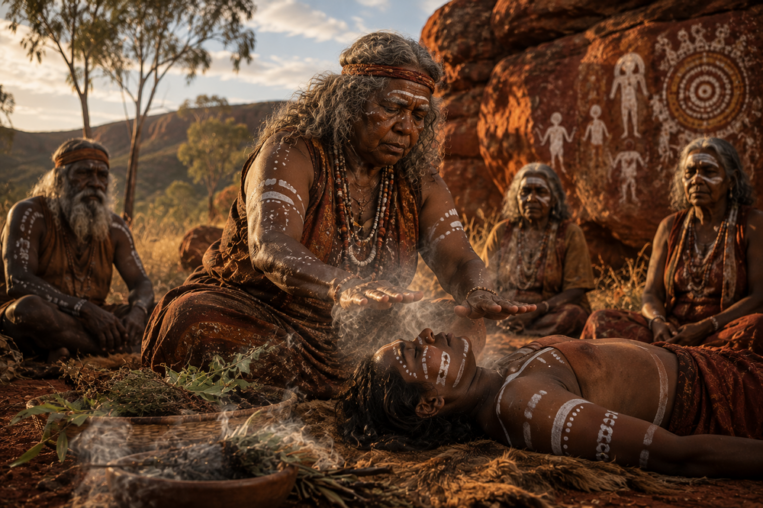
The ngangkari works with what might be translated as the spirit, or soul, marngit in Pitjantjatjara, a subtle body that can be displaced, disrupted, or damaged by forces that Western medicine cannot detect. The healer’s role is to locate and address that disruption. To draw out what should not be there, to restore what has been lost, to re-establish the person’s right relationship with the living world around them.
This work involves touch. The ngangkari works directly on the body, their hands locating and addressing the spiritual disturbance through sustained physical contact. It involves communication with ancestral powers and with the specific spiritual geography of the country the person belongs to. It involves knowledge accumulated over many years, transmitted through specific lineages, and refined through a combination of teaching and direct experience in the work itself.
Women as Healers
Women have always been ngangkari. The tradition is not a male institution with female exceptions. I is a tradition that includes both men and women, with women playing central roles in the transmission and practice of healing knowledge.
In Central Australia, the missionaries wrote of Aboriginal women’s “love magic” or yilpinji. Song-based practices centered on the power of one’s country and the forces of the natural world. Dismissing them as “witchcraft” and calling their practitioners “witches.” The colonial framing, as always, tells us more about the colonizers’ limitations than about the practices they were describing.
The women who practiced yilpinji were not working with dark forces or harmful magic. They were working with the living intelligence of the country. With the songs and relationships that maintain connection between people, between the living and the ancestral, between the human community and the land that sustains it. This is healing work. This is maintenance work. This is the kind of care for the living world that every sustainable culture must have, and that Aboriginal Australian cultures developed to extraordinary levels of sophistication over tens of thousands of years.
Senior Aboriginal women also held, and continue to hold, ceremonial knowledge that is simply inaccessible to outsiders, including other Aboriginal community members who have not been initiated into it. This restricted knowledge is not hoarded; it is maintained carefully because it is genuinely powerful and because power without the appropriate relationships and responsibilities attached to it is dangerous. Women’s law, in many Aboriginal traditions, is a complete and sophisticated spiritual system in its own right, not a secondary or lesser version of men’s law.
The Dreaming and the Land
To understand what ngangkari healing is working with, you need to understand something about the Dreaming.
The Dreaming – Tjukurpa in Pitjantjatjara – is not the past. It is not mythology in the Western sense of stories about what used to be. It is an ongoing reality. The dimension of existence in which the Ancestor beings who shaped the land during the creative period of the Dreaming continue to exist and act, and to which the living world of country, plants, animals, and human beings remain continuously connected.
Country – the specific territory that a group is connected to through lineage and law, is not merely the physical land. It is a living entity, inhabited by Ancestor presences, encoded with stories and law, responsive to the care or neglect of the people responsible for it. The health of the people and the health of the country are not separable. Illness in a person can be a signal of disruption in their relationship to country, or of disruption in the country itself.
The ngangkari healer works within this framework. Their knowledge includes knowledge of country, of the specific Ancestor presences, the sacred sites, the law of the territory, that shapes how healing works and what it requires. Their healing is not portable in the sense of being removable from its specific geographical and cosmological context. It is embedded in the land, in the relationships, in the Dreaming that persists beneath and through the surface of the physical world.
Working With Hospitals
One of the most significant recent developments in ngangkari practice is the formal recognition of traditional healing within the Australian health system. A recognition that came not from the health system’s initiative but from the persistent advocacy of ngangkari practitioners and their communities.
Ngangkari healers now work with hospitals in South Australia and elsewhere, treating Aboriginal patients alongside biomedical practitioners in an integrated approach that takes seriously the understanding that illness has both physical and spiritual dimensions. The health benefits for patients who receive both forms of care are documented and recognised.
Senior ngangkari have spoken publicly about this work, and the way they describe it is striking in its clarity. They are not replacing biomedical treatment. They are treating what biomedical treatment cannot reach. A broken bone needs a doctor. The disruption to the spirit that made the person vulnerable to the accident in the first place – or that prevents their full recovery – needs a ngangkari.
The combination is not a compromise. It is an accurate response to the full complexity of what illness is.
The Oldest Knowledge
Aboriginal Australian spiritual traditions have maintained continuity for longer than any other living traditions on Earth. What does that continuity represent?
It represents the accumulated understanding of how to live in right relationship with a specific country over tens of thousands of years. It represents the development, through careful observation and transmitted knowledge, of how the living world actually works. The connections between human health and the health of country, between the behavior of individuals and the wellbeing of communities, between the care given to the Dreaming and the sustaining of the conditions necessary for life.
This is not primitive knowledge. It is extraordinarily sophisticated knowledge, developed and refined across a timespan that makes every other human intellectual tradition look recent.
The ngangkari healer who works today in a hospital in Adelaide carries this knowledge. The elder whose ceremony maintains the living connection between community and country carries this knowledge. The woman whose restricted ceremonial practice holds the specific law of her lineage carries this knowledge.
They are not relics of the past. They are practitioners of the oldest and in many ways the most sophisticated spiritual tradition humanity has produced. One that has lasted because it works, because it is honest about what the living world is and what it requires, and because it has been maintained, across catastrophic colonial disruption, by people who understood that some things are too important to lose.
A Note on Engagement
For practitioners outside Aboriginal Australian communities, engagement with these traditions requires particular care and humility.
Much of the most significant knowledge in Aboriginal Australian spiritual traditions is restricted. Held by specific people with specific responsibilities, not available for general transmission, not appropriate for outsiders to adopt or adapt. The fact that a tradition is extraordinary and powerful does not make it available to everyone. Sovereignty over knowledge is as real as sovereignty over land.
What is appropriate – and what this post intends – is genuine respect, genuine attention, and the recognition that Australia’s traditional healers represent something that the world needs to understand and honour. Not to appropriate. To honour.
The ngangkari are working. The Dreaming is ongoing. The oldest continuous spiritual practice on Earth is still here.
The Ngangkari. Aboriginal and Torres Strait Islander traditional healers. Working within the oldest continuous cultural tradition on Earth. Working in remote communities and city hospitals. Working with the Dreaming that underlies the visible world. Still here.