 Written by
 Every culture that has lasted long enough has had to find a way to hold death.
Not to explain it, not to make it comfortable, not to wrap it in promises about what comes after – but to hold it. To give it a face and a name and a place in the world that allows the living to go on living while staying in honest relationship with the fact that they won’t always be able to. The deities who preside over death in the world’s traditions are, for this reason, among the oldest and most consistently present figures in the human spiritual imagination. They predate most theology. They outlast most of the civilisations that named them.
The Aztec civilization named theirs with particular precision.
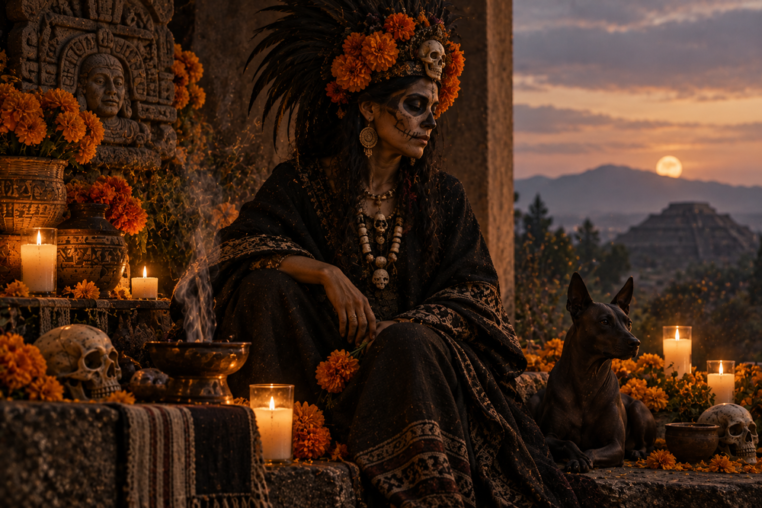
Her name in Nahuatl is Mictecacihuatl – pronounced Meek-te-kah-see-wah-tl – and it means, simply, Lady of the Dead. She has been watching over the bones of the deceased for at least eight centuries of documented history. She survived the Spanish conquest that destroyed most of what Aztec civilisation had built. She survived the forced conversion that replaced her temples with churches and her priests with Catholic missionaries. She survived – transformed, syncretised, renamed, driven underground and then surfacing again under different faces – and today she presides over Día de los Muertos, the most widely celebrated death festival in the Western Hemisphere.
She is not mythology. She is a living presence in the spiritual life of tens of millions of people. And she has been here much, much longer than anyone who tried to suppress her.
Who She Is
She was sacrificed as an infant.
The accounts vary in their details, but the broad outline persists across sources: she died in childhood, before she had lived, and was taken to Mictlan – the Aztec underworld – where she became the consort of its ruler, Mictlantecuhtli, and eventually his equal. The girl who should not have died became the goddess who watched over all death. The one who lost everything became the keeper of everything that was lost.
This origin matters. It is not incidental detail – it is the key to understanding what she is and why she governs what she governs.
She is not a death deity who came to her role through power or conquest. She came through loss. Through the experience of being taken before her time, of having life ended before it had properly begun. This makes her something that more distant and impersonal death deities are not: a figure who knows, from within, what it is to die. Who was herself one of the dead before she became their keeper.
This is why, in the tradition, she is understood to receive all of the dead with something more than cold administrative neutrality. She knows the journey. She has made it.
The Underworld She Rules
In Aztec cosmology, death was not a single event but a journey – complex, layered, requiring nine years and the crossing of nine rivers and nine levels before the soul reached its final rest.
Mictlan, the lowest level of the underworld, was where that journey ended. It was not hell in the Christian sense – not a place of punishment. It was simply the deepest place, the furthest from the light, the final destination of ordinary human souls who had died ordinary deaths. Warriors and women who died in childbirth went elsewhere – to brighter, more active afterlives. Mictlan was for everyone else.
Mictlantecuhtli ruled this realm, but he did not rule it alone. Mictecacihuatl was his consort and co-ruler, and her specific responsibility was the guardianship of the bones.
This is significant. The Aztec cosmology understood bones not as the discarded remnants of a life that had ended, but as the material through which new life could potentially be generated. In one version of the creation myth, the god Quetzalcoatl descended into Mictlan to gather the bones of the dead of previous worlds and carry them to the surface, where they were ground up and mixed with the blood of the gods to create the human beings of the present age. Mictecacihuatl watched over those bones. She kept them. She governed the possibility that what had ended could, through the right intervention of the divine, become the beginning of something new.
The guardian of bones is the guardian of potential. The Lady of the Dead is, in the deepest sense, a goddess of regeneration.
The Festivals She Governed
Long before Día de los Muertos existed in its current form, the Aztec calendar included extensive celebrations dedicated to the dead, and Mictecacihuatl presided over them.
These were not brief, solemn occasions. The largest of the Aztec death festivals ran for an entire month and involved elaborate offerings, ceremonial feasting, the tending of altars laden with food and gifts for the returning spirits, communal rituals that brought the living and the dead into direct relationship.
Her role in these festivals was to watch over and guide the proceedings – to ensure that the dead were properly honoured, that the offerings reached them, that the boundary between the living and the dead was correctly maintained during the period of its ritual permeability.
When the Spanish arrived in the early sixteenth century and began the systematic destruction of Aztec religious life, they found these death festivals impossible to eradicate entirely. The people would not stop honouring their dead. What the Spanish eventually did – with the pragmatism that characterises successful cultural colonisation – was absorb the festival into the Catholic calendar, overlaying it with All Saints’ Day and All Souls’ Day, grafting Christian theology onto a structure that had existed for centuries before Christianity arrived in the Americas.
The marigolds remained. The altar offerings remained. The understanding that the dead return, annually, to spend time with the living, and that the living have a responsibility to prepare for and welcome them – this remained, because it was rooted in something that a change of theological framework could not reach.
Mictecacihuatl remained too.
From Goddess to Santa Muerte
The Spanish conquest destroyed the temples and killed the priests and burned the codices. What it could not do was kill the relationship between the Mexican people and the figure who watched over their dead.
Mictecacihuatl’s characteristics – the skeletal form, the guardianship of bones, the sovereignty over the realm of death, the understanding that death and life are not opposites but partners in an ongoing cycle – migrated into popular religious culture. She appeared in colonial-era imagery under Catholic guise. She persisted in folk practice, in the domestic altars that preceded and outlasted official religious forms, in the art of death that remained distinctively Mesoamerican even as it adopted European visual vocabularies.
In the eighteenth century, the first documented references to Santa Muerte appear in Mexico – the folk saint who is Mictecacihuatl’s most direct contemporary descendant. The name is in Spanish, the imagery is drawn partly from medieval European death iconography, but the spiritual reality underneath is continuous with the pre-Columbian tradition. A female, skeletal, powerful figure who governs death, who offers protection to those the official institutions reject, and who asks in return the kind of direct, honest relationship that her pre-Columbian ancestor always demanded.
Santa Muerte is one of the fastest growing devotional traditions in Mexico and Latin America. Millions of people light candles to her, maintain altars in her honour, carry her image as a protection. She is condemned by the Catholic Church. She is embraced by people who have been failed by the official institutions – the poor, the marginalised, sex workers, prisoners, the undocumented, the desperate. She does not discriminate. She takes all of the dead, as she always has.
She is Mictecacihuatl, wearing the clothes that five centuries of cultural collision have dressed her in.
What She Carries for the Practitioner
Mictecacihuatl is not a comfortable figure. She is not meant to be.
She is the figure who refuses to allow death to be prettified or pushed out of sight. She holds the bones of the dead with the same care that a mother holds her children. Not because she does not understand what they have lost, but because she understands that what has ended is not therefore without value. The bones are precious. The memory is precious. The relationship between the living and the dead does not end because the body does.
For practitioners who work with ancestor veneration, her theology is deeply resonant. The Aztec understanding of death as a journey requiring active support from the living – the offerings, the tending of altars, the preparation of food and gifts – is not philosophically distant from the practices described elsewhere in this space. The form is different. The underlying understanding is structurally identical:. The dead are present, they can be communicated with, and the relationship requires maintenance from both sides.
She also carries something that is harder to articulate but equally important: the understanding that the most marginalised beings in any society – those who die without honour, without ceremony, without the official acknowledgment of their worth – are not therefore outside the protection of the divine.
Mictecacihuatl does not have a preferred clientele. She watches over all the bones. The sacrificed infant she once was is, perhaps, why she was always going to end up here: keeping the vigil for everyone the world forgot to mourn.
A note on approach: Mictecacihuatl is an active goddess in living traditions. Both in the continuity of indigenous Mesoamerican spiritual practice and in the contemporary Santa Muerte tradition, which has millions of active devotees. This post approaches her as an introduction. Those genuinely called to work with her are encouraged to seek out practitioners within these living traditions.