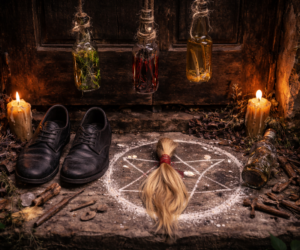
Before there were grimoires, before there were covens, before anyone wrote a word about the Wiccan Rede or the Law of Threefold Return, there was folk magic. It lived in kitchens and doorsteps. In the hands of grandmothers who would not have called themselves witches. In gestures so ordinary they had stopped looking like magic centuries ago. The pinch of salt thrown over the left shoulder, the coin placed under the doormat, the way a particular family always hung something upside down and nobody quite remembered why anymore but everyone knew not to change it. Folk magic is the oldest living tradition in the world. It does not belong to any one culture, and it does not require initiation, tools, a moon phase, or a spiritual lineage. It requires only the knowledge of what works. Passed down, adapted, borrowed, worn smooth by generations of hands using it until it became instinct. Folk magic is endless, geographically specific, and still evolving. The Logic Underneath All of It Folk magic does not operate on a single coherent theology. But it does operate on consistent underlying principles that appear across cultures and traditions worldwide: Like affects like. A thing that resembles another thing can be used to influence it. A poppet made in someone’s image, a written name, a photograph – these become the person in magical terms and can carry intention toward them. The part contains the whole. A lock of hair, a nail clipping, a worn piece of clothing, any part of a person or thing holds an energetic connection to the whole. Folk magic uses these as links. Words have power. The spoken word, especially in specific forms, the charm, the curse, the blessing, the sworn oath, carries force beyond its literal meaning. How something is named determines what it is. Reversal undoes. If something was done, it can be undone by doing the opposite. The logic of inversion, turning things backward, upside down, inside out, runs through folk magic across every tradition. Thresholds are powerful. Doorways, crossroads, the boundary between night and day, the edge of a body of water, these liminal spaces are charged with potential and are the natural location for folk magical practice. What you do at the beginning determines the whole. The first moment of any new thing, first day of the year, first customer of the day, first words spoken in the morning, carries disproportionate power and can be used to set the entire course. Hold these principles and most folk magic practices will make immediate sense. Protective Magic Turning Things Upside Down One of the most widespread and least understood folk practices: inverting an object to confuse, deflect, or reverse an unwanted influence. Shoes placed upside down on a doorstep in British and Appalachian tradition confused witches or ill-wishers trying to follow you home. An inverted shoe points in no useful direction. Bottles placed upside down in the garden (the witch bottle tradition, which we will come to) were turned to confuse and trap spirits. Brooms hung upside down at the door in multiple European and African-American folk traditions turned away evil and ill-wishers who could not cross the threshold while the broom was inverted. The logic is the logic of disorientation. A thing turned upside down has lost its orientation in the world. It cannot find its way. It cannot function. Applied to an unwanted influence, inversion makes it directionless and therefore harmless. You will still find this in practice: a broom bristles-up in the corner means company is not welcome to stay. A glass left upside down on the table in… …
 Written by -V-
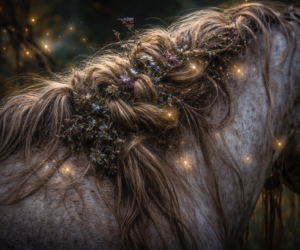
You wake in the morning to find your hair impossibly knotted – tight, twisted tangles that seem to have woven themselves in the night. No amount of tossing and turning could have produced something so intricate. You don’t remember dreaming. But something was here. In the folklore of the British Isles and Ireland, there is a name for this: fairy knots. Or elf-locks. Or witch tangles. The name changes by region, but the belief is the same. The knots were made by unseen hands, and their presence means something. What Are Fairy Knots? Fairy knots, also called elf-locks, hag-knots, witch-knots, and in Scottish Gaelic, cìr mhòr, are the unexplained tangles and matted sections found in hair (human or animal) upon waking. In folk tradition, they are understood as the physical evidence of nocturnal fairy activity: the marks left behind when the Fair Folk pass through the sleeping world and braid, twist, or tangle the hair of those they visit. They are not merely superstition about bad hair. In the magical tradition, fairy knots are considered intentional. A form of binding, a marking, or a message. The knot is one of the oldest magical acts in human history, and fairy knots are understood as fairy magic made visible on the body of the person (or animal) it has touched. The Lore Behind the Locks The Fair Folk and the Sleeping World In Irish, Scottish, and English folk belief, the boundary between the fairy realm and the human world grows thin at night. And especially thin at certain times of year. Midsummer and Samhain are well-known liminal periods, but in everyday folk practice, every night carries some degree of fairy danger. The Fair Folk move through the sleeping world freely, and humans, unconscious and unguarded, are more vulnerable to their attention. Fairies were not universally understood as benevolent. The tradition that modern culture sometimes softens into whimsy was, in its older form, a belief in powerful, unpredictable, deeply other beings who operated by their own rules. The Fair Folk could bless or harm, assist or obstruct, and their interest in a human was not always comfortable even when it wasn’t malicious. Finding fairy knots in your hair in the morning was proof that fairies had been present – and that they had taken an interest in you. The Hag-Riding Connection Fairy knots are closely tied to the older tradition of hag-riding. The experience of waking paralyzed in the night, feeling a presence, sometimes a weight on the chest, with no ability to move or cry out. What we now understand as sleep paralysis was explained in folk tradition as the Hag, the Mare, or a fairy being sitting astride a sleeping person. The tangled hair was the evidence left behind. Just as fairies were said to ride horses through the night (more on this shortly), they were also thought to ride sleeping humans. And the knots in the hair were where their fingers had gripped, braided, and woven to keep their mount in a tractable state. A knotted bridle made of hair, invisible in the morning light but present in the tangle. This is why the knots were taken seriously. They weren’t just cosmetic. They were a record of contact. Elf-Locks in Shakespearean England By the time Shakespeare was writing in the late sixteenth and early seventeenth centuries, elf-locks were a recognized piece of fairy lore familiar enough to work as a literary reference. In Romeo and Juliet, Mercutio’s famous Queen Mab speech describes the fairy queen traveling through the night and, among her many mischievous acts, tangling the manes of horses… …
 Written by -V-
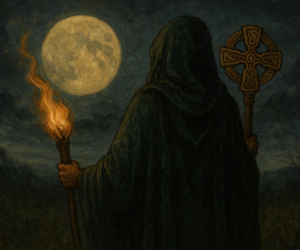
In the shadowy corners of Scottish folklore lives a figure both feared and revered, Nicnevin, described as a witch or fairy queen who rides the night sky at Samhain, leading spirits, witches, and the dead in her wake. She is Scotland’s dark goddess, the hag queen, the mother of witches. Yet her story has been nearly lost to time, fragmented across centuries of poetry, witch trials, and whispered warnings. The Mystery of Her Name The origins of Nicnevin’s name remain debated, with multiple theories emerging from the linguistic fog of history. Some scholars suggest it derives from the Scottish Gaelic Neachneohain, meaning “daughter(s) of the divine” or “daughter(s) of Scathach,” while others propose NicNaoimhein, meaning “daughter of the little saint.” Another interpretation links her name to the Gaelic Nic an Neamhain, “Daughter of Frenzy”. A fitting title for a goddess associated with the liminal chaos of Samhain night. Some scholars have even connected her to the Irish war goddess Neamhain, one of the Morrigan’s triple aspects, or to water spirits like the Nixie and Nokke. The multiplicity of her names reflects the complexity of her nature. She is not one thing, but many things at once. Her Earliest Appearance The first known mention of Nicnevin appears around 1580 in a work by Alexander Montgomerie, a court poet under King James VI of Scotland. The same king who would later become infamous for his obsession with witch-hunting and authoring the Daemonologie. In Montgomerie’s “Flyting” (a ritual exchange of poetic insults), Nicnevin appears accompanied by her nymphs, described as “venerable virgines whom the world call witches.” This early text portrays her not as a demon, but as a powerful figure who commands witches and possesses knowledge of charms and cunning. After this, silence. For over two hundred years, Nicnevin disappears from the written record. The Romantic Revival She resurfaces in the early 1800s, reimagined by Romantic writers who were busy collecting and reconstructing Scotland’s fading folklore. Sir Walter Scott referred to her as “a gigantic and malignant female, the Hecate of this mythology, who rode on the storm, and marshalled the rambling host of wanderers under her grim banner.” Later sources connected her to the Gyre-Carling, an old woman or ogress figure in Scottish tradition. And described her as wearing a long gray mantle and carrying a white wand with the power to transform water into stone and sea into dry land. By the 19th century, she was called “the mother of glamour, and near-a-kin to Satan himself,” presiding over the Hallowmass Rades. The ghostly processions that rode through Scottish skies during the darkest nights of the year. The Real Woman Behind the Legend? One of the most intriguing theories is that Nicnevin wasn’t originally a goddess at all, but a real woman whose story became mythologized. In May 1569, an accused witch named Marion Nicneven (or Nikniving) was condemned to death and burned at the stake at St. Andrews, claiming that apothecaries had caused her arrest due to her superior healing powers. Was she the origin of the legend? Or was she herself named after an already-existing mythological figure? The timeline is murky, complicated by the fact that “Nicneven” may have become a nickname for multiple women accused of witchcraft. A title bestowed upon those believed to possess extraordinary power. Who Is Nicnevin? A Synthesis of Shadows Drawing from the scattered fragments, a portrait emerges: Queen of the Unseelie Court: Nicnevin rules over the darker fairies of Scotland, the Unseelie. Spirits who are neither wholly malevolent nor wholly benevolent, but dangerous, unpredictable, and powerful. Leader of the Wild Hunt: She is… …
 Written by -V-
In the annals of New England folklore, few figures loom as large or as mysteriously as Eunice “Goody” Cole of Hampton, New Hampshire. Her story represents one of America’s most enduring tales of witchcraft accusations, community fear, and the tragic consequences of superstition in colonial society. A Life Marked by Suspicion Eunice Cole arrived in Hampton sometime in the 1640s with her husband William. From the beginning, she was viewed with suspicion by her neighbors. Perhaps it was her sharp tongue, her poverty, or simply the misfortune that seemed to follow in her wake. But Goody Cole quickly became the community scapegoat for any unexplained illness, crop failure, or maritime disaster. The accusations against her were typical of witch trials throughout New England: livestock dying mysteriously, butter failing to churn, children falling ill after encounters with the old woman. In a time when scientific explanations for natural phenomena were scarce, fear and superstition filled the void. Trial and Punishment In 1656, Goody Cole became New Hampshire’s only person to be tried and convicted of witchcraft. Unlike the more famous Salem witch trials that would follow decades later, Cole’s case resulted in imprisonment rather than execution. She spent years confined in a Boston jail, only to return to Hampton where she lived as an outcast until her death around 1680. Even in death, the community’s fear of Goody Cole persisted. Legend holds that she was buried at a crossroads with a stake driven through her heart to prevent her spirit from wandering. A practice reserved for those believed to be particularly dangerous even in death. Immortalized in Poetry The legend of Goody Cole captured the imagination of many writers, most notably John Greenleaf Whittier, who immortalized her in his poem “The Wreck of Rivermouth.” In vivid verses, Whittier painted a picture of the feared woman as sailors passed her cottage: As they rounded the point where Goody Cole Sat by her door with her wheel atwirl, A bent and blear-eyed poor old soul. “Oho!” she muttered, “ye’re brave to-day! But I hear the little waves laugh and say, The broth will be cold that waits at home; For it’s one to go, but another to come!’ “ “She’s cursed,” said the skipper; “speak her fair: I’m scary always to see her shake Her wicked head, with its wild gray hair, And nose like a hawk, and eyes like a snake.” Whittier’s portrayal captures the essence of how Goody Cole was perceived. A figure of dread whose very presence seemed to foretell doom for those who encountered her. A Legacy of Fear and Fascination The story of Goody Cole reflects the broader context of witch hysteria in colonial New England, where community tensions, religious extremism, and social anxieties manifested in accusations against vulnerable individuals. Particularly older women living on society’s margins. Modern historians view Goody Cole not as a practitioner of dark arts, but as a victim of her community’s fears and prejudices. Her sharp wit and refusal to conform to expected feminine behavior in Puritan society likely made her a target. Her poverty and outsider status made her an easy scapegoat when misfortune struck. Hampton’s Haunted Heritage Today, Hampton embraces its connection to Goody Cole as part of its historical identity. Local legends persist about her ghostly presence, and visitors often seek out locations associated with her life and death. The Tuck Museum in Hampton maintains exhibits about her story, helping separate historical fact from centuries of accumulated folklore. Her tale serves as a reminder of the dangers of mass hysteria and the importance of protecting society’s most vulnerable members. In… …