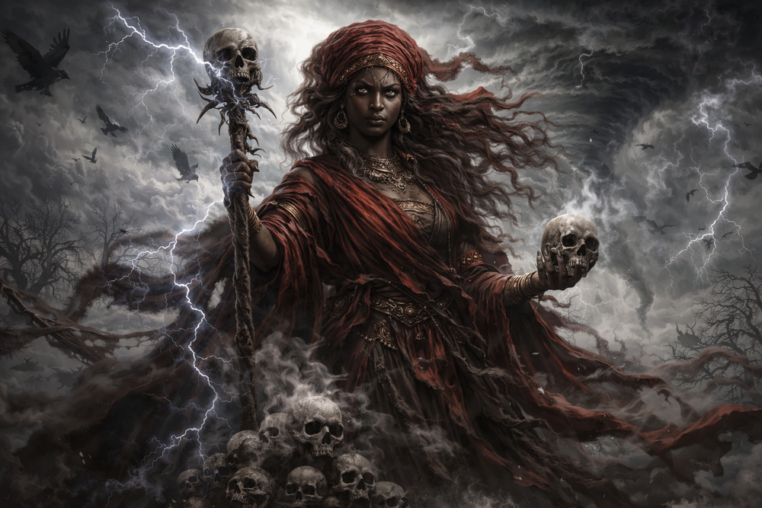

A respectful note before we begin: Oyá is not a figure from dead mythology. She is an Orisha, a living, active divine presence in the Yoruba religion and its diaspora traditions of Candomblé, Santería, Trinidad Orisha, Umbanda, and Vodou. Traditions that have millions of active devotees worldwide. She has priests and priestesses, sacred initiations, and communities of practitioners who have honored her continuously for centuries. This post approaches her with the respect that living tradition deserves. If you feel genuinely called to Oyá, seek out initiated practitioners and teachers within these traditions. What follows is an introduction. Not a substitute for that deeper engagement. Before the storm breaks, there is a change in the air. Something electric. Something that sweeps through and tells every living thing, bird, tree, blade of grass, that what is coming cannot be stopped and should not be.That is Oyá.She is the wind before the lightning finds the earth. She is the wall of air that precedes the hurricane, the dust devil spinning in a dry field, the cold front that arrives in the night and leaves the world unrecognisable by morning. She is the force that clears the old away so entirely that new things have no choice but to grow.She is the oriṣa of winds, lightning, and storms, and she is the only oriṣa capable of controlling the Eégún. The spirits of the dead. That combination, storm and death, wind and the ancestors, is not coincidental. Both are forces of total transformation. Both sweep away what was and leave behind a changed world. Both move through you whether you are ready or not.In Yorùbá, the name Oyá is believed to derive from the phrase ọ ya, “she tore”, referring to her association with powerful winds. She does not nudge. She does not suggest. She tears.And when she has torn through, the ground is clear, the air is clean, and everything that survives is stronger for having stood in her path. Oyá Is Not a Goddess of MythologyBefore going further, this distinction matters deeply.The Yoruba religion emerged among the Yoruba people of what is now Nigeria, Benin, and Togo. The orishas are divine spirits that play a key role in the Yoruba religion of West Africa and several religions of the African diaspora that derive from it, such as Haitian Vodou, Cuban Santería, and Brazilian Candomblé.Oyá is not an ancient deity whose worship has faded into legend. She is actively honoured today by millions of people. She has a priesthood. She has initiates who have dedicated their lives to her service. Through the horrors of the Atlantic Slave Trade, enslaved peoples brought the orisha to the Americas. Her survival is an act of profound cultural resistance. A sacred tradition kept alive through generations of suppression, forced conversion, and colonization.To approach Oyá with genuine respect means acknowledging this history. It means understanding that the Yoruba traditions and their diaspora cousins are living religions, not open-source spiritual material, and that deeper engagement properly involves learning from those within these traditions. Babalawos, initiated priests and priestesses, and the communities that carry this knowledge.With that foundation, let us meet her. Who is Oyá?Oyá lived on Earth as a human from the town of Ira, in present-day Kwara State, Nigeria, where she was a wife of the Alaafin of Oyo, Shango. In Yoruba understanding, the most powerful orishas were once human. Beings of such extraordinary force and virtue that at death they did not simply leave the world but became part of its governing spiritual fabric.Her name is spoken with power. In Candomblé, Oyá is known as Iansã. Revered as...
